


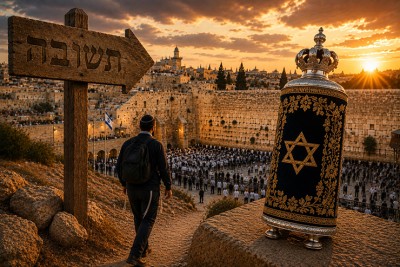
On the final day of Moshe Rabbeinu’s life, the Jewish people stood together to renew their covenant with the Almighty. Moshe made clear that the covenant was not limited to those standing before him. It included every future generation — Jews who had not yet been born and who would live centuries and millennia after those assembled on the plains of Moav.
That promise runs through Nitzavim and directly into Vayeilech. Together, the two parshiyos tell us something remarkable: The Jewish people may be scattered, persecuted, and driven far from their land, but neither their covenant nor their Torah will disappear.
Nitzavim begins:
“You are all standing today… the heads of your tribes, your elders… your children, your wives… from your woodcutter to your water-bearer.”
No one was excluded. Moshe then added that the covenant was being established not only with those present, but also “with the one who is not here with us today.”
Those words reach directly to us.
Our ancestors accepted the Torah not merely for themselves but for the generations that would follow. Moshe also warned that there would be times when Jews would abandon that covenant. Exile and suffering would follow. Yet that would not be the end of the story.
The Torah predicts that Jews scattered among the nations would eventually return:
“And you will return to the Lord, your God… you and your children, with all your heart and with all your soul.”
Then comes Vayeilech.
On that same final day, Moshe completed writing the Torah. The Almighty gave him another promise concerning the Jewish people and the Torah: “It will not be forgotten from the mouth of his offspring.”
Jewish history has tested that promise under circumstances that would seem to make its fulfillment impossible.
One of the most striking examples occurred during the destruction of European Jewry.
As World War II engulfed Europe, students and rebbeim from some of the great yeshivos fled into Lithuania. Among them were members of the Mir Yeshivah. Their future appeared hopeless. Europe was closing around them, and there seemed to be nowhere to go.
Then an unlikely escape route opened.
Japanese diplomat Chiune Sugihara issued transit visas to desperate Jewish refugees despite orders from his government. The refugees traveled thousands of miles across the Soviet Union on the Trans-Siberian Railway, eventually reaching Japan.
From there, the Mir Yeshivah ultimately reached Shanghai.
Consider what had happened. A yeshivah uprooted from Eastern Europe had crossed Russia and Asia and arrived in China — and there, Torah study continued.
Rav Yechezkel Levinstein saw something much greater than political happenstance in their escape. Soviet authorities, whose regime had spent years suppressing religious life, inexplicably permitted these Torah scholars to leave. As Mishlei teaches, “The king’s heart is in the hand of the Lord.”
The journey itself was extraordinary, but what happened in Shanghai was equally remarkable.
The refugees found the Beis Aharon Synagogue, built years earlier by a wealthy Jewish benefactor. Alongside it were facilities capable of accommodating large numbers of people. What had stood largely unused was suddenly able to serve Jews who had crossed continents seeking refuge.
And they did something extraordinary there: They learned.
Europe was burning. Their families and communities were in mortal danger. Their own future remained uncertain. Yet they understood that the Torah had to be transmitted to another generation.
The Mir survived.
After the war, its Torah spread again. The yeshivah was reestablished in Eretz Yisrael, while its students and scholars helped rebuild Torah life elsewhere.
That history gives new meaning to the words of Vayeilech: “It will not be forgotten from the mouth of his offspring.”
And it brings us back to Nitzavim.
Moshe was speaking to Jews who were about to enter Eretz Yisrael, but he was also speaking to Jews who would someday be driven from it. He was speaking to Jews in Babylon and Spain, Poland and Lithuania, Shanghai and America — and to Jews who would eventually return to Eretz Yisrael.
Nitzavim promises that the covenant will survive. Vayeilech tells us why: The Torah will survive with it.
Empires have risen and disappeared. Jewish communities have been destroyed and rebuilt. Jews have been scattered farther than Moshe’s listeners could possibly have imagined.
Yet, the chain remains.
The Jews standing before Moshe are gone. The generations of Babylon are gone. The great European Torah centers destroyed during the Holocaust are gone.
But their Torah is being learned today.
That is the promise connecting Nitzavim and Vayeilech: We may travel very far, but the Torah travels with us — until the Jewish people return home.
Parashat Nitzavim is sponsored by Aleksandr & Margarita Abdurakhmanov and Parashat Vayeilech is sponsored by Alex Sepiashvili & Family!
Rabbi Yitzchok Zilber, zt”l, dedicated his life to teaching Torah, and his impactful writings continue to inspire Jews worldwide. Copyright 2023 by The LaMaalot Foundation. Conversations on the Torah is catalogued at The Library of Congress. All rights reserved. www.LaMaalot.org
Nitzavim–Vayeilech: The Covenant That Could Not Be Broken
Typography
- Smaller Small Medium Big Bigger
- Default Helvetica Segoe Georgia Times
- Reading Mode