


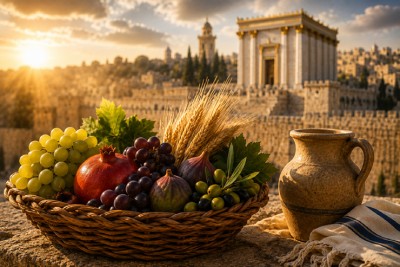
Parashat Ki Savo begins with the mitzvah of Bikkurim. A farmer in Eretz Yisrael who sees the first fruits ripening does not simply harvest them and enjoy the results of his work. He marks the first of the seven species, later brings those fruits to the Beit HaMikdash, and presents them to the Kohen.
Why the first fruits?
A farmer has worked for months. He prepared the soil, planted, tended his field, and waited. Finally, after all that effort, he sees the first sign of success. Precisely then, the Torah tells him to stop.
Before enjoying what you produced, remember Who enabled you to produce it.
Rabbi Zilber points out that this principle appears elsewhere in the Torah as well. The first is precious. The first child, the first animal, and here, the first fruits all carry a special significance. A person gives from the beginning because he must recognize from the beginning that what he has is a gift from Hashem.
The farmer then makes an extraordinary declaration. He does not merely say thank you for the fruit. He recounts Jewish history: the suffering of our ancestors, the descent to Egypt, the oppression there, the Exodus, and finally our arrival in the land Hashem promised us.
Only then does he say, in effect: And now I have brought the first fruits of the land You gave me.
That changes the meaning of gratitude.
It is easy to look at what we have and see only the last step. A person succeeds in business and thinks about the deal he made. He buys a home and remembers how hard he worked to afford it. His children succeed and he thinks about the years he invested in raising them.
None of that is false. The farmer also worked for his crop. The Torah never tells him that he did nothing.
Instead, it teaches him to see the larger picture.
Who gave him the strength to work? Who sent the rain? Who allowed the field to produce? Who brought the Jewish People to the land where that field could be planted in the first place?
That is why the declaration of Bikkurim reaches generations into the past. Gratitude requires memory.
The same lesson applies to us. We naturally turn to Hashem when we need something. When there is illness, financial difficulty, or trouble in the family, we daven. We understand very clearly that we need help from Above.
But what happens when the problem is solved?
A person gets the job. The test results are good. The child gets engaged. The business succeeds. Life settles down.
At that moment, there is a danger of forgetting the very One to Whom we turned when we were frightened.
Bikkurim teaches the opposite response. Success itself should awaken our recognition of Hashem.
This does not require diminishing our own effort. A person is supposed to work, build, plant, and accomplish. But after doing everything he can, he should be able to look at what grew and recognize that his effort alone could never guarantee the result.
The farmer therefore takes what may be the fruit he anticipated most, the first evidence that his labor succeeded, and brings it before Hashem.
That may be one of the simplest and most demanding lessons in gratitude: When something finally goes right, remember Who you called upon when you were afraid it might go wrong.
Parashat Ki Savo sponsored by Nisim & Mazal Sarikov.
Rabbi Yitzchok Zilber, zt”l, dedicated his life to teaching Torah, and his impactful writings continue to inspire Jews worldwide. Copyright 2023 by The LaMaalot Foundation. Conversations on the Torah is catalogued at The Library of Congress. All rights reserved. www.LaMaalot.org
Parashat Ki Savo: Remembering Who Gave It To You
Typography
- Smaller Small Medium Big Bigger
- Default Helvetica Segoe Georgia Times
- Reading Mode