


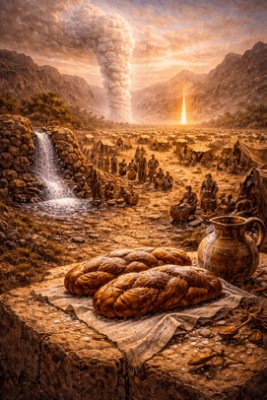
Parashat Beshalach describes the exodus from Egypt, the splitting of the Red Sea, the Jews’ first struggles in the wilderness, and their first war, against Amalek. Beyond these events, the parashah teaches how bitachon—trust in G-d—is formed not through comfort, but through lived reality.
I remember the Sinai Desert well. During the Six-Day War in 1967, Soviet newspapers expressed concern for Egyptian soldiers: if they lagged behind their units, they would die from the heat. No shade, no water, no food.
Later, when Sinai was under Israeli control, Israeli soldiers experienced this directly. Temperatures exceeded 40 degrees Celsius. There was no vegetation and no natural water source. Survival depended entirely on constant access to water.
I also recall the travel notes of Soviet diplomat Ivan Maisky, who wrote: “Passing Sinai, I understood the words ‘the great and fearsome desert.’ I have been to other deserts, but I have never seen anything like this.”
Now consider the Jewish people in that desert. There were 603,550 men over the age of twenty, along with women, children, and infants. They remained there not briefly, but for forty years.
Their survival depended entirely on G-d’s provision: the mahn, the traveling well, the pillar of cloud by day, the pillar of fire by night, and protective clouds.
The miracle of the mahn began when the food taken from Egypt ran out. G-d instructed Moshe: “I will rain down for you bread from heaven—each day’s portion for that day.”
Anyone who tried to hoard found that the food spoiled overnight. Only on Friday did a double portion remain fresh for Shabbat. This was deliberate. For forty years, the Jews learned that sustenance does not come from accumulation, but from G-d.
This is bitachon. One must work honestly and responsibly. But after doing what is required, one must understand that livelihood comes from Above.
I saw this repeatedly in my own life.
In the Soviet Union, newspapers denounced “Zionist aggressors” while distinguishing between “bad Jews” and “good Jews.” Nikita Khrushchev once said publicly:
“There are bad Jews—the Zionists—and there are good Jews. In the factory where I worked, there was a Jew who came on Saturday but did nothing. That was a good Jew.”
Strange words from the head of the Soviet Union—but accurate.
For seven years, I worked at an enterprise and gave away half my salary so I would not have to work on Shabbat. Nearby worked another Jew who did the same job. He worked Saturdays and overtime. I had four children; he had three. I bought kosher meat for five rubles per kilogram; he bought non-kosher for three.
Years later, we met in Israel. He borrowed money from me.
I asked him, “Where is the extra money you earned on Saturdays?”
He answered: “Some went bad, some disappeared, some went to doctors.”
An American neighbor told me the same story about his father. A coworker calculated that after thirty years, he should have earned the equivalent of five additional years of salary by working on Shabbat. “Where is it?” he asked.
The answer was simple: “Those who violate Shabbat lose money to doctors and lawyers.”
This is the meaning of the verse: “And G-d blessed the seventh day and sanctified it.”
In a home that keeps Shabbat, children learn that not everything can be bought. There is something higher than money. A Jew who stops working on Shabbat declares that G-d created the world and sustains it.
Parashat Beshalach teaches this not through philosophy, but through experience—desert survival, exile, tyranny, and personal sacrifice. The lesson is consistent: those who trust G-d are sustained, and those who violate Shabbat never gain from it.
Parashat Beshalach: Faith Proven By Survival
Typography
- Smaller Small Medium Big Bigger
- Default Helvetica Segoe Georgia Times
- Reading Mode