

Parashat Va’eira describes the moment when history itself turns into testimony. Hashem again sends Moshe and Aharon to Pharaoh to demand the release of the Jewish people. Pharaoh refuses. What follows is not persuasion, but revelation.
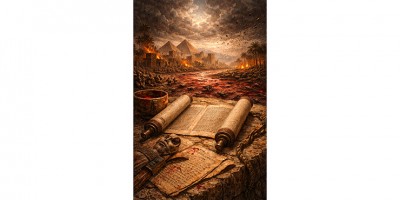
“With this you will know that I am the L-rd,” Hashem declares. “Behold, I will strike the waters of the Nile… and it will turn to blood” (Shemot 7:17).
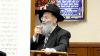
The ten plagues were not random punishments. Rabbi Zilber explains that they were measured, public, and unmistakable demonstrations of Divine control—executed selectively, never harming the Jews. Water turned to blood. Frogs overran homes and beds. Lice, wild animals, pestilence, boils, hail, and fire shattered the illusion of Egyptian power.
Six hundred thousand adult Jewish men witnessed these events firsthand. Their testimony was passed from father to son, generation to generation. Every year at the Pesach seder, Jewish parents recount these plagues—not as legend, but as national memory.
What makes Va’eira especially significant, Rabbi Zilber notes, is that Egypt itself recorded these disasters.
In 1828, the Leiden Museum acquired an ancient Egyptian manuscript now known as the Ipuwer Papyrus. Deciphered in the early twentieth century, it describes a nation collapsing under catastrophic events: rivers turning to blood, crops destroyed, livestock dying, fire raining from the sky, cities ruined, and a population crying out in despair.
The parallels between the Ipuwer Papyrus and the Book of Shemot are striking. Where the Torah says the Nile became putrid, the Papyrus laments polluted waters. Where the Torah records hail and fire destroying crops and trees, the Papyrus describes devastation so complete that “everything visible yesterday has been destroyed.” Where the Torah speaks of national mourning, the Papyrus records lamentation echoing throughout Egypt.
This is not coincidence. Rabbi Zilber emphasizes that the Torah does not fear comparison with history—because it is history.
Yet Pharaoh’s response teaches a darker lesson. Even as Egypt collapses, even as reality itself testifies against him, Pharaoh refuses to change. His heart grows heavier. Denial becomes policy.
This pattern, Rabbi Zilber explains, repeats throughout history. When truth threatens power, facts are dismissed, witnesses ignored, and blame redirected—often toward the Jews. Antisemitism thrives not on ignorance alone, but on willful denial.
Va’eira teaches that miracles do not always convince. Evidence does not always persuade. What matters is moral choice.
Only those Egyptians who “feared the word of the L-rd” protected their livestock from the hail (Shemot 9:20). Awareness was available to all—but only some chose to accept it.
The parashah ends by reminding us that redemption does not begin with wonders, but with truth. Hashem’s power is revealed openly, yet freedom comes only when falsehood collapses.
For klal Yisrael, Va’eira is a reminder that our history is not symbolic, not allegorical, and not negotiable. It is recorded—in our Torah, in our memory, and even in the archives of those who once tried to erase us.
TRUTH UNDER FIRE: When History Itself Testified Against Egypt
Typography
- Smaller Small Medium Big Bigger
- Default Helvetica Segoe Georgia Times
- Reading Mode