

Wrestling Through The Night:
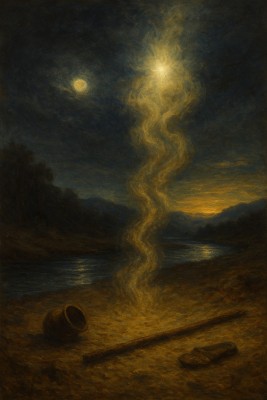
The Battle That Named Us YisraelOn the night before his fateful meeting with Eisav, Yaakov Avinu brought his wives and children across the Yabok River. The Torah describes a moment of profound solitude: “And Yaakov was left alone, and a man wrestled with him until the break of dawn.” The struggle grows stranger with each verse. The mysterious assailant, having dislocated Yaakov’s hip, begs to be released at daybreak. Yaakov refuses: “I will not let you go unless you bless me.” Only then does the figure reveal the blessing that will echo through Jewish history: “Your name shall no longer be called Yaakov but Yisrael, because you have commanding power with God and with men, and you have prevailed.”
The new name carries a new definition. A sar is a nobleman, a minister, a person of stature. Yisrael means one who stands as a “great man before God,” one whose spiritual authority cannot be diminished. Yet the contrast to Yaakov’s earlier identity sharpens the story even more. Yaakov was named for the akeiv, the heel he grasped at birth, but the name also contains an allusion to outwitting—to the cunning necessary to secure the bechorah and the blessings. With the new name, Heaven declares that no one may ever again claim that Yaakov’s greatness or blessing came from cleverness. What he earned in this midnight battle was unmistakably his, conferred from Above.
Chazal identify Yaakov’s opponent as the guardian angel of Eisav. Why would the ministering angel of Eisav fight with the father of the Jewish nation, injure him, and then—precisely at the moment he seeks escape—be pressed for a blessing? The key lies in a principle Rabbi Zilber repeats often: Maaseh avot siman labanim — the actions of the fathers chart the destiny of the children.
Yaakov was fleeing his brother’s rage, yet Eisav’s story does not end in Bereishis. Chazal teach that the descendants of Eisav include not only the Romans, who devastated Judea, but also the Germanic tribes. History records that when Kaiser Wilhelm II visited Jerusalem in 1898, nearly the entire Jewish community greeted him—except two individuals: Rav Yosef Chaim Sonnenfeld and the tzaddik Rav Tzvi Shapiro. They explained afterward that they had received from Rav Yehoshua Leib Diskin, who heard it from the Vilna Gaon, that certain Germanic peoples descend from Amalek, the grandson of Eisav whose hatred of Jews is ancient and unrelenting. Amalek carries a chilling symbolism: a sleek exterior masking a thirst for Jewish blood—Am (nation) and lek (lapping), a nation that “laps blood.” Their brutality throughout history bore this out.
Eisav, then, is not merely a brother. He is an ever-present force attempting to weaken Jewish faith, to lure us from the path of Torah, or—when possible—to destroy us outright. Rashi notes that Yaakov was left alone that night because he had returned for small, forgotten vessels. In that moment of isolation, Eisav’s angel appeared. Rabbi Zilber explains that whenever a Jew becomes overly absorbed in material possessions—especially in a foreign environment—Eisav is ready to strike. And so the struggle unfolds throughout “the night,” symbolizing the long darkness of exile, until the dawn of Mashiach.
Even the word describing their clash is revealing. Vayei’aveik, “and he wrestled,” is related to avak, dust. The Talmud teaches that the dust raised by their struggle rose to the Throne of Glory. The dust of confusion, Rabbi Zilber notes, is Eisav’s strategy: to cloud the Jew’s vision until he no longer perceives the Kingship of Hashem, His providence, and His order in the world. Eisav obscures so that we do not see that “there are no accidents in His world.”
The Sages also describe two very different ways the angel appeared to Yaakov. In one account, he looked like a great sage; in another, like a violent criminal. These are the two masks of Eisav throughout history. At times he appears as the brute: Hadrian and Titus, the Inquisition, the Crusades, the massacres of Khmelnytsky and Petliura, the Nazis. When annihilation fails, Eisav reappears in the mask of sophistication—an “enlightened” intellectual determined to prove that Judaism is fabricated, borrowed, or obsolete. From Hellenists to French materialists, from biblical critics to Marxists, the strategy remained the same: undermine faith at its roots.
Rabbi Zilber cites a chilling example from Avraham Sutzkever’s wartime memoir. Germans who once studied Hebrew and Judaica at the Hebrew University—men who posed as friends of the Jewish people—were later dispatched to Vilna to plunder and destroy priceless manuscripts, sefarim, and Torah scrolls. Even the chief of the Nazi High Command, Field Marshal Wilhelm Keitel, was the son of a notorious Bible critic. The refined “scholars” and the murderous criminals were, in essence, one Eisav.
Through all of this, Yaakov continues to hold on. Even wounded, he refuses to release the angel until he receives a blessing—teaching his children for all generations that our relationship with Hashem deepens precisely through struggle. Dawn eventually breaks. The exile eventually ends. And the nation named Yisrael emerges not in spite of the dust, the blows, and the confusion, but through them—carrying an identity sanctified by a father who prevailed in the night and would not let go.
Parashat Vayishlach sponsored by Pinchas & Ester Sabzanov
By Rabbi Yitzchak Zilber, zt”l, Founder, LaMaalot Foundation
Rabbi Yitzchok Zilber, zt”l, dedicated his life to teaching Torah, and his impactful writings continue to inspire Jews worldwide. Copyright 2023 by The LaMaalot Foundation. Conversations on the Torah is catalogued at The Library of Congress. All rights reserved. www.LaMaalot.org
Parashat Vayishlach:
Typography
- Smaller Small Medium Big Bigger
- Default Helvetica Segoe Georgia Times
- Reading Mode