

When the State of Israel was established in 1948, one of its greatest challenges was developing the Negev. Much of the region was arid, rainfall was scarce, and establishing permanent communities required finding reliable sources of water.
Yet, as Rav Yitzchak Zilber relates, some of the clues were found in an unexpected place: the Torah.
Drawing upon Werner Keller’s The Bible as History, Rav Zilber recounts how biblical descriptions helped inspire efforts to investigate the Negev’s natural resources.
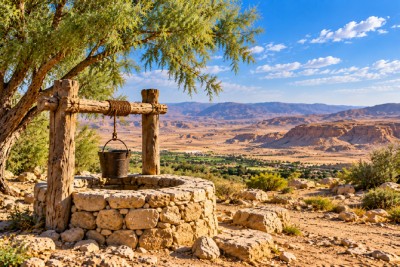
Parashat Vayeira tells us that Avraham Avinu journeyed southward and settled in the region of Gerar (Bereishit 20:1). Avraham possessed substantial herds of livestock, which required considerable quantities of water. How could Avraham have maintained those animals in such an unforgiving landscape?
Another passage provided a clue.
In Parashat Toldot, the Torah tells us that Yitzchak reopened wells dug during Avraham’s lifetime (Bereishit 26:18). These accounts suggested that underground water sources had once supported life in the region.
According to Rav Zilber’s account, geologists drew upon these descriptions while investigating the Negev. Their efforts reportedly led to the discovery of a well containing drinkable spring water near Be’er Sheva. At the time described in the source, the well was said to supply approximately sixty families.
Water, however, was only one obstacle. Another challenge was identifying trees capable of surviving the desert’s harsh climate.
Rav Zilber recounts how Yosef Weitz, a leading figure in the Jewish National Fund’s forestry efforts, turned to the Torah for inspiration.
The Torah states that Avraham planted an eshel, commonly identified as a tamarisk tree, in Be’er Sheva (Bereishit 21:33).
For those attempting to establish vegetation in the Negev, the reference suggested that a tree associated with the region since ancient times might be suitable for renewed planting.
Rav Zilber relates that the Jewish National Fund ultimately planted approximately two million trees in the Negev as part of its broader development efforts.
Rav Zilber also cites Professor Zagari of the Hebrew University, who suggested that the Book of Yehoshua could provide clues about areas where forests had once existed. Yehoshua had instructed members of the tribes of Ephraim and Menashe to clear forested land (Yehoshua 17:14–18). If trees had flourished there in the past, the professor reasoned, they might grow there again.
These accounts illustrate how ancient descriptions could inspire modern investigation. The Torah was not replacing scientific research; rather, its geographical details offered questions worth exploring.
For Rav Zilber, the significance extended beyond water and trees. Thousands of years separated Avraham’s journeys from the pioneers working to develop the Negev, yet the same land continued to hold possibilities for future generations.
The wells of the Patriarchs and the trees of Be’er Sheva were more than memories of the past. They offered a reminder that the Jewish People’s connection to Eretz Yisrael remained alive, even after centuries of exile.
Parashat Vayeira is sponsored by Alexandr & Lara Mashkevich.
Rabbi Yitzchok Zilber, zt”l, dedicated his life to teaching Torah, and his impactful writings continue to inspire Jews worldwide. Copyright 2023 by The LaMaalot Foundation. Conversations on the Torah is catalogued at The Library of Congress. All rights reserved. www.LaMaalot.org
Parashat Vayeira: When The Desert Revealed The Torah’s Secrets
Typography
- Smaller Small Medium Big Bigger
- Default Helvetica Segoe Georgia Times
- Reading Mode