

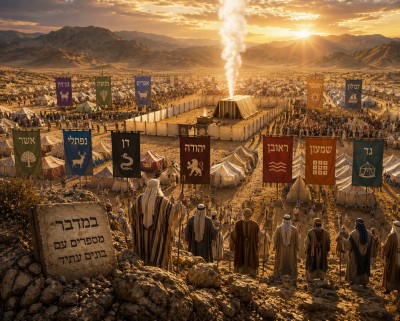
“The desert was not empty. It was where the Jewish people learned who they truly were.”
The opening parashah of Bamidbar begins with a census of the Jewish people during the second year after the Exodus from Egypt. Moshe is commanded to count the nation tribe by tribe, while the tribe of Levi is counted separately because of its responsibility for the Mishkan.
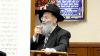
Rabbi Zilber notes something remarkable about this census. Moshe received the command on the first day of the month of Iyar, and on that very same day the counting began. There were no lengthy preparations or delays. Mфoshe informed Aharon and the tribal leaders, and the work immediately started. Rabbi Zilber writes that Moshe teaches us how quickly a mitzvah should be carried out.
The names listed in the census also reveal the faith of the Jews in Egypt. These children were born to families living under crushing slavery, fear, and uncertainty. Yet their parents chose names filled with trust in Hashem.
Names such as Elishama — “My G-d heard,” Elitzur — “My G-d is my strength,” and Pedahtzur — “Redeem, O Rock,” reflected hope even during suffering. Rabbi Zilber explains that while the Egyptians controlled the labor of the Jewish slaves, they could not destroy their faith.
Rabbi Zilber also points to the tribes of Dan and Binyamin. Dan had only one son, yet eventually became one of the largest tribes. Binyamin had ten sons, yet his tribe was far smaller. From this, Rabbi Zilber teaches that blessing does not follow human calculations. A person should not become arrogant because of abundance or despair because of lack.
The arrangement of the camps reflected the Torah’s emphasis on order and responsibility. Every tribe had its own place, flag, and identity, yet all surrounded the Mishkan at the center. Jewish unity did not erase individuality. Each tribe maintained its own strengths while remaining connected to holiness.
The Midrash teaches that the Torah was given through fire, water, and desert. Avraham endured the test of fire. Nachshon entered the sea before it split. The Jewish people survived forty years in the wilderness. Rabbi Zilber explains that these tests showed that the Torah was not given by chance. It was given to a people prepared to remain faithful under every condition.
The desert did not break the Jewish people.
It built them.
Parashat Bamidbar is sponsored by Ed & Ella Ilyagzhanov
Rabbi Yitzchok Zilber, zt”l, dedicated his life to teaching Torah, and his impactful writings continue to inspire Jews worldwide. Copyright 2023 by The LaMaalot Foundation. Conversations on the Torah is catalogued at The Library of Congress. All rights reserved. www.LaMaalot.org
Parashat Bamidbar: Faith In The Wilderness
Typography
- Smaller Small Medium Big Bigger
- Default Helvetica Segoe Georgia Times
- Reading Mode