

“With the construction of the Third Beit HaMikdash, G-d will finally grant us room to exist, to flourish, and to remain fruitful in the land — once and for all time.”
In Parashat Toldot, we encounter Yitzchak Avinu not only as a tzaddik, but also as a determined rancher and land developer. The Torah recounts his agricultural successes — and the tension they triggered:
“And Yitzchak sowed in that land, and he found in that year a hundredfold, and Hashem blessed him. And the man became great, and he grew constantly greater until he had grown very great. And he had possessions of sheep and cattle and abundant production, and the Pelishtim envied him…” (Bereishit 26:12–14)
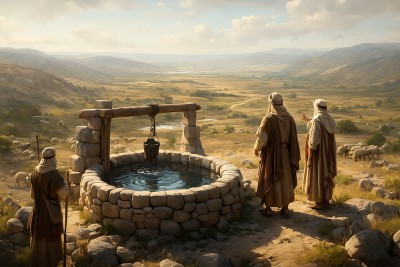
What follows is a series of displacements. The Pelishtim, envious of his prosperity, demanded Yitzchak leave their territory: “Go away from us, for you have become much stronger than we.” Yitzchak obliges. Each time he digs a well, it is taken from him. The Torah records the names he assigns them: Esek (Challenge), Sitnah (Accusation), and finally Rechovot (Wide Spaces), where there is no dispute, and peace reigns.
Why such detail about wells? Why name them at all?
The Ramban (Nachmanides) offers a profound answer: The Torah is compared to water — essential for life and spirituality alike. “Ho! All who thirst, go to water,” cries the prophet Yeshayahu (Yeshayahu 55:1). The Beit HaMikdash itself is the ultimate wellspring of this Divine nourishment — the source from which Torah and prophecy flowed.
In this light, Yitzchak’s three wells represent the three Batei Mikdash:
The first, Esek (Challenge), symbolizes the First Temple, destroyed after years of rising hostility between Bavel and Yehudah. This was not a sudden collapse — it followed mounting conflicts.
The second, Sitnah (Accusation), echoes the Second Temple era. Enemies of the Jews sent letters to the Persian king urging him to halt construction, arguing that peace in the region would be jeopardized. As Ezra (4:6) records: “In the reign of Achashveirosh… they wrote an accusation against the dwellers of Yehudah and Yerushalayim.” The result was an 18-year delay in rebuilding.
The third well, Rechovot (Wide Spaces), points to the future — the Third Beit HaMikdash. A time will come when no nation will oppose us, and G-d will make room for our people to flourish without fear.
This pattern mirrors Jewish history. For centuries, Jews lived peacefully in foreign lands — until we became prosperous. As soon as Jewish prominence emerged, expulsions and envy followed, from medieval England to France and Spain. Whenever we dug new “wells,” our spiritual or economic livelihood was taken from us.
Yet Yitzchak’s journey reminds us: Our destiny is not to remain in Esek or Sitnah, but to reach Rechovot. The ultimate promise of G-d is that we will no longer be chased from well to well. When the final Temple rises, it will be met not with challenge or accusation, but with spaciousness, permanence, and peace.
Parashat Toldot sponsored by Isak & Miryam Nissanov and Boris & Ilanit Nissanov
Rabbi Yitzchok Zilber, zt”l, was the founder of LaMaalot Foundation. He dedicated his life to teaching Torah, and his impactful writings continue to inspire Jews worldwide. Copyright 2023 by The LaMaalot Foundation. Conversations on the Torah, by Rabbi Yitzchak Zilber is catalogued at The Library of Congress. All rights reserved. www.LaMaalot.org
Parashat Toldot: Digging Through Time Yitzchak’s Wells And The Three Temples
Typography
- Smaller Small Medium Big Bigger
- Default Helvetica Segoe Georgia Times
- Reading Mode