


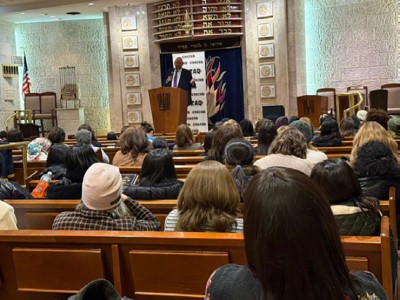



The room inside Young Israel of Hillcrest this past Sunday night carried a weight you could feel as soon as you walked in. From the opening moments of the Night Of Emunah, presented by Chazaq, there was no need to explain why people had come. Rabbi Yaniv Meirov, CEO of Chazaq, opened with T'hillim, setting the tone before any formal remarks. The focus was clear from the start: strengthening emunah through pain. The idea of “ani ma’amin ki adaber”—that speaking about emunah strengthens it—was not left as a concept alone; it was placed directly into people’s hands, with Ani Ma’amin cards and books distributed throughout the room.
The evening was dedicated l'zecher nishmas Dovi Steinmetz, z”l, one of the forty-five pure neshamot lost in the Meron tragedy. As the program unfolded, it became clear that Dovi’s story did not end there. Chazaq’s broader work was also in focus, reaching thousands of public school students across more than twenty locations and helping guide over 2,000 children into yeshivah education. The numbers matter, but what stood out most was the sense that this is ongoing work—building, not just remembering.
When Shloimi Steinmetz took the stage, the tone shifted. It was his first time in Queens, yet the room did not feel unfamiliar. Faces in the crowd—some connected to Dovi, others connected to the mission—closed that distance quickly. A simple line framed everything that followed: “I’m in the door business, not the Ani Ma’amin business.” It drew a reaction, but more than that, it explained the moment. This was not a role he chose. It was one he accepted.
This wasn’t a retelling of a tragedy. It was a picture of a life. Dovi was remembered as a serious yeshivah bochur, closely connected to his Rosh Yeshivah, someone who helped others quietly, without needing recognition. Story after story revealed that pattern. During COVID, while learning near Ein Gedi in extreme conditions, Dovi ordered 3,000 shekels’ worth of food—not for himself, but for other bochurim struggling through quarantine. A boy who had lost his father needed to get to Har HaZeisim; Dovi arranged a car, security, and made sure he could say Kaddish properly. A newly arrived American bochur, completely lost at the airport, was taken in, given a phone, placed in a dira, and guided into yeshivah life. Months later, that same boy stood at the levayah, only then understanding what had been done for him.
Even the smaller details carried the same message. Dovi didn’t lock his electric bike. “Hashem knows I need it,” he would say. It stayed there, untouched—until someone else decided to lock it. Within a week, it was gone. The room reacted with a quiet, knowing laugh. It sounded exactly like him.
Then came Meron. Dovi and his friends arrived early, setting up to give out drinks—chai rotel—to the crowds. When the situation turned, he moved toward it, trying to pull children out. One was saved. The rest of what happened came back later, through those who were there.
In the days that followed, the family sat shiv'ah in Monticello. Despite COVID, thousands came through in a single day. At one point, without planning, the room began singing Ani Ma’amin. “It felt like Dovi was singing with us.” That moment stayed. What began with one hundred cards in a Montreal shul grew quickly—1,000, then 10,000, then far beyond. Today, more than 300,000 Ani Ma’amin cards have been distributed worldwide, including to soldiers in Gaza. When Mr. Steinmetz spoke with them, many responded immediately: “אנחנו יודעים מה זה שלושה עשר עיקרים.” They asked for the cards. They wanted something to hold onto.
“We’re not moving on. We’re moving forward.”
That message carried into the words of Rabbi Dovid Ashear, where another layer of the struggle—the moments when a person feels distant from Hashem—was addressed. Yosef HaTzaddik in prison, Rebbi Shimon bar Yochai in the cave, and Sarah Imeinu waiting years for a child were not presented as stories of distance, but of growth. What feels like being pushed away can be the moment that defines a person. The idea extended further: those who leave this world while performing mitzvot are elevated in ways that cannot be measured, reaching the highest levels of Gan Eden.
The story of Joey brought that idea into focus. A profitable share in a bus company was given up rather than benefit from chillul Shabbat, leading to a life of financial struggle, selling soap door-to-door. Years later, when confronted by a former colleague who had become wealthy, there was no argument. Instead, there was a Siyum HaShat, a son who knew Torah baal peh, and generations built on that decision. The return was there—just not in the form most people expect.
By the time Rabbi Paysach Krohn spoke, the room was listening differently. A familiar line from Pirkei Avot—“da ma l’maala mimcha”—took on new meaning. The word “ma” carries a gematria of 45, a reminder that the forty-five neshamot are above us, beyond what we can understand. The message was simple and direct: emunah does not mean everything will work out the way we want. It means trusting that there is a plan, even when we don’t see it. The Chofetz Chaim’s example of Ashrei followed naturally—someone who comes late or leaves early only hears part of the pasuk and walks away with the wrong understanding. That, in many ways, is how people experience life.
There was also something practical to take home. Before going to sleep, think of ten good things from the day. Notice them. Hold onto them. In difficult moments, return to Shema Yisrael, recognizing that both chesed and din come from the same place. The story of Sarah Kriegsman left the final impression: “If I never asked ‘Why me?’ when things were good, I can’t ask it when things are hard.”
When the program ended, people did not rush out. Some stayed seated, holding the small blue Ani Ma’amin cards. Others sat quietly. There was nothing more that needed to be said.
In the heart of Queens, forty-five voices were not silenced. They are still being heard.
The Echo Of 45: A Night Of Emunah In The Heart Of Queens
Typography
- Smaller Small Medium Big Bigger
- Default Helvetica Segoe Georgia Times
- Reading Mode