


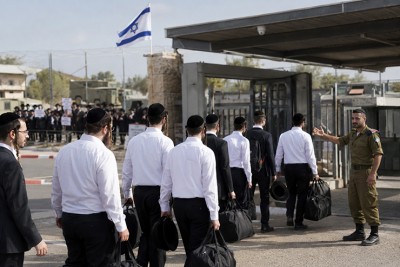
Hundreds of Chareidi men arrived at the IDF’s Tel HaShomer induction center at the end of August as anti-draft demonstrators attempted to block access to the base. The competing scenes captured the central contradiction in Israel’s long-running conscription dispute: Chareidi enlistment is growing, but the legal and political battle over who must serve remains unresolved.
The IDF reported approximately 4,000 new Chareidi soldiers over the most recent year, compared with roughly 1,800 annually before the war that began on October 7, 2023. Earlier this year, more than 530 Chareidim enlisted in what the military described as its largest single-day Chareidi induction, with recruits entering combat and combat-support tracks.
The figures demonstrate that meaningful enlistment is possible when frameworks are designed for Chareidi soldiers. They also remain far below the number of eligible men and the manpower the IDF says it needs after years of war and extraordinary reliance on reservists.
The legal foundation for blanket non-enlistment has already collapsed. In June 2024, Israel’s High Court unanimously ruled that, without a valid exemption law, the government must apply the draft to eligible Chareidi men and cannot continue funding yeshivos for students whose military deferrals are no longer lawful.
The Knesset attempted to restrict enforcement in July 2026 by passing, 58-54, a temporary measure blocking arrests, investigations and other proceedings against qualifying Chareidi draft evaders. Supporters described the law as a pause intended to reduce confrontation while a broader arrangement was pursued. Critics argued that it rewarded noncompliance and shifted the burden back onto soldiers and reservists already serving.
The measure never took effect. The High Court froze it on July 15, one day after its passage, and a nine-justice panel extended that freeze on July 28 pending a final ruling. Attorney General Gali Baharav-Miara urged the court to strike down the law, calling it discriminatory and legally defective. Enforcement therefore remains legally available, although its practical application continues to generate confrontation and political pressure.
Israel now faces several possible paths.
The first is continued enforcement through draft orders, financial consequences and arrests while the Knesset measure remains frozen. That approach may produce additional enlistment, but broad coercion risks deeper resistance and mass confrontation without creating the conditions needed to retain religious soldiers. The High Court’s eventual ruling will determine whether the Knesset’s attempted enforcement pause survives at all.
The second is a negotiated law built around gradually increasing targets, meaningful consequences for institutions or individuals that disregard them, and protected exemptions for a defined core of serious Torah scholars. Such an arrangement would require measurable results rather than promises, while recognizing that limud haTorah is not merely another occupation within Chareidi life.
The third is a substantial expansion of service designed around the realities of Chareidi observance. That includes gender-sensitive units, reliable standards of kashrus and Shabbos, rabbinic guidance, protected time for learning, vocational training and options outside conventional combat service. Civilian emergency, medical, technological and national-service roles could also contribute to the country’s needs, although the IDF’s immediate manpower shortage means civilian service alone cannot resolve the military problem.
The approaching October 27 election makes a durable settlement less likely in the short term. Chareidi parties remain determined to protect the yeshivah world, while opposition parties and many reservists are demanding enforceable equality. Any proposal can therefore become a campaign weapon before it becomes workable legislation.
The men entering Tel HaShomer suggest that the public debate has already moved beyond the false choice between drafting every yeshivah student and drafting none. A growing number are demonstrating that military service and Chareidi observance can coexist when the framework is credible. At the same time, the state must distinguish between those genuinely immersed in Torah learning and those using the yeshivah system to avoid any form of service.
The eventual solution will have to preserve serious Torah learning, meet real defense needs and impose consequences that are neither symbolic nor indiscriminate. Israel has delayed that balance for years. The latest enlistments show a possible direction, but not yet a national agreement.
Hundreds Of Chareidim Enlist As Israel’s Draft Battle Enters A New Phase
Typography
- Smaller Small Medium Big Bigger
- Default Helvetica Segoe Georgia Times
- Reading Mode