

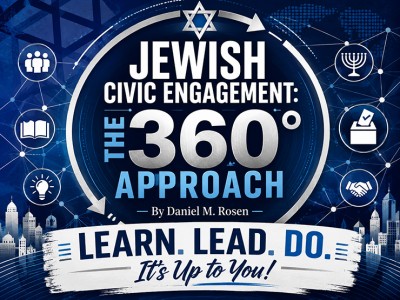
The Jewish community and its allies ought to adopt a comprehensive 360° strategy to confront modern Jew-hatred. Success depends on aligning our efforts across three horizons—immediate action, medium-term engagement, and long-term education—supported by a cohesive technological strategy. At the core of this mission are three guiding principles: Resilience, Joy, and a Commitment to Service.
The emergence of organizations such as the Democratic Socialists of America and the rise of political figures including Alexandria Ocasio-Cortez, Rashida Tlaib, Ilhan Omar, Zohran Mamdani, and others did not happen in a vacuum. These political breakthroughs reflect years of organizing, leadership development, and investment in building a broader, coordinated movement.
While it took decades for these movements to solidify, rapid technological advancement offers the Jewish community an opportunity to compress that timeline and organize with unprecedented speed.
Here is the plan:
First: Activate Those Who Are Ready Now
The most immediate opportunity is among Jews aged 55 and older. Many in this cohort understand the seriousness of the moment and are willing to act. They vote, register voters, attend rallies, write letters, communicate with elected officials, and engage on social media. They are often willing to put themselves on the line in ways that other segments of the community have not yet been prepared to do.
This group should not be taken for granted. It is a valuable, existing reservoir of civic engagement that should be recognized, organized, trained, and amplified. These individuals are already making an impact, and their experience and commitment can serve as a foundation for broader communal action.
Second: Mobilize the 30- and 40-Something Generation
This may be the most strategically important cohort for the medium term. Its members are uniquely positioned because they remember the pre-social-media world while also being highly capable in today’s digital environment.
They are deeply involved in careers, families, synagogues, and communal life. Many are navigating the demanding years of raising school-aged children and building careers, yet the challenges facing the Jewish community require them to find the bandwidth to become more engaged. That shift in priorities must take place.
People in their 30s and 40s are educated, articulate, energetic, and connected, yet many have never been taught how to translate those strengths into sustained civic engagement.
Leaders and rabbis across denominations would be wise to embrace a broader mandate. In addition to serving as spiritual and communal caretakers, they can become shepherds of action, guiding their communities in confronting the challenges facing the broader Jewish community. The synagogue is a vital venue where this generation can learn that participation is not merely optional; it is a communal responsibility.
Third: Transform Jewish Education
This is where the deepest and most lasting change can occur.
The Jewish school system should prepare students not only academically and Judaically, but also for a lifetime of service and leadership. The educational mission should be simple:
Learn. Lead. Do. It’s Up to You!
There is a generational opportunity to transform Jewish education. By focusing on students in grades seven through 12, three fundamental values can be instilled: Resilience in the face of adversity, Joy in a shared heritage, and a practical Commitment to Service.
That commitment must extend beyond the classroom. Students can be taught how to register voters, canvass neighborhoods, use social and traditional media effectively, attend rallies, communicate with public officials, and speak out with knowledge and conviction wherever they find themselves.
The scale of the opportunity is significant. If thousands of Modern Orthodox and Conservative students in the New York-New Jersey region graduate each year with these skills, within several years tens of thousands of young people could enter universities, professions, and public life prepared to participate actively and constructively.
Ultimately, this model can expand throughout the Jewish community and among its allies.
Fourth: Build Connective Technology
All three cohorts need an infrastructure that connects them.
The Jewish community needs technology that enables schools, synagogues, organizations, grassroots groups, and individual activists to share campaigns, resources, messaging, and opportunities for action while allowing each organization to maintain control of its own community.
The goal is not centralized control. It is connective tissue: a system capable of moving information, ideas, resources, and coordinated opportunities quickly when moments of significance arise.
Together, these four elements can activate those already engaged, mobilize those who have yet to become involved, prepare the next generation, and give the broader community the tools to organize effectively.
The mission is clear:
Learn. Lead. Do. It’s Up to You!
Daniel M. Rosen is president and co-founder of IMPACT, a movement dedicated to organizing, empowering, and mobilizing individuals to combat Jew-hatred on social media and beyond. IMPACT’s activities have been covered by NBC, CBS, FOX, WPIX, ABC News, The Jerusalem Post, amNewYork, JNS, The Times of Israel, Arutz Sheva, JTA, and other outlets. Follow IMPACT at @joinimpactnow.
Learn. Lead. Do.
Typography
- Smaller Small Medium Big Bigger
- Default Helvetica Segoe Georgia Times
- Reading Mode