



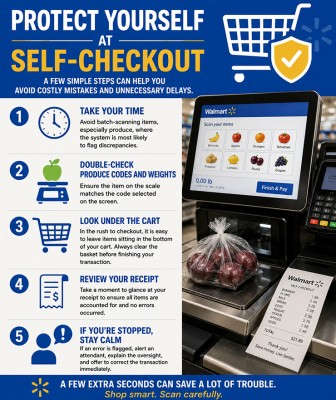
Imagine paying for an entire cart of groceries, only to find yourself involved in a dispute over a minor weighing error. Reports circulating within the Catskills community about interactions at the Walmart in Monticello have prompted a broader conversation about how a routine shopping trip can unexpectedly escalate in the era of automated retail.
The Catskills see thousands of seasonal residents and visitors every summer. They rely on the Monticello Walmart for everything from basic groceries to last-minute necessities. For these shoppers, recent reports of store-level interactions at retailers nationwide have turned what is ordinarily a routine stop into a moment of anxiety at the self-checkout.
Community members have expressed concern about being stopped for minor mistakes—such as picking the wrong produce code, miscounting items, or failing to scan a low-cost item. These mistakes often involve just a few dollars, yet the fear is that an oversight could lead to a review by store security or, in some cases, further intervention. While no official statement has been released regarding specific local reports, these stories have resonated because they reflect a tension many shoppers have felt since self-checkout became the norm.
Retailers are in an ongoing effort to combat "shrink," an industry term for the billions of dollars lost annually to theft, fraud, and administrative errors. To address this, stores are increasingly installing surveillance and monitoring software. In some cases, these systems are designed to monitor transactions and flag discrepancies for review. For stores, this is an attempt to secure inventory; for shoppers, it means that transactions may be subject to greater technological scrutiny than ever before. Some retail chains have even begun removing self-checkout lanes entirely after deciding the cost of these security incidents outweighs the convenience.
This marks a shift in the shopping experience. For generations, grocers relied on trained staff to handle the nuances of the register. Today, shoppers are expected to identify produce, weigh items, and process their own payments. Unlike professional cashiers who perform these tasks hundreds of times each day, most shoppers do so only occasionally. That experience gap makes ordinary mistakes almost inevitable.
Produce is a frequent catalyst for error. Unlike packaged goods with a barcode, fresh items require a shopper to navigate codes, varieties, and weights. A distraction is rarely a sign of intent, yet these systems are often programmed to flag any discrepancy. This creates an environment where a mistake may be flagged for review before a store employee has a chance to determine whether it was simply human error or something more.
Under New York law, larceny requires proof of intentional theft. An incorrect produce code or a forgotten item does not automatically make someone a criminal. Yet, by the time that distinction is addressed, a shopper may already have been stopped and asked to explain the transaction. Whether a violation has occurred depends on the specific facts of each case, including the intent behind the action.
If a store employee questions a transaction, remain calm and courteous. Ask to review the receipt and the items in question, and if an error occurred, offer to correct it immediately. Many checkout discrepancies can be resolved without further escalation when addressed promptly and respectfully.
Ultimately, the concerns raised in Monticello extend well beyond a single Walmart store. They reflect the growing complexities of a retail landscape in which technology increasingly serves as the first line of defense against theft while customers assume responsibilities once handled by trained cashiers. As automation continues to reshape the shopping experience, retailers will face the challenge of protecting merchandise without losing sight of the reality that honest mistakes remain part of everyday life.
By Shabsie Saphirstein
The Price Of Convenience At Walmart Monticello
Typography
- Smaller Small Medium Big Bigger
- Default Helvetica Segoe Georgia Times
- Reading Mode