


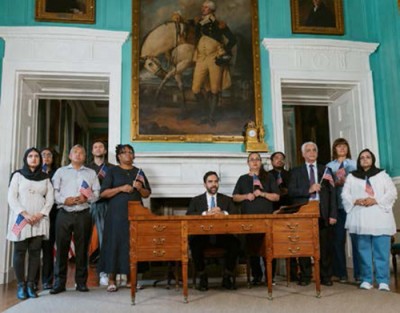
America’s 250th birthday should have been a moment of pride, gratitude, and shared national purpose. It was a clear opportunity for elected leaders to remind citizens why this country remains the greatest experiment in human freedom the world has ever known.
Instead, New York City Mayor Zohran Mamdani used his America 250 address to deliver a speech that sounded less like a celebration of the United States and more like an indictment of it.
The setting was highly deliberate. Mamdani spoke from City Hall, seated behind George Washington’s desk and surrounded by recently naturalized citizens. The symbolism could have been powerful: a naturalized citizen leading the nation’s largest city marking the nation’s semiquincentennial by honoring the country that gave generations of newcomers a home, a voice, and a future.
There were moments when Mamdani appeared to recognize that promise. He spoke of New York Harbor, the Statue of Liberty, the waves of immigrants who arrived in search of opportunity, and the revolutionary history that saved the American cause. He acknowledged that America’s founding ideals still matter, noted that millions across the globe continue to see this country as a land of possibility, and even closed his remarks with "G-d Bless America."
But the speech quickly shifted from gratitude to grievance, focusing heavily on national defects while keeping America's achievements in the shadows.
Mamdani framed the country as a “nation of contradictions,” a place where children go hungry while the wealthy hunger for more, where monopolies dominate industries, where “oligarchs” buy elections, where health insurers exploit the sick, where corporate landlords neglect tenants, and where tax dollars are spent on “bombs and bailouts.”
To be fair, no serious person believes America is perfect. The United States has known slavery, discrimination, poverty, political corruption, and ugly moments of division. A mature, clear-eyed patriotism does not require pretending otherwise. But there is a massive difference between acknowledging historical flaws and using Independence Day to make citizens feel that loving their country is something they should apologize for.
That was the fundamental failure of Mamdani’s address: it treated a historic national milestone as a platform to lecture Americans about what is wrong with their country. By the end, the speech left listeners feeling not proud to live in America, but almost embarrassed to say so.
The underlying symbolism made this tension even more striking. Sitting behind George Washington’s desk, Mamdani had the perfect opportunity to speak about sacrifice, courage, ordered liberty, and the reality of self-government. Instead, he used that historical anchor to suggest that America is still mostly a bitter struggle against a powerful few who manipulate everyone else. George Washington risked everything to create a country where free citizens could govern themselves; Mamdani used Washington's platform to catalog modern resentments.
The mayor tried to salvage the tone by defining patriotism as “righteous dissent.” There is truth in the idea that protest has shaped American history—the civil rights movement, labor movements, and local civic battles have all helped America live up to its founding promise. Yet dissent alone is not patriotism. Protest alone is not love of country. Anger alone cannot sustain a nation's soul.
For New York’s Jewish community, this distinction is not an abstract political debate; it is deeply personal. America is the exceptional land where Jewish families fleeing pogroms, poverty, and persecution built shuls, yeshivos, businesses, charities, and thriving communities. It is the country where Jews can walk openly to shul on Shabbos, send their children to day schools, advocate publicly for Eretz Yisrael, criticize elected officials, and participate fully in civic life without fear. That level of freedom deserves far more than a passing, conditional mention on the Fourth of July.
This stark imbalance is precisely what drew a fierce counter-response from Nassau County Executive and Republican candidate for governor Bruce Blakeman, who blasted the mayor’s remarks as “a dark and vindictive appraisal of America’s past, present and future.”
“America is a beacon of freedom that has created more prosperity for everyday people than any other civilization in the history of the world,” Blakeman said. “No wonder people from all over the world crave to come here.”
Blakeman went further, calling Mamdani “a dangerous subversive who must be stopped” and arguing that Governor Kathy Hochul’s embrace of Mamdani’s rhetoric disqualifies her from continuing as governor.
While the political sharpness of the exchange will dominate the headlines, beneath the noise lies a serious question: What kind of message should a leader send on the Fourth of July, especially on America’s 250th birthday?
Should an Independence Day address leave citizens with the defeatist sense that America’s greatness is mostly a myth, its institutions fundamentally corrupt, its prosperity inherently unjust, and its patriotism expressed solely through protest?
A healthy nation requires gratitude, loyalty, memory, and pride to survive. Patriotism without gratitude quickly sours into resentment. Patriotism without pride becomes mere scolding. America does not need leaders who pretend the country has no flaws. But on its 250th birthday, it deserved leaders who could speak with pride, gratitude, and moral clarity about why this nation remains worth loving.
By Shabsie Saphirstein
Mamdani’s July 4 Address Put America On Trial Instead Of Celebrating Its 250th Birthday
Typography
- Smaller Small Medium Big Bigger
- Default Helvetica Segoe Georgia Times
- Reading Mode