


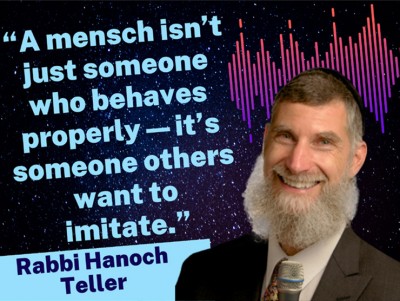
When Rabbi Yaniv Meirov sat down with Rabbi Hanoch Teller—world-renowned author, lecturer, and the voice behind “Teller From Jerusalem”—the conversation quickly moved past definitions into something deeper: what it means to live as a mensch. Rabbi Teller, who has authored nearly thirty books, teaches widely, and delivers regular shiurim, including at the Kotel, brought decades of experience into a discussion that felt remarkably grounded. Even as a father of a large family—eighteen children, as was humorously noted—his message remained focused on something simple, but often overlooked.
“A mensch begins with civility,” Rabbi Teller explained, “but it doesn’t end there.” Civility is the baseline—basic decency, respect, and awareness of others—but mentchlichkeit demands more. It calls for nobility: a way of living that not only avoids wrongdoing, but actively elevates those around you. It’s not just about being correct—it’s about being compelling, about living in a way that people see and want to emulate.
This idea becomes especially relevant during Sefirat HaOmer. We mourn the loss of Rabbi Akiva’s 24,000 students—individuals who reached extraordinary heights in Torah, yet were lacking in how they treated one another. Rabbi Teller emphasized that while we cannot grasp their level, the lesson is unmistakable: Torah greatness alone is not enough if it isn’t accompanied by respect. And that message is not reserved for those in the beit midrash. Not everyone will teach Torah, but everyone is expected to live in a way that reflects it.
Drawing from Parashat Kedoshim, Rabbi Teller outlined a powerful progression: mitzvos elevate a person, that elevation leads to kedushah, and the ultimate goal is kiddush Hashem. Holiness is not meant to remain internal; it must be visible, expressed in how a person speaks, acts, and interacts. Whether we realize it or not, every interaction is a form of representation. Every word, every reaction, every moment—public or private—reflects on something larger than ourselves.
Often, being a mensch is revealed in the smallest details. Not cutting a line, even when rushed. Respecting other people’s time. Putting a phone away when someone is speaking. Speaking with awareness in shared spaces. Asking “How are you?” and actually caring about the answer. These are not dramatic moments, but they are decisive. As the well-known idea goes, people don’t care how much you know until they know how much you care.
Another cornerstone of mentchlichkeit is how we view others. We rarely know the full story. Background, struggles, pressures—so much remains unseen. We are often stepping into the middle of someone else’s story, not the beginning. Without that awareness, judgment becomes shallow—often unfair—and we risk misunderstanding people entirely.
There’s a phrase people sometimes say: “It’s hard to be a Jew.” But Rabbi Moshe Feinstein rejected that mindset. Yiddishkeit is not meant to feel like constant suffering. It requires effort and demands growth, but it is meant to be lived with clarity, purpose, and even joy. That perspective reframes the entire experience—not as a burden, but as an opportunity.
One of the most striking contrasts Rabbi Teller raised is between generations. In the darkest times, especially during the Holocaust, Jews displayed unimaginable mesirut nefesh. Simple mitzvos—wearing tzitzit, keeping Shabbat, holding onto identity—came at enormous personal risk. Yet today, in comfort and freedom, those same commitments can sometimes feel difficult. That contrast is not meant to criticize, but to awaken. If they could rise in darkness, what are we capable of in light?
Rabbi Teller illustrated this through powerful examples. He spoke about Aaron Feuerstein, who kept thousands of employees on payroll after his factory burned down because it was simply the right thing to do. He described a Detroit family, living in a city once known for deep-rooted antisemitism, whose consistent kindness to a housekeeper left such a lasting impression that her son later became a newspaper editor who spent years defending Jews and Israel. He also shared the story of the Bobover Rebbe, who treated a simple worker with dignity and warmth, leaving a lifelong impression. These were not speeches—they were lived examples of Torah in action.
At the same time, Rabbi Teller did not avoid a difficult truth. Public behavior matters, and not always in the way it should. Moments of impatience, entitlement, or lack of awareness—whether in travel, public settings, or everyday interactions—can undo so much good. That is why the foundation must be rebuilt carefully and honestly. Before striving for greatness, we must first restore civility. Without that, nothing else stands.
As we move through Sefirah toward Shavuot, the message becomes clear. Preparation is not only about learning more—it is about becoming more. More aware, more respectful, more refined. Torah is not only something we receive; it is something we reflect in how we live.
Being a mensch is not complicated, but it requires intention. It is built in small decisions—how we speak, how we listen, how we treat others when no one is watching. In a world that often overlooks those details, choosing to live with that awareness stands out. Not just as proper behavior, but as something others see and want to follow.
Rabbi Yaniv Meirov is the mara d’atra of Kehilat Charm Circle in Kew Gardens Hills and serves as Chief Executive Officer of Chazaq. Now 222 episodes strong, Chazaq Torah Talks continues to inspire by showing that Jewish growth and survival are shaped through lived experience, commitment, and connection.
From Civility To Nobility: What It Means To Be A Mensch
Typography
- Smaller Small Medium Big Bigger
- Default Helvetica Segoe Georgia Times
- Reading Mode