

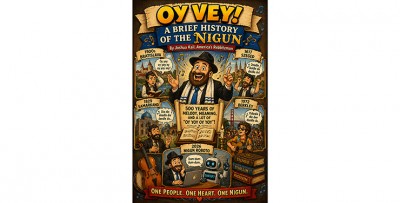
Perhaps one of the most well-known, yet least understood schools of music in all of Judaism is the deceitfully simplistic nigun. These wordless tunes have been chanted throughout generations. It is the soundtrack of our people. But where did the nigun come from, how has it evolved, and what role does it play in modern Judaism? These may seem like unanswerable questions, but I, America’s Rebbitzman, have put in the time and research to answer them all.
With something so simple as a song without lyrics, one might assume that the nigun predates all other liturgy—but you’d be wrong, DEAD wrong. The story of the nigun started over five hundred years ago in the yeshivah of Bratislava, by a less-than-apt pupil named Shmini Ben Yoseph.
Every morning during shacharit, he was surrounded by people praying so fast and accurately that he had no hope of keeping up. While his peers shuffled back and forth with the spirit of prayer, Shmini would shuffle in anxiety. To help hide his ignorance, Shmini would just mumble as he shuffled, “Oy yoy oy yoy oy oy yoy vey.”
One day after mincha, his friend Lev asked him about his bizarre prayers. Shmini confessed everything. But rather than being ridiculed for his actions, word spread of what he was doing, and like wildfire, this proto-nigun infiltrated the yeshivot of Europe. Whenever a yeshivah bochur had a late night at a hora rave or got lost in a debate over whether a French braided Havdalah candle was kosher, only to find themselves in shape to recite Modeh Ani the next morning, they would instead mumble Shmini’s tune: “Oy yoy oy yoy oy oy yoy vey.”
By the end of the 1500’s, there would be over 3000 different nigunim on record. In that time, it transformed from a “bent-over” cure used by overly extracurricular rabbinical students into the legitimate meditative prayer we all know and love today.
Below, we will look at some of the most popular nigunim throughout Jewish history and break down their meaning and evolution.
1617 — The Nigun Of Szeged:
Considered by many to be one of the earliest examples of the use of “deedle,” this nigun was the pop sensation of its time. The full nigun, as I am sure you will recognize, is:
Deedle deidle do deidle do deidle do
Doodle deedle die, deidle die, deidle die
Deedle deidle doodle do doodle do
Prior to the Szeged nigun, the very thought of using “deedle” would have been considered an excommunicatory offense. The fact that this addition was not only allowed but thrived is a telling look at how the times were changing. Many believe that the reason “deedle” was embraced was because it so closely followed the “Barley Famine” of 1616. People were looking for a way to really let loose and celebrate the long-awaited return of kasha and varnishkas to the Shabbos table. Whatever the reason, in 1617, “deedle” made its way onto the public bimah and never looked back.
1829 — The Nigun Of Samarkand:
The Nigun of Samarkand is notable because it took the hectic, almost anti-establishment nature of the Nigun of Szeged and brought it back to a place of musical and spiritual refinement. By this time, “deedle” had become so commonplace that it was a cliché. This point was made all too clear when looking at the disaster that was Moshe’s Nigun, a twenty-minute chanting of “deedle” over and over. Historians agree that Moshe’s Nigun contains “the worst lyrics never written.”
This is why the Nigun of Samarkand is so important; it creates order from chaos, a beauty from the common. While Moshe’s Nigun risked ending the nigun entirely, the Nigun of Samarkand rescued it from becoming a footnote in a future sermon. Just read below and see how this complex simplicity kept the nigun as an integral part of Judaism:
Die die deedle die deedle do deedle do
Die die deedle die deedle do deedle do
Die deedle do deedel do deedle doo
Die deedle do deedel do deedle doo
Die die deedle die deedle do deedle do
1972 — The Nigun Of Berkley:
The Nigun of Berkley was perhaps the most important reflection of the changing times in the history of Judaism. Berkley’s impact would be permanent. In the midst of the turbulent social restructuring of America in the 1960s, the nigun exploded out of the shul and into pop culture. The historic performance of The Beetles’ classic Ashkenazi Arnie Herring Monger on The Ed Sullivan Show and its chorus of “yi di dee dee di do” in a Liverpoolian inflection not only impacted externally but internally as well.
It was only natural for that overlap of religious and secular music to be reflected in nigunim. What the Beetles may have started, Dylan forever changed with his invention of “yidiedie.” Some scholars argue Dylan wasn’t singing a nigun at all, and he was simply mumbling lyrics as was his style at the time. Regardless, the mark was made and “yidiedie’s” stark contrast to the “deedles” and the “doydles” of past nigunim was a direct swipe at the shtetl influences on the Jewish people. This bold choice drew the line in the sand as if saying, “Our time has arrived in America!” In its day, you would be hard-pressed not to see the wincing face of an elder Rabbi upon hearing a younger yeshivah bochur uttering “yidiedie” while walking by in a tie-dyed Borsalino. The Nigun of Berkley will forever be seen as a turning point in not only nigunim but in Judaism itself. Thankfully, the same cannot be said for tie-dying.
Excerpt from Bob Dylan’s Tzit Tzit In The Wind Nigun:
Yidiedie die dee deedle die Yidiedie die dee
deedle do yidiedie die yidiedie die yideidei
die deedle do
2026 — The Nigun Of America’s Rebbitzman (Nigun Roboto):
What makes the nigun such a beautiful and powerful meditation of Judaism is its ability to turn something meaningless into something meaningful. A nigun can transform a collection of letters with no previous value, purpose, or impact into a sound that brings together the totality of Jewish spiritualism and peoplehood. It is, in every sense, magical.
At the same time, songwriting is hard, and as America’s Rebbitzman, I don’t lack the vocabulary to write one on my own. To help, I turned to a digital gabbi (ChatGPT). While I don’t trust such tech to write actual words, I felt safe in relying on it to not write any words. Alas, that sweet, simply complex nigun proved too tough a task for even AI, as you will see below. But who am I to stop the flow of 500 years of progress?
I give you the Nigun of the Rebbitzman, AKA Nigun Roboto:
Dum-dum-dum-dum, dum-dum-dum-dum, Dum-dum-dum-dum, dum-dum-dum-dum.
With joyful leaps and heartfelt sighs, the nigun dances through the skies. It weaves its way through notes and keys, unleashing melodies on the breeze.
Dum-dum-dum-dum, dum-dum-dum-dum, Dum-dum-dum-dum, dum-dum-dum-dum.
In every note, a story told, of struggles fought and love unfold. With each repetition, it gains new might, an ancient rhythm, shining bright.
Dum-dum-dum-dum, dum-dum-dum-dum, Dum-dum-dum-dum, dum-dum-dum-dum.
From soul to soul, it spreads its wings, a song of hope, the heart it sings. No words are needed, just pure sound, as it circles the earth, unbound.
Dum-dum-dum-dum, dum-dum-dum-dum, Dum-dum-dum-dum, dum-dum-dum-dum.
So let us join in harmony, and let the nigun set us free. With each heartbeat, we’ll make it soar, forevermore, forevermore.
Dum-dum-dum-dum, dum-dum-dum-dum, Dum-dum-dum-dum, dum-dum-dum-dum.
By Joshua Kail, America’s Rebbitzman
A Brief History Of The Nigun
Typography
- Smaller Small Medium Big Bigger
- Default Helvetica Segoe Georgia Times
- Reading Mode