


With Pesach fast approaching, many of you are probably facing the same question as you walk through the doors of your shul, synagogue, shtiebel, or rented-out church basement.
That question is:
“What exactly am I supposed to say to these people?”
This is not because you haven’t seen many of them since this time last year, or because you saw their recent social media post and are still trying to process it.
No. The problem is far more serious.
There are simply too many Jewish greetings.
This isn’t just a Pesach problem — it’s every holiday! I’ve counted, and we Jews have approximately 128 different ways to greet each other over the holidays.
It is completely out of control.
Do you know how many ways Christians greet each other on their holidays?
Two.
They either say “Happy” or they say “Merry.”
That’s it.
They took the word merry and limited it to a single viable use case. Imagine the discipline that requires. In fact, back in the 1800s, if you were to say the word “merry” and it wasn’t in the context of their holiday, people would assume something had gone terribly wrong and politely escort you away.
This is probably why Christianity spread so widely around the world. It wasn’t because of missionaries.
It was because they eliminated the social anxiety of greeting someone at a religious event.
I can only imagine how simple and carefree life would be if, regardless of the holiday, I simply had to put the word “happy” in front of its name and know with confidence I was using the correct phrase.
Unfortunately, “Happy Tisha B’Av” doesn’t quite work.
Now, before you get your tzitzit in a twist, I am not suggesting we toss out our wonderfully complicated system of 300-plus greetings.
That would be crazy.
And frankly, it wouldn’t work.
Can you imagine calling together a multi-denominational congress of rabbis to come to a global agreement on what we should say to each other on Rosh Hashanah?
It would be chaos.
The Orthodox rabbis would insist we say something like:
“Shanah Tovah U’Metukah! Tizku L’Shanim Rabot! May you merit many years of blessing, like Yitzchak ben Avraham when the ram appeared on Har HaMoriah — may such brachah befall your family!”
Their goal would be to make the greeting so long that it essentially becomes a service in and of itself, ensuring that not a moment of potential prayer goes to waste.
The Conservative rabbis would argue that the greeting must be short, efficient, and dignified to properly reflect the seriousness of the occasion.
They might insist that “Gut Yontif” is not quite sufficient and upgrade it to something like:
“Gutyonzeit!”
That way you cover the holiday greeting and the appropriate response if the person sneezes.
Efficiency.
The Reform rabbis would be more open to experimentation, but would probably suggest incorporating the word “howdy” somewhere into the greeting.
This is so that we can be more inclusive of people who enjoy saying “howdy.”
The Reconstructionist rabbis would not see this as a problem at all.
They would simply hug everyone.
In fact, they already hug people as a response to… well, pretty much everything.
So what is the solution?
Simple.
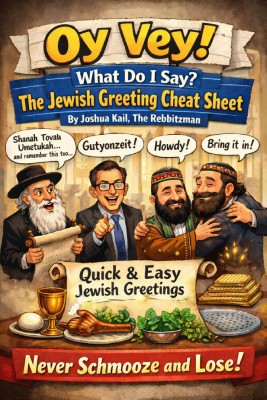
You just need to memorize The Rebbitzman’s Quick and Easy Jewish Greeting Cheat Sheet.
Rosh Hashanah
“Shanah Tovah!”
“Gut Yontif!”
“Anyada Bueno, Dulce y Alegre!”
Or simply:
“Yoni? I thought you moved to Florida!”
Shabbat
“Good Shabbos.”
“Shabbat Shalom.”
Or the slightly more enthusiastic
“Guuuud Shabbos!”
Sukkot
“Chag Sameach.”
“Moadim L’Simchah.”
Or the classic:
“Nice sukkah! Mind if I shake your lulav?”
Chanukah
“The dreidel spins at sundown!”
Or
“A very good oil unto you!”
(The appropriate response being:
“May your sufganiyot only drip a little bit.”)
Purim
“Schnapps?”
“Schnapps!”
Pesach
“May the maror exit easier than it entered.”
Havdalah
The sun sets, the spices are passed around, and suddenly we are struck with the bittersweet realization that Shabbat is leaving us once again.
And yet we know that the peace we experienced does not disappear. It simply waits for us, quietly, until the next Shabbat arrives.
So as we stand together at that threshold between holiness and the coming week, we wish one another strength, blessing, and the promise that we will soon meet again in the light of another peaceful Shabbat.
A Jewish Greeting Cheat Sheet
Typography
- Smaller Small Medium Big Bigger
- Default Helvetica Segoe Georgia Times
- Reading Mode