


I. Introduction
Bakhsh is a traditional dish eaten primarily by Bukharian Jews around the world. It was customary to serve it, along with another dish called sirkanis, during the seudah shelishit (third Shabbat meal), since it can be eaten cold.1
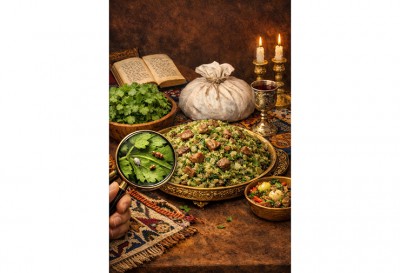
It is made primarily from rice, cilantro (or other herbs), and diced meat. Traditionally, all ingredients are mixed and boiled inside a cotton bag. Alternatively, it may be cooked in a pot like other rice dishes.
Cilantro and other herbs are often infested with mites, thrips, aphids, leaf miners, and whiteflies. Because of this, one is halachically obligated to check the cilantro before use (the specifics of when, how, and by whom are beyond the scope of this article).
When one is served bakhsh containing cilantro or other herbs whose washing and checking status is questionable, should one refrain from eating it due to the concern of infestation, or is there room to rely on certain halachic considerations that would permit eating it?
- Halachic Issues
- Torah Prohibitions
The Torah (Vayikra 11:41– 44) prohibits Jews from consuming insects, even if they are tiny. Four general types of insects are mentioned, water insects, land insects, winged insects, and swarming insects, and each insect may involve between four to six separate Torah prohibitions.
I. When Checking Is Required
Before consuming any vegetables, herbs, or fruits, one must determine whether halacha requires checking them for infestation. If an item is known to be infested more than 50% of the time, one is obligated by Torah law (de’oraita) to check it before use, and if insects are found, each individual piece of the herb must be examined prior to consumption.
However, if the item is infested close to 50% of the time, the obligation to check is rabbinic. If the infestation rate is below 50%, there is no obligation to check it, and it may be consumed without washing or checking (e.g., apples, pears, tomatoes, potatoes).
The Rivash (Responsa 191) defines mi’ut ha-matzu’i as an infestation rate close to half, meaning the obligation to check begins only when the occurrence of insects approaches 50%. Sefer Hora’ah Berurah (84:56, and Biur Halacha Aruch) cites many leading poskim, Rav Ovadia Yosef, Rav Meir Mazuz, Rav Moshe Levi, and the sages of Jerba, who rule in accordance with the Rivash. Yalkut Yosef (Issur VeHeter, vol. 2, p. 212) appears to rule the same way.
Sefer Tola’at Shani (vol. 1, p. 92) also records that Rav Ovadia Yosef followed the Rivash’s position, though one who wishes to be stringent should not set the threshold lower than 10%. Some poskim (Mishkenot Ya’akov Y.D. #16), however, maintain that only an infestation rate of less than 10% permits consuming the item without washing or checking. This is the standard used by most kashrut agencies in the United States.
II. Nullification and the Status of a “Berya”
Halacha allows certain forbidden traces to be ‘nullified’ if they constitute less than 1/60 of the mixture, meaning they are halachically insignificant. One might assume that trace amounts of insects would be nullified in the bakhsh mixture. However, this is not the case. The insects in the herbs cannot be nullified due to the principle of berya, a complete creature, whether dead or alive, which cannot be nullified even in a ratio of one to a thousand. This would render the entire mixture non-kosher.2
However, if the insects are not intact, the regular rules of nullification may apply. Once the insect is no longer whole, it can be nullified at a ratio of one in sixty, which may occur during cooking or baking.
Maran in the Shulchan Aruch,3 based on the Rashba, rules that if produce that was potentially infested was not examined before cooking, and it is in a state where inspection is no longer possible after cooking, the product is permitted bedieved (post factum). This leniency is based on the principle of safek sefeka (a compound doubt): (1) perhaps no insect was present, and (2) even if one was present, perhaps it dissolved during the cooking process and is therefore nullifiable.4 When two doubts exist, the halacha is more lenient.
The Pri Chadash (Y.D. 84:33) notes that this leniency applies only if the food is stirred during cooking, helping to break apart any insects. Therefore, this leniency applies only to bakhsh cooked in a pot, not in a cotton bag.
If, however, the produce is known to be infested, the first doubt is removed, and only one doubt remains: perhaps the insect dissolved during cooking.5 Yalkut Yosef,6 however, maintains that safek sefeka still applies even when the produce is known to contain insects.
It should be emphasized that this leniency applies only after the fact. It must not be used as a justification for cooking produce without first checking it, which is required by halacha.
III. Application of Halachic Principles
Sefer Birkot Mayim (51c) records experiments in which insects were found not to dissolve during the cooking process. However, Gilyon Emunat Itecha7 cites research showing that during long cooking, insects often dissolve at least from their legs, rendering them no longer a complete berya and therefore subject to nullification.
Hora’ah Berurah (84:66) concludes that each case depends on multiple factors, including the size of the insect, the cooking temperature, and the length of the cooking process.8
Nevertheless, since cilantro generally does not reach an infestation level9 that requires checking according to the Rivash (see Section II.B), there is halachic basis to permit eating the bakhsh based on the principle of safek sefeka. This is further supported by the fact that the cilantro and herbs were washed before cooking (even if not according to the highest standard), which likely removed10 many insects, possibly to the point that further checking would not be required.11
Conclusion
If one finds oneself in a situation where eating the bakhsh is unavoidable, there is halachic basis to rely upon bediavad (the minimum acceptable ruling after the fact). Nevertheless, lechatchila (the ideal, preferred practice), one should never compromise on kashrut. A thorough checking must always be performed before use, as many factors influence infestation levels, including season, rainfall, farm location, cleaning methods, and the farm’s pest-management system.12
1 Bechori Yisrael Vol. 3, 17:3
This was because, there was no practical way to reheat the food (like hotplate), so only dishes that could be eaten cold were served.
2 Shulchan Aruch Y.D 100:1
בריה דהיינו כגון נמלה או עוף טמא וגיד הנשה ואבר מן החי וביצה שיש בה אפרוח וכיוצא בהם אפי' באלף לא בטלה ואין לו דין בריה אא"כ הוא דבר שהיה בו חיות לאפוקי חטה אחת של איסור וכן צריך שיהא דבר שאסור מתחילת ברייתו לאפוקי עוף טהור שנתנבל ושור הנסקל וכן צריך שיהיה דבר שלם שאם יחלק אין שמו עליו לאפוקי חלב וכן צריך שיהא שלם: הגה ועיקר גיד הנשה אינו אלא על הכף בלבד והוא כרוחב ד' אצבעות ואם הוא שלם מקרי בריה (בארוך כלל כ"ח)
3 Y.D 84:9
עבר ובישל תוך י"ב חדש בלא בדיקה אם יכול לבדוק בודק ואם לאו מותר ואם נמצאו קצת בקדרה משליכם ואוכל השאר (כי אין לך פרי שאין בו ס' נגד טעם התולעת שבתוכו) (תשובת הרא"ש בשם מהר"ם) ויש מי שאומר דהני מילי שלא נמצאו אלא א' או ב' אבל ג' או ד' הכל אסור: הגה ודוקא מאכל דאי אפשר לסננו ולהסיר מהם התולעים ומאחר שהוחזק בתולעים כולו אסור אבל אם אפשר לסננו מעביר משם התולעים הנמצאים שם והשאר מותר (רשב"א סימן ק"נ) ועיין לקמן סוף סימן ק'
4 There is also a chazaka (a status quo) on the herbs (or vegetables) which are kosher and in good standing unless a valid reason to suspect otherwise.
5 Hora’ah Berurah (84:67)
6 Issur Veheter vol. 2 pg. 213
7 #12 pg.34 quoted in Hora’ah Berurah Siman 84:note 118
8 See also OU- Document C-77 which also concludes that cooking process would always break apart an insect, depending on the degree, and physical composition of the insect before cooking began (e.g..-maturity, the softness of the insect beforehand, whether it began as whole, etc.)
9 Halachos Of Insects (Rabbi Dovid Cohen) pg. 57
Accordingly, since most vegetables sold in the United States are only infested to a level which is assur mid'rabannan to eat (without checking), it should be permitted to do business with those vegetables.
10 Halachos Of Insects (Rabbi Dovid Cohen) pg. 119 cites a ruling from Rav Yisroel Belsky that an inspection protocol does not need to be 100% effective at detecting or removing every single insect (see also Pri Megadim, Siftei Da’as 84:24). Accordingly, Rav Belsky held that if the washing system reduces infestation to the level of mi’ut she’eino matzuy, there is no obligation of bedikah, and the produce may be eaten without any further checking. See also Sefer Hora’ah Berurah (p. 102, s.v. Sheivdok).
11 See OU Document C-67 where Rav Yisroel Belsky rules that the obligation to check the produce is applicable when one is ready to use the food, which in our case is after washing.
12 Halachos Of Insects (Rabbi Dovid Cohen) pg. 139
Infestation In Bakhsh
Typography
- Smaller Small Medium Big Bigger
- Default Helvetica Segoe Georgia Times
- Reading Mode