


Hello and welcome back to Listening Corner. I’m really glad you’re here with me today.
Let’s start with a situation that might feel a little too familiar. You’re sitting on the couch, maybe reading a book or just relaxing, when suddenly you feel a strange, sharp twinge in your side. Maybe your heart does a little flutter, or a dull ache appears behind your eye.
For many people, that moment passes without much thought. But if you struggle with health anxiety, your brain may not let it go. Within seconds, your mind jumps to the worst-case scenario. You start checking your pulse. You take deep breaths to make sure you can breathe properly. You monitor the sensation, wondering whether it is getting worse. Before long, you may be completely consumed by the fear that something is terribly wrong.
If you’ve experienced that sudden wave of fear, know this: you are not alone, and what you are experiencing is very real. Today, we’re talking about health anxiety—what was once commonly referred to as hypochondria.
That word carries a lot of baggage. For years, health anxiety has been treated as a punchline in movies and television—the quirky character who panics over every sneeze. But if you’re the person lying awake at night listening to your heartbeat, there is nothing funny about it. It can be exhausting, isolating, and powerful enough to steal your peace of mind.
The Fear Is Real
One of the biggest misconceptions about health anxiety is that people are simply “making it up” or looking for attention. That misses what is actually happening. The fear is real, and often, the physical sensation that triggered the fear is real, too.
Health anxiety is not necessarily about imagining a sensation that does not exist. It can involve becoming intensely focused on normal bodily sensations or minor symptoms and interpreting them as evidence of serious illness.
Think of it like an overly sensitive smoke detector in your kitchen. A smoke detector is supposed to sound the alarm when there is a fire. But imagine one that goes off at full volume every time you put a piece of bread in the toaster. The house isn’t burning down. You’re just making breakfast. But the alarm is so loud and convincing that your body reacts as though there really is a fire.
That is one way to understand health anxiety. Our bodies are constantly producing sensations. Muscles twitch. Stomachs gurgle. Joints pop. Hearts occasionally seem to beat differently. Stress itself can cause headaches, muscle tension, sweating, stomach discomfort, and a racing heart. When your internal alarm system is on high alert, an ordinary sensation may no longer feel ordinary. It feels like a threat.
When Fear Creates More Symptoms
Once your brain believes there may be danger, anxiety itself can produce very real physical symptoms. Your heart may beat faster. Your breathing may change. Your chest can feel tight. Your hands may sweat. Your stomach may become unsettled.
And here is what makes health anxiety particularly difficult: those anxiety symptoms can then become additional evidence for the illness you already fear. Your heart starts racing because you are frightened, and your mind says, “See? I knew something was wrong with my heart.” That thought creates more fear, the additional fear produces more physical sensations, and the cycle continues. The sensation feeds the fear, and the fear intensifies the sensation.
When Dr. Google Makes It Worse
Modern technology can make this cycle even harder to escape. Years ago, if you felt a strange ache, there were limits to how much medical information you could immediately access. Today, an enormous amount of it sits in your pocket.
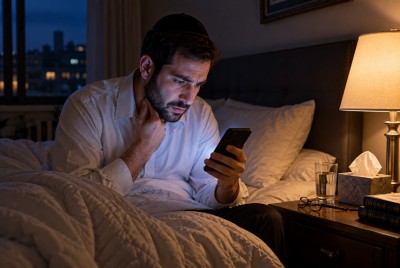
We’ve all been there. It’s 1:00 a.m., you can’t sleep, and you decide to “quickly” search a symptom online. Five minutes later, you’ve gone from reading about a common headache to worrying about a rare neurological disease.
The internet contains useful medical information, but when you are already anxious, repeatedly searching symptoms can expose you to an overwhelming number of possibilities without the clinical context needed to determine which ones are actually likely. Instead of reassuring you, the search can create ten new things to worry about. That is why compulsively searching symptoms can become part of the health-anxiety cycle.
How Do We Begin To Break The Cycle?
Learning to trust your body again does not mean ignoring your health. It means learning to distinguish between appropriately responding to a medical concern and repeatedly feeding an anxiety cycle.
- Step Away From The Search Bar
Try to reduce the habit of repeatedly Googling symptoms. If you have a new, persistent, worsening, or genuinely concerning symptom, speak with an appropriate medical professional rather than attempting to diagnose yourself online. A healthcare provider can evaluate the symptom in the context of your medical history and overall health.
Of course, symptoms that could indicate a medical emergency should be treated as such rather than “waited out” because you think they might be anxiety. The goal is not to ignore your body. The goal is to stop asking the internet to provide certainty that it usually cannot provide.
- Remember That Bodies Are Noisy
Cars make sounds. Houses creak. Human bodies twitch, ache, gurgle, shift, and occasionally do things we notice but cannot immediately explain. Not every sensation requires an investigation.
When you notice something minor and familiar that has already been medically evaluated or does not require urgent attention, practice allowing the sensation to exist without immediately checking it again. Instead of “What if this is something terrible?” try: “I notice this sensation, and I don't have to solve it this second.” That small shift can matter.
- Delay The Checking—When It Is Safe To Do So
Health anxiety often creates an urgent need to do something immediately: check your pulse, inspect your body, ask someone for reassurance, search the internet, or repeatedly monitor the sensation. When you know there is no medical emergency and the situation fits your familiar anxiety pattern, practice delaying that checking behavior.
Give the anxiety an opportunity to rise and fall without immediately feeding it. Over time, you may begin to discover something important: Anxiety can feel urgent without actually requiring an urgent response.
- Be Gentle With Your Brain
You cannot snap your fingers and turn off anxiety. Retraining an overly sensitive alarm system takes time and practice.
Don't attack yourself for becoming frightened. Notice what is happening: “My alarm system is going off again.” Then, rather than trying to achieve absolute certainty that nothing could possibly be wrong, practice tolerating the discomfort and bringing your attention back to your day.
When Self-Help Isn't Enough
If worries about your health are taking over your life, repeatedly sending you to doctors or the internet for reassurance, causing you to avoid activities, or making it difficult to function normally, you do not have to simply live with it. Health anxiety is treatable.
Cognitive behavioral therapy, or CBT, can help people examine catastrophic interpretations of bodily sensations, reduce repeated checking and reassurance-seeking, tolerate uncertainty, and change the behaviors that keep the anxiety cycle going. In some cases, medication may also be considered as part of treatment.
The goal is not to convince yourself that you will never become sick. None of us can have that guarantee. The goal is to reach a point where uncertainty about your health no longer controls your life.
Your body is not something you should have to spend every waking moment monitoring. Learning to trust it again may not happen overnight. But piece by piece, with practice and professional support when needed, that hypersensitive smoke detector can become quieter. And life can begin to feel like life again—not a constant search for the next symptom.
Thank you for spending this time with me today on Listening Corner. Go easy on yourself, and I look forward to talking with you again next time.
David Kahan is a Licensed Clinical Social Worker and Psychotherapist with over a decade of experience. He has worked in various mental health clinics and is now seeing clients in private practice. He is now accepting clients who are dealing with a new or established mild to moderate mental health diagnosis and can be reached at This email address is being protected from spambots. You need JavaScript enabled to view it. or 718-350-5408.
When You Can't Stop Worrying About Your Health
Typography
- Smaller Small Medium Big Bigger
- Default Helvetica Segoe Georgia Times
- Reading Mode