

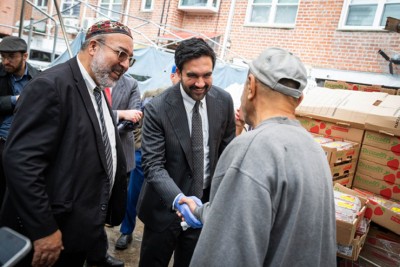
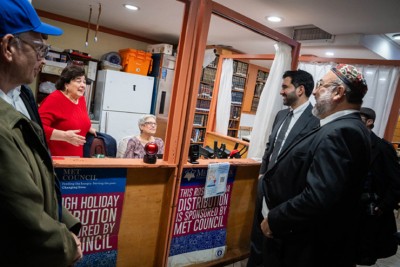
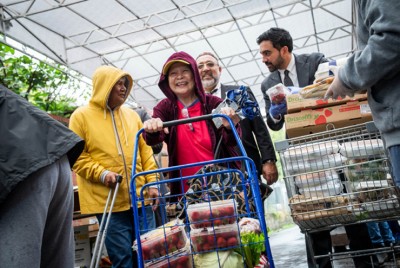
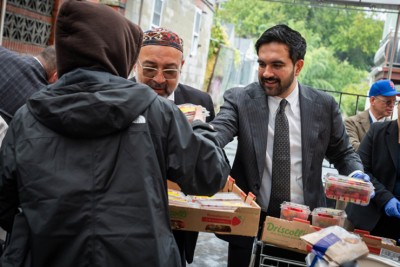
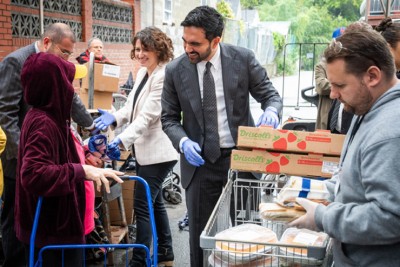
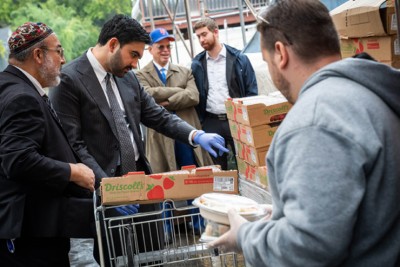
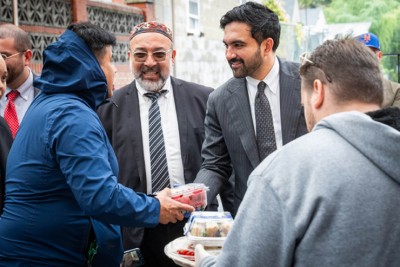
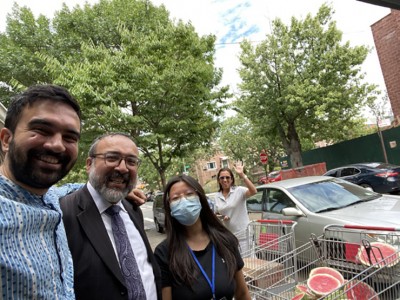
By the time Mayor Zohran Mamdani stepped beneath the canopy outside Kehilat Sephardim, the morning’s distribution was well underway. Boxes of produce had been opened and sorted, and shopping carts waited beside the tables. Volunteers assisted recipients while Rabbi Shlomo Nisanov moved between the staff and the mayor’s party.
Mamdani’s arrival changed who appeared in the photographs, but not the purpose of the morning. Residents had come for groceries, and Kehilat’s volunteers were there to serve them.
That routine was more than three decades in the making. Kehilat opened the pantry around 1990 for Jewish immigrants arriving from the former Soviet Union, many of whom were learning a new language and an unfamiliar system while trying to establish homes in Queens. Food was one need among many. Families also required Jewish schools, Shabbat hospitality, social services and people who could explain where to turn.
At a 2025 communal meeting, Queens’ Bukharian population was estimated at more than 70,000. Many families had become established, but Kehilat continued helping newcomers and other neighbors in need.
Rabbi Nisanov understood that transition personally. He was nine when his family immigrated to Queens in 1980, carrying with them a rabbinic tradition that stretched across generations in Central Asia. Rabbi Nisanov has recalled that his grandfather founded a Bukharian school and became the first Bukharian Jew to receive the Lenin Medal.
After the family arrived in America, Rabbi Nisanov’s father insisted that his children receive a yeshivah education. By 19, Rabbi Nisanov was teaching in Bukharian, Hebrew, Russian and English and had accepted a leadership role at Kehilat Sephardim of Ahavat Achim. Those four languages helped him work with newly arrived parents, their American-raised children and the institutions serving both generations.
Rebbetzin Ora shared that work and once volunteered with Queens’ Tomchei Shabbat. Together, the couple helped immigrants obtain groceries, enroll children in Jewish education, arrange Shabbat hospitality and understand American social-service systems.
Its reach gradually widened beyond the population it was created to serve. Everything distributed remained kosher, but recipients came from many religious and ethnic backgrounds. During Covid, tractor-trailers and pallets of produce became familiar outside Kehilat as demand grew across Queens. Around Pesach, then-Mayor Bill de Blasio called Rabbi Nisanov to recognize the effort.
Mamdani joined the September 28 distribution during Chol HaMoed Sukkot. He greeted recipients, met the staff and put on gloves to hand out groceries. For Rabbi Nisanov, hunger was a practical problem that did not require agreement on every other issue.
There was also a halachic decision behind the visit. Before confirming it, Rabbi Nisanov turned to a well-respected Queens Rav and poseik—a premier halachic authority—whose guidance he follows. The Rav determined that receiving the city’s mayor at a charitable distribution was a chiyuv—an obligation—and that rejecting the request in those circumstances would create a chilul Hashem. Mamdani was coming to observe and assist a charitable program, not address the congregation or participate in a religious service.
For part of the morning, cameras followed the mayor along the food line. Recipients then rolled their carts away, volunteers reset the tables and the next person stepped forward. That rhythm began long before this visit and continued after the mayor left.
By Shabsie Saphirstein
Before The Cameras Arrived At Kehilat The Family And Community Behind A Queens Food Line
Typography
- Smaller Small Medium Big Bigger
- Default Helvetica Segoe Georgia Times
- Reading Mode