


Bruce Blakeman and Hundreds Defy Hate at Massive Queens Rally
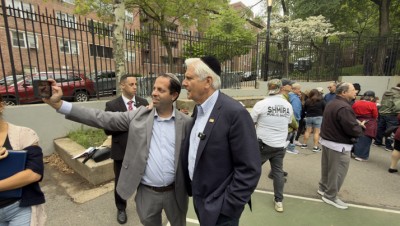
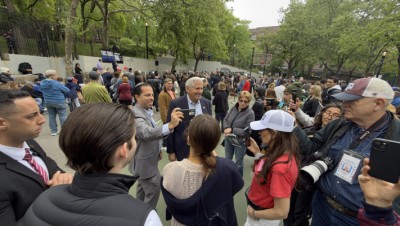
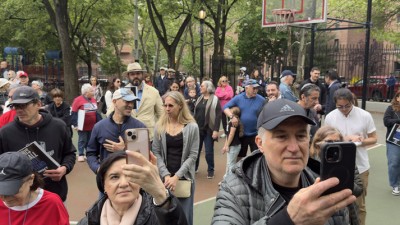
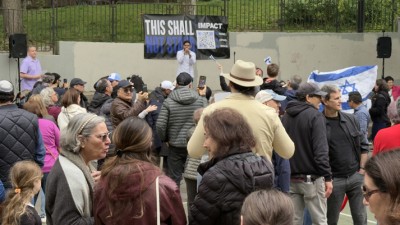
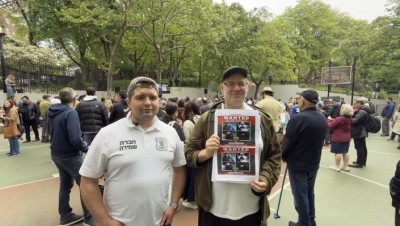
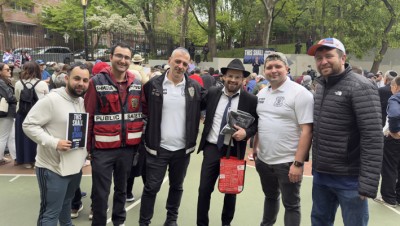
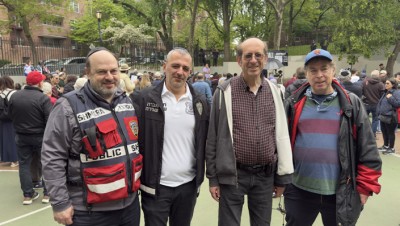
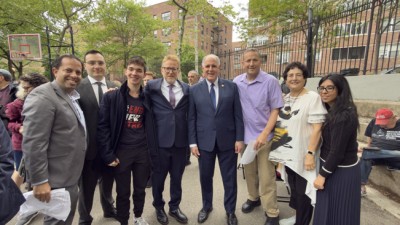
“This shall not stand.” The chant echoed off the trees in Yellowstone Park this past Sunday morning, May 10. On a day usually reserved for quiet Mother’s Day brunches, hundreds of Queens residents stood shoulder to shoulder beneath a banner that transformed a park lawn into a line in the sand. The Rally Against Hate was a direct response to a wave of swastikas and hateful graffiti that recently defaced private homes, a local daycare, and synagogues like Machane Chodosh in Forest Hills and Rego Park. While the vandalism was the catalyst, the presence of major state and local leaders turned the gathering into a powerful platform for political and communal resolve.
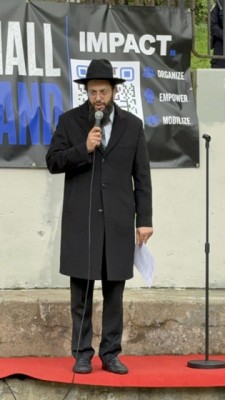
“Hate divides. Unity defines,” the flyer read—a sentiment that set the tone for the morning. Presented by IMPACT (formerly known as Emissary), the rally was a collaborative effort involving End Jew Hatred, EMET Outreach, Chazaq, Queens Shmira, RAJE, and several other partners. The morning opened with music by Shlomo Mash, before Rabbi Yaniv Meirov, CEO of Chazaq, offered an opening invocation calling for strength in a community that has recently been under siege.
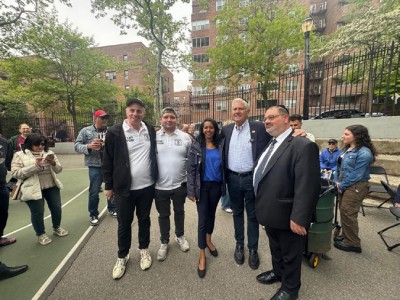
Nassau County Executive Bruce Blakeman, a key figure in the program and a leading voice in the New York State Republican party as the gubernatorial candidate, delivered a resounding address that brought a sharp sense of urgency to the park. Blakeman framed the rise of antisemitism as a direct threat to American values, calling it "un-American" and a violation of the freedom of religion. Standing as a symbol of the Nassau-Queens alliance, he warned that the current climate mirrors the historical loss of rights seen during the Holocaust and the pogroms of the former Soviet Union. He made it clear that the tide of hate crossing county lines requires more than just words; it requires the kind of zero-tolerance leadership he has championed in Nassau.
Daniel Rosen, President and co-founder of IMPACT, reinforced this message of defiance by rooting it in local history. He noted that the graffiti hit close to home, as he grew up attending the local Y where his mother, Judy Rosen, served as president for years. He defined IMPACT as a movement dedicated to "organizing for empowerment" and mobilizing both online and offline. He led the crowd in a rallying cry: “Organize! Mobilize!” and “No more silence! No more fear!”. Aaron Herman, CEO of IMPACT, followed by listing the recent incidents of harassment and vandalism, with the crowd roaring back the same three words: “This shall not stand”. Organizers also noted that while former Assemblymember Dov Hikind was slated to speak, he was unable to attend due to illness.
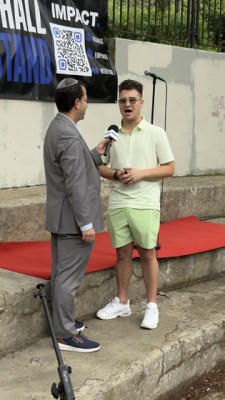
One of the morning’s most electric moments came from comedian and activist Zach Sage Fox. Wearing a large Star of David, Fox took aim at the celebrities who attended the Met Gala—just miles from the swastikas in Queens—choosing to focus on "$30,000 tickets" rather than the rise of Nazism in their own city. He argued that the Jewish community must create its own heroes rather than relying on silent celebrities. “For the first time in Jewish history, we have the ability to pull out our iPhones and shoot our resistance in 4K,” Fox said. “We do not have to be silent”.
Assemblyman David Weprin, representing one of the city's most diverse districts, noted the irony of the attacks in a neighborhood meant to be a model of New York’s promise. He referenced the cowardly targeting of Machane Chodosh and the Rego Park Jewish Center, invoking Hillel's famous words—“If I am not for myself, who will be for me?”—to stress the necessity of this public stand. Jayne Zirkle of The Lawfare Project added to the call for moral clarity, citing the legal action taken after Jewish students at Cooper Union were "barricaded inside a classroom by pro-Hamas activists".
The voices of young activists provided the emotional core of the day. Ariel Akbashev, a junior at Queens College, described how he found himself on a campus battlefield after October 7, refusing to remain on the sidelines after students were physically assaulted. He shared how a simple, non-confrontational conversation with a lead protester caused a crowd of hundreds to disperse within two hours. Hillel Kornwasser, a student at TABC (Torah Academy of Bergen County) in Teaneck and a 16-year-old activist, focused on the loss of innocence for a child seeing a swastika for the first time. He noted that while his peers should be focused on sports, Jewish youth are now forced to ask if it is safe to wear a kippah in public.
Rabbi Moshe Taub of Young Israel of Holliswood-Holliswood Jewish Center shared a sobering personal detail: his own daughter recently asked to be driven around the block rather than walk a short distance alone because she no longer feels safe. He called antisemitism a "metastasizing cancer" and noted a troubling poll showing 25% of young Americans believe the Holocaust is a myth or exaggerated. Council Member James Gennaro connected the local graffiti to a broader "rising tide of anti-Semitism" across the city, including protests where Hezbollah flags were waved outside synagogues. He warned that the "one-way street of violence" directed at Jews is not sustainable and insisted that leaders must condemn these acts without equivocation.
Nassau Legislator Mazi Pilip, standing alongside Blakeman, pointed to Nassau’s recent steps to ban masked intimidation at protests and create "buffer zones" to protect houses of worship. Together with Blakeman, she urged New York City officials to stop offering empty platitudes and start taking the kind of concrete action that restores dignity to Jewish neighborhoods. In a final perspective, 19-year-old Tzvi Steiman offered an invitation to those spreading hate to actually experience a Shabbos or visit a synagogue to see the beauty of the community firsthand before judging it.
As the rally concluded, Daniel Rosen returned to thank the many supporters, including the JCRC, UJA-Federation, and Yaakov Serle of the Queens Jewish Link. As the music of Shlomo Mash once again filled the air, the crowds moved back into the streets of Forest Hills. The message left behind was clear: the graffiti may have been scrubbed away, but the community that rose up to answer it—and the leaders who stood with them—aren't going anywhere. On this Mother’s Day, unity defined the day, and the echo of the morning’s chant remained: This shall not stand.
“This Shall Not Stand”
Typography
- Smaller Small Medium Big Bigger
- Default Helvetica Segoe Georgia Times
- Reading Mode