



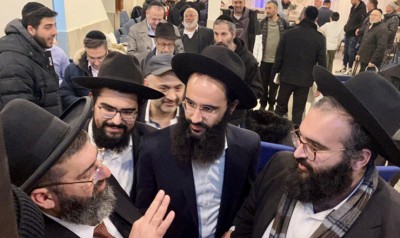
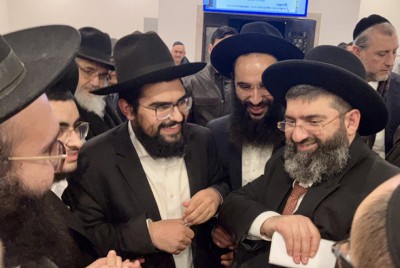
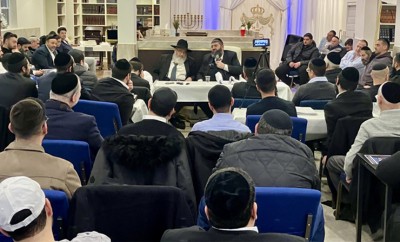
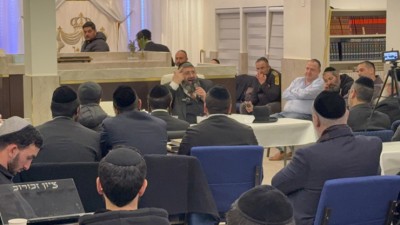

The beit midrash at Shuva Yisrael in Kew Gardens Hills filled on Thursday night, December 25, as men and women from across Queens gathered for an evening that felt urgent, personal, and deeply relevant.
The event welcomed Rabbi Eyal Amrami of Eretz Yisrael, who arrived together with the shul’s mara d’atra, Rabbi Shimon Sadon. From the outset, it was clear this was not a guest appearance detached from the community, but a message delivered with the full presence and support of local rabbinic leadership.
What followed was neither a polished lecture nor a scripted program. It was a long, unfiltered outpouring about faith, struggle, and what Torah is actually meant to do to a person. The shiur stretched late into the night, yet few people moved to leave.
“I’m not saying my own chiddush,” Rabbi Amrami said early on. “It’s written clearly. We just don’t live it.”
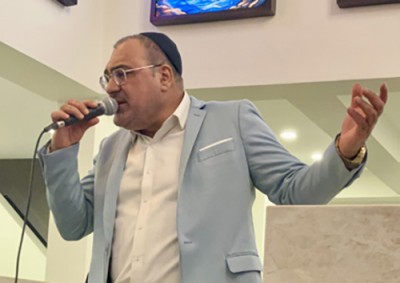
Interspersed throughout the evening were soulful melodies sung by Binyamin Denishman, whose voice led the crowd through Tov Lehodos LaHashem and other familiar niggunim. The singing was not an intermission. It slowed the pace, softened the room, and allowed the message to settle.
Rabbi Amrami’s central claim was direct and uncompromising: the Torah was given primarily to bring a Jew to bitachon — complete trust in Hashem. Not knowledge alone. Not titles. Not even observance by itself.
To explain, the rav spoke in plain, everyday language. When someone buys a car, there is an ikar and a tafel. The engine is the ikar. The color, accessories, and features matter — but no one buys a car because of the cupholders. The same applies to purchasing a home: the neighborhood, the people, and the light come first. Convenience comes later.
Marriage, too, has an ikar: a good heart, yirat Shamayim, loyalty, and compassion. Other qualities are important, but they are not the engine.
“So it is with Torah,” Rabbi Amrami explained.
A person can keep Shabbat, learn Torah constantly, give tzedakah, and raise children in Torah institutions. But when life does not go as planned — when a deal collapses, a child struggles, a relative wrongs someone, or a neighbor causes trouble — the response reveals whether the Torah reached its purpose.
That, Rabbi Amrami stressed, is where bitachon is tested.
Quoting the Vilna Gaon in Even Shleimah, the Rav explained that the Torah was not given to create intellectual giants, but trusting Jews. After 120 years, a person will not only be asked whether Torah was learned, but whether that Torah led to bitachon.
One line Rabbi Amrami repeated almost verbatim cut through the room:
Ikar netinat haTorah l’Yisrael hayah bishvil ha’bitachon.
(The Torah was given so that the bnei Yisrael could live with true bitachon.)
Throughout the shiur, Rabbi Amrami grounded lofty ideas in familiar scenarios. A neighbor calls the police. A business partner does not pay. A brother takes more than a fair share of an inheritance. A child leaves yeshivah at nineteen to work in a pizza shop.
Was it the person who caused the pain — or was it Hashem?
“If you get angry at the messenger,” Rabbi Amrami said, “you’re missing the Sender.”
Citing Chovot HaLevavot, the Rav defined bitachon as menuchat halev — a settled heart. A person who understands that no human being has independent power. Everyone is a messenger. Everything is directed.
“You don’t scream at the electric company worker,” the Rav said. “You know the worker isn’t the boss.”
Moving fluidly between Torah sources and lived experience, Rabbi Amrami shared stories of Rav Huna, whose wine turned to vinegar until a wrong was corrected, and Nachum Ish Gamzu, who declared gam zu l’tovah even when jewels turned to dust — trusting that what appeared disastrous was, in fact, salvation.
The Rav also spoke about weddings where plans unravel, photographers fail to show, and pressure mounts — and how a person with bitachon remains calm, knowing that Hashem is running the event.
One of the most striking moments came when Rabbi Amrami spoke candidly about himself. For decades, the Rav explained, Torah learning and teaching filled every part of life. Rabbi Amrami headed kollelim, taught Shas and Shulchan Aruch, and trained rabbinic judges — yet something was still missing.
At that point, Rabbi Amrami put it plainly.
“Haytah li emunah shel Muslemim — I had faith that was spoken, but not yet lived,” the Rav said, explaining that belief existed on an intellectual level, but had not yet matured into full bitachon. Frustration, blame, and resentment still surfaced when life did not go as planned.
Hashem’s love, Rabbi Amrami emphasized, is not conditional. It does not depend on observance, success, or perfection. Just as a parent does not stop loving a child because the child stumbles, Hashem’s love remains constant — and infinitely greater.
“If a Jew really knew how much Hashem loves him,” Rabbi Amrami said quietly, “the Jew would dance through life.”
The Queens shiur was part of a broader New York–New Jersey visit organized by Chazaq reflecting the growing demand for Rabbi Amrami’s message. The Rav continued on Friday with a lecture at Ohr Torah in North Woodmere; on Motza’ei Shabbat, at Sha’arei Emunah in Cedarhurst, and on Sunday, back in Queens for a jam-packed lecture at Rabbi Yaniv Meirov’s Cong. Charm Circle, before continuing to Brooklyn on Monday and concluding the tour Tuesday night in Toms River, New Jersey.
At each stop, the pattern was the same: extended shiurim, full rooms, and audiences reluctant to leave.
Rabbi Eyal Amrami’s growing popularity is rooted in clarity and honesty. Rather than offering inspirational soundbites, the Rav speaks directly about inner faith, responsibility, and the everyday tests that define emunah in real life. Torah learning, Rabbi Amrami insists, must lead somewhere — to calm, accountability, and trust in Hashem — not merely to greater knowledge.
In an era marked by pressure, uncertainty, and rising anxiety even within observant communities, Rabbi Amrami’s message resonates precisely because it is demanding — and because it offers something rare: peace of mind grounded in bitachon.
As the evening drew to a close, the atmosphere shifted from quiet reflection to open joy. Men rose from their seats and formed circles around the Rav, dancing together in spontaneous celebration. The singing grew stronger, and several times the microphone was handed to Rabbi Amrami himself, who joined the crowd in song, his voice lifting the room even higher. Long after the formal shiur had ended, participants surrounded the Rav to receive brachot, lingering moments that spoke volumes about the connection formed that night. It was a fitting conclusion to an evening that moved seamlessly from teaching to trust, from words to joy — a living expression of bitachon in motion.
By Shabsie Saphirstein
Faith Above All: Rabbi Eyal Amrami On Bitachon In Queens
Typography
- Smaller Small Medium Big Bigger
- Default Helvetica Segoe Georgia Times
- Reading Mode