


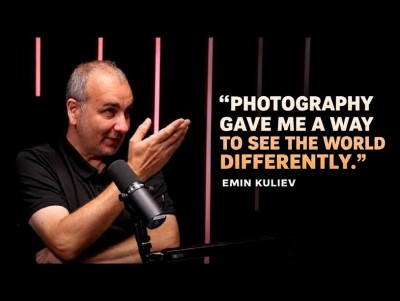
A Life Behind The Camera, The Search For The Moment, And Why Artificial Intelligence May Change What We Believe
Roman Kaykov introduced Emin Kuliev as a man with an unusual eye. Coming from a third-generation photographer, it was not casual praise. Kuliev’s story, however, suggests that the eye came long before the camera.
Kuliev grew up in Baku and remembers spending much of his childhood with his grandmother. When he was perhaps four or five and still unable to read, they visited an apartment where a Jewish family preparing to leave was selling its belongings. Among the books was a volume of the Great Soviet Encyclopedia. Kuliev found images of Rembrandt, Dalí, Leonardo da Vinci, the Impressionists, and artists a Soviet child might otherwise rarely encounter. He could not understand the text, but he understood the pictures.
He returned to that volume for years and drew constantly, often filling the backs of school notebooks while algebra or physics occupied the front. Some subjects came easily; others did not. Teachers lowered their expectations, and Kuliev eventually lowered his own. He sometimes skipped class to sit in movie theaters, watching less for the story than for the moving images. Long before photography became a profession, he was training himself to look.
As a young man, practicality briefly won. Kuliev entered a nuclear medicine program, attracted by the promise of a stable career. During hospital training, however, he found himself watching the clock exactly as he had in school, waiting for one minute to become the next. He imagined spending years that way and changed his major to art, knowing freelance creative work offered far less certainty. The decision reflected a principle he would spend the next quarter-century testing: Work that remains interesting can sustain a life in a way a secure paycheck alone cannot.
A serious car accident in the early 2000s gave photography a larger place in that life. Kuliev spent close to a year severely limited in his movement. Shortly before the accident, he had bought an early digital point-and-shoot camera. Film had frustrated him with its limited exposures and delayed uncertainty; digital photography let him immediately see what worked and try again.
Unable to travel far during recovery, Kuliev photographed what was available, sometimes little more than a leaf on a balcony. With no YouTube tutorials and far fewer online resources, repetition became his teacher. He experimented with light, angles, backgrounds, composition, and people until the camera became less an object he was learning to operate and more a way of thinking.
Weddings followed quickly. In the early years, Kuliev remembers working alone at events with hundreds of guests. He had to anticipate what was about to happen, know where to stand, choose the right lens, and decide whether moving for a better angle was worth risking the moment itself. The moment usually won.
One early wedding permanently changed how he prepared. A camera developed a shutter problem while his backup began the day with only a partial charge. Kuliev conserved power by switching it on for a few frames and shutting it down again, stretching the battery through the final dance. After that, he carried more batteries. The lesson was simple and permanent: Experience often begins with the thing that goes wrong.
Kuliev became increasingly drawn to wedding photojournalism rather than the posed, flash-heavy photographs common at the time. Seeing photographers treat weddings as a series of genuine moments rather than a sequence of people arranged for the camera changed his approach. Nearly a decade working in retail also proved useful. He had learned to read posture, expression, and behavior quickly; at weddings, that instinct helped him anticipate what people might do before they did it.
Today, the same pursuit takes him into the streets of Manhattan. Kuliev often photographs without looking through the viewfinder, watching movement, listening for sound, and noticing how people, color, and objects come together. A monopod allows him to reach angles his body cannot easily follow. He shoots far more than he keeps, because after decades of watching people, familiar gestures repeat themselves. “The further you go, the harder it gets,” he said. For Kuliev, that difficulty is part of what keeps photography interesting.
One of his favorite compliments now contains an irony he could not have imagined when he began. People sometimes look at one of his real street photographs and insist it must have been generated by artificial intelligence. Kuliev takes that as praise: After decades spent training his eye, some viewers cannot understand how an ordinary moment could have been captured that way.
At the same time, he believes AI may disrupt photography more profoundly than any technology before it. Kuliev began experimenting with image generators when distorted hands, broken lettering, and impossible details made the results easy to dismiss. What caught his attention was not how bad the images were, but how quickly those flaws began disappearing.
His prediction is stark. Kuliev believes that within only a few years, generated imagery may become effectively indistinguishable from conventional photography for many uses. “I think three years, and it’s the end,” he told Roman. The forecast is Kuliev’s, not a certainty, and he does not mean that every photographer or every form of photography will disappear. Studio work, food, landscapes, advertising, and portraits strike him as particularly vulnerable because a client may ultimately care more about the final image than whether a camera ever captured it.
Events may last longer because something actually happened in a specific place with recognizable people. Even there, photography has already changed. Where Kuliev once might have been the only person holding a camera, virtually every guest now carries one. During a ceremony or first dance, dozens of phones can capture the same moment from different positions before the professional photographer delivers a single image. Kuliev compares it to arriving at a restaurant after already eating: The food may still be excellent, but the hunger is gone.
The larger concern for Kuliev is not simply whether photographers will continue earning a living. It is whether photographs will continue functioning as evidence. Most people have never personally witnessed the overwhelming majority of events they believe occurred. They encounter wars, protests, politicians, disasters, and distant countries through images and video. Photography became one of the ways reality authenticated itself. What happens when a fabricated photograph becomes visually indistinguishable from an authentic one?
Kuliev already encounters AI-generated portraits he cannot reliably separate from photographs. For someone who has spent decades studying images, that admission carries weight. Photography was once the proof; increasingly, the image itself may need proof.
He demonstrated the speed of the change through another experiment. Kuliev does not speak Bukhori, the Judeo-Persian language of Bukharian Jews, yet he wrote lyrics in Russian, used AI tools to translate and adapt them, and generated music in different styles, including experiments inspired by Shashmaqam and Western classical music. He produced roughly 200 versions before choosing a handful.
His point was not that he had suddenly become a musician. It was that technical barriers once guarded by years of specialized training can now be crossed, or at least approached, by someone entering from another field. Photography already experienced an earlier version of that disruption as cameras became easier, phones became better, and millions of people gained the ability to produce acceptable images without hiring a professional.
Kuliev has adjusted his own expectations accordingly. If someone asks him to photograph an event today, he wants to know that the client consciously chose his work rather than simply needs someone with a camera. He does not want to be interchangeable. After decades in the field, being specifically wanted for how he sees matters more than merely being booked.
Roman eventually asked what would remain if the cameras, lenses, awards, and professional titles disappeared. Kuliev’s answer returned to the beginning of his story: He would still look. Even without a camera, he studies faces, gestures, movement, and the relationships between strangers. Photography trained him to notice.
That is also why Kuliev is skeptical of the word “photographer” when possession of equipment is treated as though it conveys expertise. Owning a knife does not make someone a surgeon, he argued; owning a pen does not make someone a writer. A camera is a tool. What matters is what the person holding it has learned to see.
Kuliev has reached a broader conclusion about work and life as well: The real currency is time. He remembers watching classroom clocks and later hospital clocks, waiting for the minutes to pass. Photography gave him work in which hours could disappear without his noticing. For Kuliev, that difference matters more than the promise of a safe profession he never wanted.
Near the end of the conversation, Roman asked what Kuliev would tell younger people trying to establish themselves creatively. His advice was simple: Stay hungry and do not give up. Kuliev compared it to the familiar story of the frog that falls into cream and keeps kicking until the cream becomes butter. Even when the outcome is uncertain, he believes the struggle itself gives life momentum and meaning.
For a man who once watched the clock one minute at a time, that may be the clearest measure of whether he chose the right path. Twenty-five years later, Emin Kuliev is still searching for the next frame, even as he wonders whether the future will need a camera to create one at all.
ROMAN KAYKOV is president of Kaykov Media and host and senior producer of KAYKOV TV. Through Kaykov TV, Roman sits down with rabbis, educators, business leaders, artists, and community figures for conversations about Jewish life, Bukharian identity, family, culture, faith, business, and community.
Emin Kuliev: What Happens When Photographs Stop Proving Anything?
Typography
- Smaller Small Medium Big Bigger
- Default Helvetica Segoe Georgia Times
- Reading Mode