


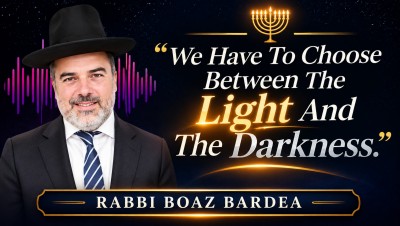
Chazaq Torah Talks – Episode 132
Originally Released December 12, 2023
The Chanukah candles burn for a short time, but Rabbi Boaz Bardea believes their message must remain in a Jewish home throughout the year. The question is not simply whether a family lights the menorah. It is whether children see the values represented by those flames in their parents’ everyday choices.
Speaking with Rabbi Yaniv Meirov on Chazaq’s Torah Talks, Rabbi Bardea explored why the Maccabees fought, how material pleasures can serve a spiritual purpose, and why setbacks need not define a person’s religious journey. Above all, Rabbi Bardea challenged parents to consider what they teach their children through their behavior.
Born and raised in Israel, Rabbi Bardea later came to America to pursue advanced Torah study. Rabbi Bardea received semichah from Rav Dovid Feinstein zt”l and has served as a rav and Rosh Kollel in Brooklyn, including at Congregation Tehilla LeDavid. Rabbi Bardea also leads Kollel Benei Levi, where advanced students study halachah and prepare for rabbinic ordination. During the interview, Rabbi Bardea reported that more than 100 rabbanim had completed his training programs and gone on to serve Jewish communities.
Rabbi Bardea introduced his discussion with a teaching from the Gemara in Kiddushin (32b), which explains the term zaken as zeh shekanah chochmah, one who has acquired wisdom. Material possessions eventually leave their owners, Rabbi Bardea observed, but Torah knowledge becomes part of the person who acquires it. That enduring value helps explain his commitment to transmitting Torah to others.
To understand Chanukah, Rabbi Bardea began by contrasting the threats faced by the Jewish people during Purim and Chanukah. Haman sought their physical destruction. The Greek decrees, as Rabbi Bardea explained, targeted Jewish religious observance and identity, seeking to draw the nation toward a culture whose priorities conflicted with Torah. The Maccabees resisted because the struggle concerned not merely Jewish survival, but the character of Jewish life itself.
Rabbi Bardea acknowledged the beauty of the physical world. Food, comfort, recreation, and material possessions are not inherently objectionable. The distinction lies in whether they remain tools for meaningful living or become life’s purpose. He described Greek culture as elevating physical pleasure and beauty above spiritual obligations, while Torah teaches people to use what Hashem created in His service.
The Chanukah flame illustrates that relationship. Oil and wick are physical materials, yet together they produce light. Similarly, the body requires nourishment and care so that a person can learn Torah, perform mitzvot, and fulfill responsibilities. Physical needs serve a spiritual purpose when they provide the strength to accomplish something meaningful.
The difficulty, Rabbi Bardea explained, is maintaining those priorities in a society that constantly encourages people to seek more.
He recalled seeing an advertisement urging travelers to book their next vacation immediately after leaving an airplane. One experience had barely ended, yet another was already being offered. Rabbi Bardea compared the endless pursuit of material satisfaction to drinking salt water: The more a person drinks, the thirstier he becomes.
Rabbi Meirov raised an important distinction. Judaism encourages enjoyment on Shabbat, including good food and a pleasant atmosphere. Exercise and recreation also have legitimate benefits. Rabbi Bardea agreed. His concern was not enjoyment itself, but allowing pleasure to become the organizing purpose of life. Even a meal or a game can have value when it supports health, relationships, or one’s ability to fulfill responsibilities.
To resist the influence of surrounding culture, Rabbi Bardea urged listeners to maintain a connection to Torah learning and the beit midrash.
He compared that connection to Noach’s ark, which provided refuge during the Flood. The Gemara in Zevachim (113b) discusses how the enormous re’em could survive when it was too large to enter the ark. One explanation describes the tip of its nose being brought inside so it could breathe.
Rabbi Bardea applied the image to people unable to devote extended periods to Torah learning. Even someone who cannot spend hours in a beit midrash can attend a shiur, speak with a rav, or establish a short daily learning session. Maintaining that connection can provide spiritual direction amid competing influences.
But what happens when someone has already gone astray?
Rabbi Meirov asked how a person who feels distant from religious observance can find the strength to begin again.
Rabbi Bardea warned that a setback becomes far more damaging when it leads to despair. He described a dieter who intends to eat one potato chip, gives in to temptation, and then finishes the entire bag because the diet already seems ruined.
That reasoning, Rabbi Bardea observed, makes as little sense as losing a thousand dollars and voluntarily throwing away another thousand. One mistake does not justify abandoning the entire effort.
Spiritual growth, he continued, cannot be judged solely by the final result.
Imagine someone who spends an entire day resisting the temptation to speak lashon hara but eventually falters at night. Another person gives in immediately without attempting to exercise restraint. Both may have committed the same prohibition, yet their efforts were not equivalent. The first person spent hours struggling to do what was right, and that effort retains its value.
Rabbi Bardea contrasted this with an examination, where a student might study for months and receive a low grade while someone else achieves a high score after little preparation. The grade reflects the result, not necessarily the work invested.
In serving Hashem, the effort itself carries significance. The Mishnah in Pirkei Avot (5:23) expresses the principle l’fum tza’ara agra: Reward is commensurate with effort.
A story about a husband searching for pink roses made the lesson personal.
Knowing how much his wife appreciated those flowers, the husband drove to Long Island, only to discover that the florist was closed. He continued to Brooklyn, where the roses had sold out, and then to Queens, where another shop was also closed.
Eventually, he returned home empty-handed.
Would his wife focus only on the missing roses, Rabbi Bardea asked, or recognize the extraordinary effort her husband had made to please her?
The journey itself expressed his love.
Rabbi Bardea compared this relationship to the covenant between Hashem and the Jewish people. A business contract focuses on obligations and results. A covenant involves an enduring relationship in which devotion and sincerity matter. A person should strive to fulfill Hashem’s will, but failure must not become a reason to abandon that commitment.
He also connected the Hebrew word nisayon, a test, with nes, a banner. Through this homiletic comparison, Rabbi Bardea explained that confronting a challenge can elevate a person, even when the struggle is difficult.
The conversation returned to the danger of losing Jewish identity through imitation.
Rabbi Bardea pointed to safeguards established by Chazal to protect Jewish religious distinctiveness, including restrictions concerning certain bread and cooked foods prepared by non-Jews. These laws, discussed in Avodah Zarah, reflect concerns about social relationships and influences that could lead to intermarriage, although their practical applications contain important distinctions.
His broader point was that preserving Jewish identity requires deliberate attention to the environments, relationships, and influences shaping a person’s life.
For another example, Rabbi Bardea turned to Yosef HaTzaddik.
Taken from his father’s home at 17, Yosef rose to a position of extraordinary power in Egypt, surrounded by wealth and values unlike those of Yaakov Avinu’s household. Rabbi Bardea reflected on Yaakov’s concern upon learning that Yosef was still alive. Had his son also preserved the Torah he had learned at home?
According to Rashi on Bereishit (45:27), Yosef’s wagons alluded to eglah arufah, the Torah subject he and Yaakov had studied before their separation. Rabbi Bardea understood the reference as reassurance that Yosef had remained connected to his father’s teachings despite his years in Egypt.
For Yaakov, that spiritual continuity mattered more than Yosef’s wealth or political position.
Rabbi Bardea saw in Yosef’s experience a lesson about Jewish survival through generations of exile. Communities preserved Shabbat, Torah learning, and mitzvot because parents and teachers continued transmitting their traditions to children.
That continuity did not occur automatically.
Each generation made choices that allowed the next to inherit what had been entrusted to it. Rabbi Bardea warned that parents who neglect this responsibility risk weakening a chain extending back thousands of years.
The greatest influence, however, is often not what parents say. It is what their children see.
Rabbi Bardea described children as exceptionally capable imitators. They absorb their parents’ habits, priorities, and reactions. They notice whether a parent makes time for Torah study, how Shabbat is observed, how family members speak to one another, and which activities receive the greatest attention.
Telling children that Torah matters carries less weight when the example before them suggests otherwise.
Rabbi Bardea also asked listeners to consider what enters their homes through screens and electronic devices. A stranger appearing in the living room at two in the morning would immediately alarm a parent. Yet outside messages and values can enter quietly through the material children watch and the digital environments they encounter.
His concern was not technology alone, but whether parents recognize the influences to which their children are being exposed.
This brought Rabbi Bardea back to Chanukah.
The Maccabees resisted a campaign against Jewish religious life. Today’s parents face the daily responsibility of preserving and transmitting the values for which they fought. A home connected to Torah learning, religious observance, and meaningful family relationships provides children with a foundation they can carry into adulthood.
Rabbi Bardea asked parents to picture the future they hoped to see: children establishing Jewish homes, grandchildren continuing the family’s traditions, and succeeding generations remaining connected to Torah.
That future cannot be secured by a speech delivered at the family table decades later. The example must begin now, in the choices children witness each day.
The Chanukah candles eventually go out. Whether their light remains in the home depends on what the family does after the flames disappear.
Rabbi Yaniv Meirov is the mara d’atra of Kehilat Charm Circle in Kew Gardens Hills and serves as Chief Executive Officer of Chazaq. Now 222 episodes strong, Chazaq Torah Talks continues to inspire by showing that Jewish growth and survival are shaped through lived experience, commitment, and connection.
The Main Lesson Of Chanukah: Bringing The Light Of Torah Into Our Homes
Typography
- Smaller Small Medium Big Bigger
- Default Helvetica Segoe Georgia Times
- Reading Mode