


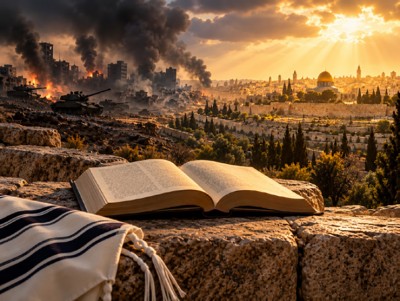
There is a famous Chazal found in the Midrash in Parshat Lech Lecha. It says, “When you see kingdoms agitating each other, look for the footsteps of Moshiach.” The Chofetz Chaim quoted this Midrash when World War I began, calling it the first of the wars of Gog U’Magog, which would have three parts (the two world wars, and perhaps now).
All the countries and nations either joined in or were dragged in. Some joined because of treaties they had signed with other nations, not because they wanted more land or power. The Yalkut Shimoni (Bereishit, remez 72) says that the success of Avraham Avinu came after the war of the four kings against the five kings.
Rav Avigdor Miller zt”l writes in his sefer on Chumash Bereishit that Avraham Avinu was terribly disturbed by what Kedarla’omer, Amrafel (Nimrod), and their partners had introduced to the world: warfare.
Yes, this was a new concept: to force your will upon others and rule over them by force. This is the first mention of war in the Torah, as it says, asu milchamah — they made war, introducing the concept of warfare. The world was still relatively new, only a few hundred years after the Mabul, and everyone was literally related, even though they had already divided into seventy nations. Noach’s son Shem was still alive, together with many others who had seen Noach. Everyone was unique, living with their families, each according to their ways.
Then along came these four kings, who decided to force the five wealthy kings of Sedom, Amorah, and the neighboring kingdoms to pay tribute to them. When they refused to continue paying, Kedarla’omer brought his allies and went on the warpath, not only against the five kings but also against other nations in their path. By capturing Sedom, they captured Lot, Avraham Avinu’s nephew, who had chosen to settle there.
Avraham considered this a direct assault against Hashem! It went against Hashem’s traits of chesed and kindness, upon which the world is built, and which Avraham was trying to emulate and teach. He taught about Hashem’s chesed through the Divine plan and purpose in nature, and emulated it through his own acts of kindness and hospitality. Murder, theft, and other acts associated with warfare are all against the will of Hashem. This is besides violating many of the mitzvot that bnei Noach are required to keep.
War also stems from a denial of Hashem’s involvement in this world. Hashem created everyone and everything, placing everyone where they are supposed to be and giving everyone what they are supposed to receive. To say, “I think things should be different, and I’ll try to get what I want by force, and if necessary, kill for it,” is just the opposite. Jealousy, greed, and a desire for power remove a person from the perfect world Hashem designed, corrupting it through selfishness.
Imagine a father providing each of his children with a portion of something, exactly what he wants and thinks each one should receive. One of the children decides they want more than their share. They gather some friends, promise them rewards, and begin threatening their siblings to give up their shares. They beat and hurt whoever won’t cooperate. Exactly the opposite of what the father wanted!
Avraham Avinu saw war as a massive chillul Hashem. Even worse, it would set a precedent in the world. Therefore, he endangered himself, taking his household — 318 servants and students, chanichei yelidei beito, people educated and raised in his household — to stop the four kings and save Lot.
Rashi brings a Midrash that it meant only his servant Eliezer, who was equal to all 318 servants. Another Midrash identifies Eliezer’s father as Nimrod. He went to battle against his own father, following his beloved master, Avraham. So great was the need to battle against the chillul Hashem.
Now, what was their real target? The Midrash says that their real target was Avraham Avinu. They went after Lot to draw out Avraham. Even though it appeared that there was a whole story leading to this war, with cause and effect — servitude, rebellion, and so on — the entire plan was to get Avraham Avinu.
Amrafel (Nimrod) was an old archenemy of Avraham. The Yalkut Shimoni says that Nimrod honored Avraham after he survived being thrown into the fire in Ur Kasdim. He was so impressed that he gave his son Eliezer to be Avraham’s servant. That honor and respect did not last.
Why did they want to get rid of Avraham? He was teaching about Hashem. Why was that so bad?
Avraham Avinu was a major threat to them. After the Mabul and the dispersion around the world by the Dor HaFlagah, they were very angry with Hashem. He had foiled all their plans, getting involved in life down here on Earth! Stay up there in Heaven, and we’ll run things our way. We don’t need You!
But now there was a representative, an ambassador here, teaching everyone about You. Well, we can’t get to You, but we can try to kill him! That is why they wanted to get rid of Avraham Avinu. He was a threat to their desire to be separate from Hashem, and they wanted to take out their anger on him.
Let’s return to the beginning. “When you see kingdoms agitating each other, look for the footsteps of Moshiach.” Why are they starting up with each other? There’s something disturbing them, and they’re not sure what it is.
Really, it is their malach above who senses something big coming — Moshiach. That is bothering them, but they don’t understand or know what to do about it. They sense something coming that will end their rule and power, and they don’t want that to happen. So they aggravate each other, but they really want to get Hashem’s ambassadors in this world, klal Yisrael. And it will be klal Yisrael who will emerge from all this with the greatest salvation!
All of history has been and is being directed by Hashem. Everything is in His master plan. There is no one who can change it, even though they would want to. History is indeed His story — Hashem’s story. And it is us, klal Yisrael, with our loyalty and trust in Hashem, who will get through it successfully.
What will happen, only Hashem knows. With all the crazy events going on — Israeli elections, midterm elections, unrest in France and elsewhere, continuing wars in Ukraine, Yemen, and Iran, and the constant threats against Eretz Yisrael — we need to strengthen our emunah and bitachon in Hashem. We can do so by focusing on and recognizing His constant kindness to us, seeing all the open miracles He has recently done for us, and remaining loyal to the Torah and mitzvot.
In addition, Hashem has a great debt to repay to the month of Cheshvan! (Yalkut Shimoni, Melachim 184.) The first Beit HaMikdash was completed in Cheshvan, but the chanukat habayit was delayed until later. Cheshvan complained, “I lost a major Yom Tov!” Hashem promised to repay it.
Just as with the Mishkan, which was completed in Kislev but whose inauguration was delayed, and Kislev was repaid with the Chanukah miracle, so too, Cheshvan will be repaid with great miracles, a great Yom Tov! May it be this year!
May we be zoche to greet Moshiach very soon!
R’ Dovi Chaitovsky lives with his family in Eretz Yisrael, where he has the zechut to learn and teach Torah. His divrei Torah often draw from the shiurim of R’ Yisrael Altusky shlit”a of Yeshiva Torah Ore, available on www.KolHalashon.com. In Connecting The Dots: Torah Thoughts For Modern Times, he uses Torah sources, stories, parables, and current events to connect timeless Torah wisdom with contemporary challenges and encourage practical growth.
History — His Story
Typography
- Smaller Small Medium Big Bigger
- Default Helvetica Segoe Georgia Times
- Reading Mode