


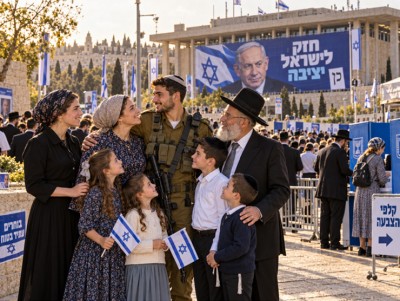
For Jewish families in Queens with parents, children, siblings, and grandchildren living in Israel, the coming election is not a distant political contest. Decisions made in Jerusalem can affect a son serving in the IDF, a student learning in a yeshivah, a family struggling with housing costs, or relatives wondering what the next few years will bring.
Israelis vote Tuesday, October 27, to elect the 26th Knesset, the 120-member parliament whose composition will determine whether Prime Minister Benjamin Netanyahu can form another governing coalition or whether his opponents can assemble an alternative majority. Because Israel elects party lists rather than a prime minister directly, the results may not yield a government immediately.
The election follows three years marked by the October 7, 2023, Hamas attacks, war, questions of military preparedness and political accountability, and continuing arguments over Israel's security. For many voters, the central issue is who can protect the country and restore confidence in its leadership. Other Israelis see the election as an opportunity to change course after a prolonged period of division.
Military service is among the most difficult issues facing the next government. Debates over the enlistment of chareidi men have strained relationships between religious parties and other coalition partners. Families connected to the yeshivah world are following those discussions closely, but positions within Orthodox society are not uniform.
Economic pressures are equally immediate. Housing, household expenses, the demands of military spending, and the strength of Israel's high-tech economy will help determine what kind of future young families can build. The Bank of Israel's decisions and the country's fiscal outlook form part of the political conversation, even if they do not fit neatly into party slogans.
Netanyahu's Likud is competing with parties seeking to replace him, including centrist and right-of-center challengers. Smaller factions, among them Shas, United Torah Judaism, and Otzma Yehudit, could prove decisive in coalition negotiations. A party's seat total matters, but so does its willingness to join a government under particular conditions.
For the Bukharian Jewish community, whose family connections often extend from Queens to cities throughout Israel, the election brings familiar questions into sharp focus: safety, opportunities for young families, preserving Jewish education, and keeping loved ones close even when they live thousands of miles apart. Those concerns do not produce a single political preference, but they explain why conversations about the election can be personal.
After polls close, attention will turn to the distribution of seats and the efforts to assemble a coalition of at least 61 members. The Israel Democracy Institute lists November 4 as the date for publication of official results. Between election night and the formation of a government, the political picture may change repeatedly.
For families watching from Queens, the campaign is about more than choosing a leader. It is about the security and daily lives of people they love, and the future of a country with which they maintain an enduring connection.
Israel Votes October 27 As Security, Army Service, And The Economy Shape A Defining
Typography
- Smaller Small Medium Big Bigger
- Default Helvetica Segoe Georgia Times
- Reading Mode