


The MTA has begun design and environmental review and has committed half the estimated project cost in its capital plan. Construction funding, a final design and an opening date remain unsettled.
For Queens residents traveling between Jackson Heights, Ridgewood and Brooklyn, a trip that looks short on a map can involve transfers, detours or a long bus ride. The proposed Interborough Express could offer a direct rail connection between the boroughs, bypassing Manhattan.
The project has advanced beyond an idea, but it is not close to opening. The MTA has hired a design team, begun preliminary engineering and started environmental review. At the same time, it has not set an opening date, and only half the estimated project cost is included in its current capital plan.
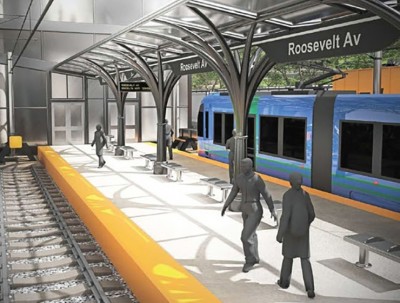
The proposed 14-mile line would use an existing freight rail corridor and include 18 accessible stations. Five are planned in Queens: Roosevelt Avenue, Grand Avenue, Eliot Avenue, Metropolitan Avenue and Myrtle Avenue. The MTA estimates a 32-minute end-to-end trip and projects 160,000 weekday riders. Those are projections; station designs and entrances are still being developed.
The project’s clearest evidence of progress is the work already underway. In 2025, the MTA Board approved a preliminary-design contract with Jacobs and HDR worth up to $165.98 million, with an additional option of up to $8.62 million. The contract gives the team 24 months to develop preliminary designs and prepare procurement documents for construction. The MTA has also begun its environmental review, with a draft environmental impact statement expected for public review in late 2026.
That design contract is not a construction contract, and it does not mean the full project is funded. The current estimated cost is $5.5 billion. The MTA’s 2025–2029 Capital Plan includes $2.75 billion for the IBX—half the estimate. The state and MTA have also identified money for design work, and a federal grant is supporting a corridor assessment. Those steps pay for planning and move the project forward; they do not cover the full price of building the line.
The schedule is also still open. The design phase is expected to run through 2027, while the MTA says the timing of later phases will depend on the final design and available funding. Construction would require major work, including bridge rehabilitation or replacement, utility relocation, freight-track changes, new tunnels and stations. The MTA has not announced a date for service to begin. In practical terms, residents should think of this as a project advancing through planning—not a train service arriving soon.
For Queens, the planned stations would serve Jackson Heights, Elmhurst, Woodside, Maspeth, Middle Village, Ridgewood and Glendale. The Roosevelt Avenue station is proposed near 72nd Street, with connections to subway lines, buses and the LIRR at Woodside. Other proposed stops include Grand Avenue near 79th Street, Eliot Avenue near 75th Street, Metropolitan Avenue and Myrtle Avenue near Fresh Pond Road.
Residents’ response has been divided. Some see the line as a long-needed way to reach jobs, schools, medical care and family in Brooklyn without traveling through Manhattan. Others—particularly near the proposed Grand and Eliot Avenue stations—have raised concerns about traffic, noise, construction, trees and possible effects on homes. At a September protest near Grand Avenue, residents also questioned whether the area’s existing streets and bus routes could handle additional activity.
Some answers will have to wait for the environmental review and more detailed design. The MTA acknowledges that some full or partial property acquisitions will be necessary, though it says it is working to limit residential impacts. It is studying noise, air quality, stormwater and power needs; the agency says the IBX is not expected to draw electricity from residents’ household supply. The draft environmental statement is expected to detail impacts and possible mitigation, and will open a public comment period.
So the IBX is not simply a promise with no work behind it: the MTA has authorized a substantial design contract, begun environmental review and placed $2.75 billion in its capital plan. But the other half of the projected cost, construction decisions and an opening schedule remain ahead. For Queens residents, the next meaningful test will be whether the MTA’s review answers local questions—and whether funding and approvals carry the line from preliminary plans to construction.
Queens’ Interborough Express Is More Than Talk—But Still Years From Service
Typography
- Smaller Small Medium Big Bigger
- Default Helvetica Segoe Georgia Times
- Reading Mode