


More than two months after four Jewish bar associations challenged Mayor Zohran Mamdani over the absence of Jewish representation on his Mayor’s Advisory Committee on the Judiciary, the controversy has not gone away. New public comments from retired Appellate Division Justice John Leventhal have instead sharpened the question of how a panel City Hall described as representative of New York’s legal profession ended up without a Jewish member that the organizations could identify.
City Hall announced 18 appointees in July. Together with Chairman Ali Najmi, whom Mamdani appointed in January, they form the 19-member committee responsible for screening and recommending candidates for mayoral judicial appointments.
The administration introduced the panel as part of an effort to make judicial selection more inclusive and transparent. Mamdani said the committee would help ensure that the judicial system “reflects the city it serves,” while Chief Counsel Ramzi Kassem called its members a “truly representative cross-section” of New York City’s legal profession.
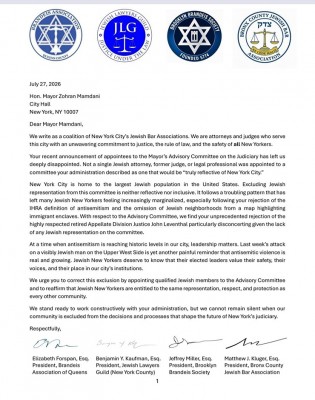
Four organizations — the Brandeis Association of Queens, Jewish Lawyers Guild of New York County, Brooklyn Brandeis Society, and Bronx County Jewish Bar Association — objected in a July 27 letter, saying they could not identify a single Jewish attorney, former judge, or legal professional among the members. They urged Mamdani to appoint qualified Jewish members.
The dispute gained new life in September when Leventhal spoke publicly about his rejection from the committee. Chief Judge Rowan Wilson had nominated the retired appellate justice, but the Mamdani administration declined to approve him.
In a September 17 NY1 interview, Leventhal called the administration’s explanation “hypocritical” and a “pretext,” saying his exclusion “smacks of antisemitism.”
Kassem rejected that implication but did not question Leventhal’s credentials. In fact, he called him an “eminently qualified jurist.”
Kassem said City Hall objected to Leventhal’s paid appellate representation of Ghislaine Maxwell because the administration wanted committee members without financial ties to associates of Jeffrey Epstein. He distinguished that from his own pro bono representation of incarcerated individuals.
The fuller explanation answers why City Hall says it rejected Leventhal. It does not answer why another qualified Jewish legal professional was not appointed instead.
That distinction matters because the controversy was never simply about whether Leventhal deserved a seat. Executive Order 6 directs that committee membership reflect New York City’s “cosmopolitan population” and specifically includes creed among the characteristics contemplated by that mandate.
City Hall has offered evidence that Jewish attorneys are not being excluded from the broader judicial process. Kassem noted that four of the 12 judges Mamdani appointed or reappointed in January identify as Jewish, and Mamdani has said Jewish judges will continue to be appointed because they reflect New York’s population.
Corporation Counsel Steven Banks, who is Jewish, also participates later in the judicial-selection process. Executive Order 6 provides for consultation among the committee chair, chief counsel, and corporation counsel regarding judicial appointments. Banks, however, is not one of the 19 committee members who screen candidates and recommend who advances.
The administration has also made changes that deserve recognition. It restored the New York City Bar Association’s independent role in reviewing judicial candidates after the previous administration ended the longstanding arrangement. The committee has since published its first public code of conduct, setting rules governing impartiality, conflicts of interest, disclosures, and recusals.
Those reforms strengthen the process. They also leave the original question intact.
More than two months after the four Jewish bar associations raised their objection, City Hall’s publicly announced committee remains the same. The administration has explained why it did not want Leventhal, pointed to Jewish judges Mamdani has appointed or reappointed, and highlighted a broader process in which Banks plays a role. What it has not explained is how the 19-member committee itself ended up without an identifiable Jewish legal professional.
That is not an argument that every government panel must mirror the city according to a religious formula, nor does the committee’s composition alone prove deliberate discrimination. But the standard at issue came from City Hall itself: an inclusive process, a committee reflective of New York, and a “truly representative cross-section” of its legal profession.
New York’s Jewish legal community has produced generations of judges, prosecutors, defense attorneys, professors, public-interest lawyers, and leaders of the bar. Against that backdrop, its absence from this committee remains difficult to understand.
If Jewish New Yorkers should see themselves reflected on the bench — and Mamdani has said they should — the question remains why that same principle did not extend to the committee helping determine who gets there.
New Details Renew Questions Over Mamdani’s Judiciary Panel
Typography
- Smaller Small Medium Big Bigger
- Default Helvetica Segoe Georgia Times
- Reading Mode