


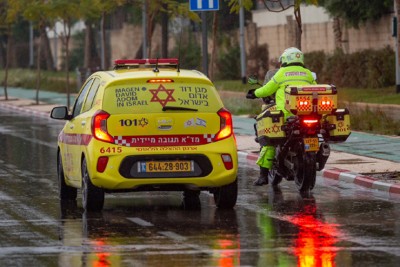
As Israel prepares to welcome the new year, Magen David Adom has released its annual “Year in Numbers,” offering a sweeping picture of an organization that rarely stops moving. During 5786, MDA emergency teams were dispatched 1,911,412 times across Israel — an average of one dispatch every 16.5 seconds. Its 101 Emergency Call Center received 2,020,218 calls, or one every 15.9 seconds, while maintaining an average call-response time of two seconds or less.
Those figures tell only part of the story. Now marking 96 years of activity, MDA spent the past year responding to everyday medical emergencies while simultaneously maintaining its capabilities during war and periods of heightened security. Approximately 39,200 volunteers, employees, national-service participants, and civil-service members serve with the organization, including some 16,500 youth volunteers, while another 18,000 Life Guardians, known as Ne’emanei Haim, are active within its network. Together, MDA volunteers contributed more than 6.3 million hours of service during 5786, with volunteers ranging in age from 14 to 92.
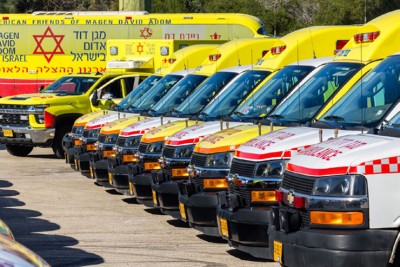
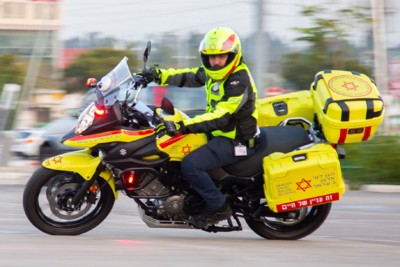
That enormous human network is backed by an equally broad physical presence. MDA operates 213 stations and dispatch points throughout Israel and deploys thousands of ambulances, mobile intensive care units, motorcycles, rapid-response vehicles, and specialized emergency vehicles. Its fleet includes 275 rapid-response vehicles, 652 motorcycles, 27 mass-casualty incident vehicles, five intensive-care buses, and more than 100 ambulances, MICUs, and command vehicles with ballistic protection. Specialized vehicles allow teams to continue reaching patients under circumstances in which conventional ambulances may not be enough.
MDA’s reach also extends well beyond Israel’s roads. An intensive-care sea ambulance operates on the Sea of Galilee, while another sea ambulance serves the waters off Eilat; together, they were dispatched to 153 incidents during the year. In cooperation with Hatzalah Air and Brook Aviation, MDA also operates five helicopters equipped for intensive care, which treated and evacuated 264 patients and injured individuals to hospitals across Israel.
The scope of the need becomes clearer in the individual categories behind the overall dispatch figure. MDA EMTs and paramedics treated 67,624 people injured in road accidents during 5786. During the current bathing season, teams have so far treated 229 adults and children rescued following drowning incidents in seas, swimming pools, and other bodies of water. MDA personnel also transported 18,727 pregnant women to hospitals, including 1,399 women who gave birth with the assistance of MDA teams either at home or while en route. A program that dispatches professional on-call midwives alongside mobile intensive care units continued to expand, with 97 midwives joining during the year and assisting teams in dozens of obstetric emergencies.
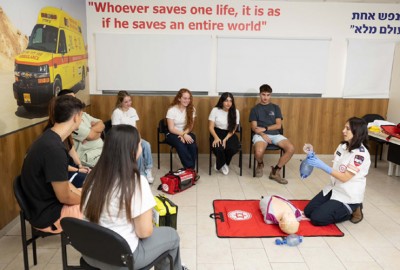
At the same time, MDA continued working to ensure that lifesaving care does not begin only when an ambulance arrives. Approximately 500,000 men and women completed CPR and first-aid training through more than 17,000 courses held throughout Israel during the past year. Thousands more received free first-aid and emergency building-responder training in bomb shelters and protected spaces during the ongoing wartime period.
That emphasis on community preparedness has become particularly important since October 7, 2023. Through Project Magen, which was developed from lessons learned following the attacks, MDA has trained 17,804 civilians — including members of local security squads, municipal employees, inspectors, doctors, and paramedics — to provide initial medical treatment when professional emergency crews cannot immediately reach a community. Participants are equipped with medical supplies so they can respond during war, terrorist attacks, natural disasters, or other emergencies that may temporarily cut communities off from outside assistance.
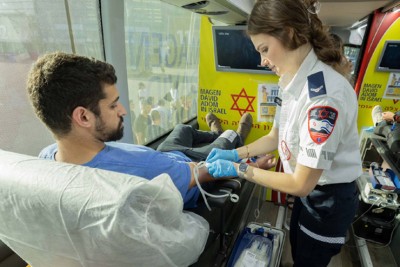
Beyond emergency response, MDA’s work touches Israel’s medical system every day through its blood services. During 5786, MDA collected 281,917 blood units at thousands of drives held in public spaces, schools, workplaces, IDF bases, blood-donation centers, and other locations. More than 46,000 people were first-time donors. The donated blood was tested at MDA’s protected blood-services facility at its headquarters in Ramla before being supplied to hospitals and the IDF.
Another less visible but deeply consequential part of the organization’s work is its National Human Milk Bank, which supplied approximately 5,700 liters of breast milk during the year to premature infants in neonatal intensive care units, newborns in hospitals, and medically vulnerable babies at home. Approximately 370 new milk donors joined the program during the year. In certain circumstances, the bank also supplied milk to infants whose mothers died after childbirth.
Preparing for the next emergency remains a constant part of MDA’s mission. Teams participated in 485 exercises during 5786 involving ambulances, mobile intensive-care units, motorcycles, mass-casualty vehicles, ATVs, helicopters, command centers, and other equipment. MDA also installed another 128 automated external defibrillators in public spaces across 45 communities. Since launching its public AED placement project, the organization has installed 2,036 devices in hundreds of communities, in addition to more than 600 AEDs placed in synagogues in Jerusalem and other cities.
MDA Director General Eli Bin credited the organization’s tens of thousands of volunteers and employees with maintaining that vast operation under difficult circumstances, including while teams worked under fire. He noted that MDA personnel served Israel’s residents day and night, by air, sea, and land, throughout Shabbat, holidays, summer, and winter, and pledged that the organization would continue strengthening its lifesaving capabilities in 5787.
Taken together, the statistics provide a remarkable portrait of the breadth of MDA’s work, but behind each number is an individual moment of need: a family calling 101, an accident victim awaiting an ambulance, a woman giving birth, a critically ill patient being flown to a hospital, or a blood unit reaching someone whose life depends upon it. Nearly two million dispatches in a single year represent nearly two million times that Magen David Adom was called upon to respond — and, as 5787 begins, that lifesaving work continues without pause.
Magen David Adom Marks 5786 With Nearly 1.9 Million Emergency Dispatches
Typography
- Smaller Small Medium Big Bigger
- Default Helvetica Segoe Georgia Times
- Reading Mode