


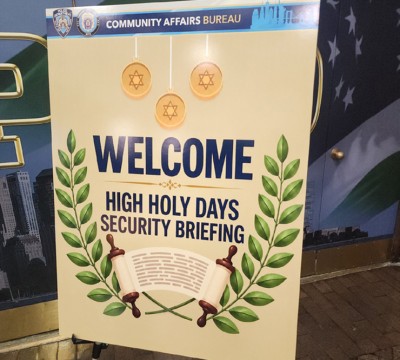
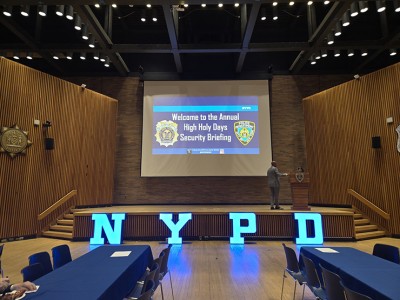
Jewish community leaders, askanim, law enforcement officials, and clergy from across New York City gathered at One Police Plaza for the NYPD’s annual High Holy Days Security Briefing, where department leadership detailed an expanded security operation surrounding Rosh Hashanah, Yom Kippur, and Jewish institutions throughout the five boroughs. This year’s gathering came amid a particularly sensitive security environment, as antisemitic incidents continue to account for more than half of all confirmed hate crimes in New York City and events overseas are being closely monitored for potential repercussions at home. Yet the evening was not defined solely by security concerns. From the opening strains of the national anthem to the sound of the shofar, the program reflected the close relationship between the NYPD and the diverse Jewish communities it serves.
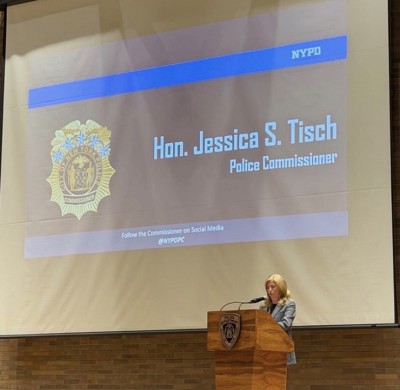
A video presentation opened the evening with a message reflecting the mission of New York’s police officers: defending the defenseless, aiding the injured, protecting liberty, and holding together the fabric of the city. Following the presentation of the colors, international Jewish recording artist Yoni Z once again led the gathering in “The Star-Spangled Banner,” filling the auditorium at One Police Plaza before Police Commissioner Jessica S. Tisch took the podium.
Tisch: Security So Jews Can Focus On Prayer
Commissioner Tisch approached the briefing not only as the leader of the nation’s largest police department, but also, as she emphasized, as a Jewish New Yorker preparing for the Yomim Nora’im herself. “We are fast approaching Rosh Hashanah and then Yom Kippur,” Tisch began, describing the period as one of reflection and repentance, but also of renewal and hope. Tisch then invoked a striking passage from the Gemara in Maseches Shabbos, which lists among the questions a person is asked before the Heavenly Court: Tzipisa l’yeshuah? — did you anticipate redemption? “For all the challenges facing Jewish people today, we cannot allow ourselves to be mired in the past or resigned to the present,” Tisch said. “In these days of atonement, we look to the horizon, working to improve ourselves, strengthen the bonds of our community, and build a better world.” Through teshuvah, tefillah, and tzedakah, she said, Jews continue to yearn for that redemption and work to bring it closer.
The commissioner then turned to the reason so many Jewish leaders had assembled at Police Headquarters: the security environment confronting Jewish New Yorkers. Through the first eight months of 2026, confirmed hate crimes across New York City increased 16 percent, while confirmed antisemitic hate crimes rose 9 percent. According to figures cited by the Times of Israel, 229 confirmed antisemitic hate crimes accounted for 54 percent of all confirmed hate crimes citywide, even though Jews comprise approximately 10 percent of the city’s population. Tisch stressed that those figures represent real incidents affecting Jewish New Yorkers. She recalled recently standing inside Central Synagogue after an individual disrupted Shabbos services and assaulted a congregant and a member of the synagogue’s security team. She also cited the stabbing of a Jewish man outside a synagogue on Manhattan’s Upper West Side and a vehicle deliberately driven into Chabad-Lubavitch headquarters in Brooklyn. The NYPD’s intelligence professionals, Tisch added, have tracked threats and helped disrupt alleged plots directed at Jewish institutions in the city.
Together, she said, these incidents have forced Jewish New Yorkers to consider security at times that should instead be devoted to prayer, family, and community. Still, Tisch delivered an important reassurance: the NYPD was aware of no specific credible threat directed at High Holy Day observances in New York City. The absence of a specific threat, however, does not diminish the department’s vigilance. The NYPD Intelligence and Counterterrorism Bureau continues monitoring developments both domestically and around the world, working with federal, state, local, and international partners to identify emerging threats and quickly bring relevant intelligence back to New York. The Hate Crimes Task Force, meanwhile, continues investigating antisemitic incidents and pursuing those responsible.
An Expanded High Holiday Deployment
The NYPD’s operational plans for the High Holidays were already in place by the time of the briefing. Jewish New Yorkers will see an increased police presence around shuls, yeshivos, schools, and other sensitive locations throughout all five boroughs, including additional uniformed foot posts and dedicated house-of-worship vehicles. Precinct commanders and Community Affairs officers have been working directly with rabbanim, institutional leaders, and security personnel so that individual security plans account for the needs and circumstances of each community. Other layers of protection will deliberately remain unseen. “There will also be resources protecting you that you will not see,” Tisch said, explaining that intelligence personnel would continue monitoring threats throughout the holiday period while counterterrorism resources are positioned where they can provide the greatest protection.
Tisch placed particular emphasis on the relationships between local Jewish institutions and the NYPD. Those relationships, she explained, allow concerns to reach police quickly, help commanders understand what individual neighborhoods are experiencing, and allow resources to be deployed where they will make the greatest difference. “Please keep talking to us,” Tisch urged. “If something concerns you, tell us.” Suspicious activity near a shul, school, or communal institution should be reported rather than dismissed on the assumption that someone else has already contacted police. “What you share with us can make a real difference,” she said.
The commissioner then made perhaps the evening’s most personal commitment. “I am standing here tonight as your police commissioner, but also as a Jewish New Yorker who understands what these days mean and what it means for this community to enter them at a moment like this.” The purpose of the extensive security operation, Tisch explained, is ultimately quite simple: Jewish New Yorkers should be able to enter a shul thinking about davening rather than calculating the danger of being there. Parents should be able to send their children to school, families should be able to gather, and Jews should be able to observe traditions carried through thousands of years without wondering whether doing so makes them targets.
Nearly 35,000 members of the NYPD stand behind that commitment, Tisch said, together with the department’s Hate Crimes Task Force and its intelligence and counterterrorism professionals. The department cannot promise that hatred will disappear, she acknowledged, but it can remain vigilant, investigate threats, pursue those who target the Jewish community, and continually adapt its security posture. “So, as you enter the new year, I hope you can give your attention to what these days are meant to hold,” Tisch concluded. “To your faith, your family, the year behind you, and the promise of the year ahead.”
Intelligence From Around The World
Following Tisch’s remarks, senior members of the NYPD provided a more detailed intelligence and security briefing. The presentations included representatives of the department’s Intelligence and Counterterrorism Bureau, research operations, and Hate Crimes Task Force, including Kelly Foy and Captain Berkim Beraj. Officials described an intelligence network that extends far beyond New York City. The NYPD continually examines developments around the world, sharing and receiving information through relationships with domestic and international law enforcement agencies and determining whether overseas events may carry implications for New Yorkers.
The intelligence picture has evolved considerably since September 11, 2001. Threats no longer necessarily originate with a large, centrally organized terrorist group. Authorities must also consider individuals radicalized online, lone actors, rapidly changing international developments, and threats emerging from a wide range of ideologies. Information gathered overseas is analyzed with a central question in mind: what, if anything, does it mean for New York? That worldwide intelligence capability has particular relevance for the Jewish community, where developments in Israel and elsewhere can quickly produce heightened rhetoric, demonstrations, threats, or violence thousands of miles away. Commissioner Tisch said the department has already “amped up” its deployments amid the current international situation, while reiterating that no specific credible High Holiday threat had been identified.
NYPD Shomrim President Addresses Gathering
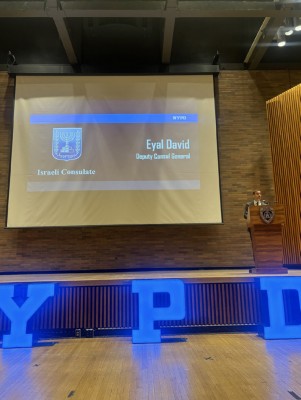
Detective Josh Zucker, president of the NYPD Shomrim Society, also addressed the gathering, representing the Jewish members of the department and the longstanding relationship between Jewish New Yorkers and the NYPD. The Shomrim Society, founded more than a century ago, serves Jewish members of the New York City Police Department while maintaining strong connections with Jewish communities throughout the city. Zucker’s participation carried particular resonance at a briefing where Jewish officers, NYPD leadership, rabbanim, communal representatives, and volunteer public-safety organizations came together around a shared concern. Also addressing the gathering was Eyal David, Deputy Consul General of Israel in New York, representing the Consulate General of Israel.
For Queens, those relationships are particularly important. Kew Gardens Hills, Hillcrest, Fresh Meadows, Jamaica Estates, Forest Hills, Rego Park, and neighboring communities contain a dense network of shuls, yeshivos, schools, and Jewish organizations. Local precincts, Community Affairs officers, institutional security personnel, and volunteer safety organizations maintain regular communication regarding concerns within these communities.
A Shofar Sounds At One Police Plaza
The program also offered a distinctly Jewish moment as Rabbi Manes Kogan, Jewish chaplain and Spiritual Leader of Hillcrest Jewish Center, addressed the gathering. Rabbi Kogan noted the custom of sounding the shofar each morning during Elul. With daylight still remaining, the Queens Rav raised a shofar before the assembled police brass and communal leadership and sounded its calls through One Police Plaza. Rabbi Kogan then offered a blessing for those gathered and their families: a year of peace and contentment, joy and plenty, meaning and hope — and a good and sweet new year. Yoni Z later returned to lead those assembled in “G-d Bless America,” bringing the ceremonial portion of the annual gathering to a close.
The patriotic opening and conclusion, with the sound of the shofar between them, captured much of what the evening represented: Jewish New Yorkers preparing for their holiest days while standing alongside the men and women charged with protecting their ability to observe them freely. For the hundreds of thousands of Jewish New Yorkers who will walk to shul, gather for tefillah, and spend the Yomim Nora’im with family and community, much of the NYPD’s High Holiday security operation will be plainly visible, while other elements intentionally will not be. The message from One Police Plaza was one of vigilance without panic. No specific credible threat had been identified, but in an environment of persistent antisemitism and rapidly changing threats around the world, the department was taking no chances.
Tisch’s message ultimately returned the gathering to the purpose behind all of those preparations. Security is not an end in itself. It is intended to allow Jewish New Yorkers to enter the new year focused not on fear, but on teshuvah, tefillah, family, community, and hope for the year ahead.
By Shabsie Saphirstein
NYPD High Holiday Briefing Pledges Heightened Security Across New York City
Typography
- Smaller Small Medium Big Bigger
- Default Helvetica Segoe Georgia Times
- Reading Mode