


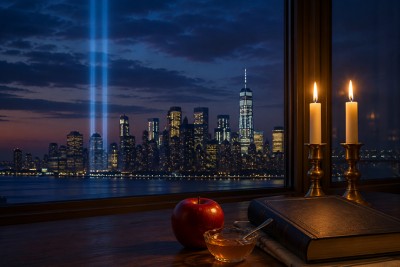
On Friday, September 11, New Yorkers will mark 25 years since the terrorist attacks that took 2,977 lives and altered the city forever. As the commemorations conclude and the sun begins to set, Jewish families will light candles and welcome Rosh Hashanah, with the first day of the new year falling on Shabbat.
The convergence places two very different forms of remembrance alongside one another. September 11 calls the city back to a morning of devastation, heroism and unity. Rosh Hashanah asks every Jew to examine the year that has passed, accept the sovereignty of Hashem and enter the new year with humility, responsibility and hope.
At the National September 11 Memorial in Lower Manhattan, relatives will read the names of those killed in the 2001 attacks and the 1993 World Trade Center bombing. Moments of silence will mark when the planes struck, when the towers fell, the attacks on the Pentagon and Flight 93, and those who later died from illnesses connected to the rescue and recovery effort. For the first time, the ceremony will include a seventh moment of silence devoted specifically to those lost to 9/11-related illnesses and injuries. The observance will become a permanent part of future anniversary ceremonies. This year’s program will begin at 8:30 a.m., with the first silence at 8:46.
For Queens, the anniversary is intensely personal. Firefighters, police officers, emergency personnel and ordinary commuters left their homes here that morning and never returned. Others survived the attack, joined the rescue effort or spent months working at Ground Zero. Families across the borough continue to live with the consequences, including illnesses that emerged years later.
A quarter century has also produced a generation with no memory of the attacks. The 9/11 Memorial & Museum estimates that approximately 100 million Americans are now too young to remember that day. Its anniversary programming therefore emphasizes not only commemoration, but education: teaching younger Americans what happened, whom the nation lost and how acts of courage and kindness emerged from the destruction.
That obligation has particular resonance as Rosh Hashanah begins. Jewish memory is not passive. We remember in order to accept responsibility, transmit values and shape what comes next. The command never to forget carries little meaning if the story is not passed from parents and teachers to children who were born years later.
The timing will also change how many observant Jewish families experience the anniversary. The familiar Tribute in Light will appear as Rosh Hashanah begins, but those observing Yom Tov will have stepped away from broadcasts, phones and public events. For them, the transition from the civic memorials of Friday into the stillness of Rosh Hashanah will be immediate.
The two observances are not the same, but each confronts the fragility of life. September 11 reminds New Yorkers how quickly an ordinary morning can be shattered. Rosh Hashanah reminds us that life cannot be taken for granted and that every person and every deed matters.
Twenty-five years later, the most fitting tribute is not limited to recalling where we stood when the towers fell. It is found in how we live after remembering: with gratitude, faith, responsibility and a commitment to one another. As Queens remembers those it lost and Jewish homes prepare to welcome 5787, mourning and hope will meet at the edge of a new year.
Twenty-Five Years Later, 9/11 Leads Directly Into Rosh Hashanah
Typography
- Smaller Small Medium Big Bigger
- Default Helvetica Segoe Georgia Times
- Reading Mode