


Life, Marriage, Parenting, Judaism & Purpose
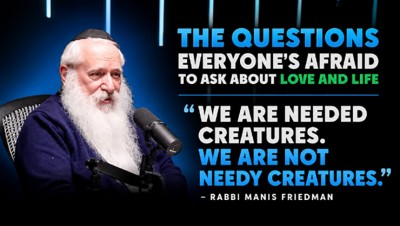
What if the problem isn’t that we haven’t figured out how to get what we need? What if we were never supposed to spend our lives thinking primarily about what we need in the first place?
That was the idea Rabbi Manis Friedman put before Roman Kaykov during a wide-ranging conversation on Kaykov TV, and once he did, almost everything else they discussed came back to it: marriage, children, money, anxiety, college, Shabbat, Heaven, and even Mashiach.
Roman kept testing that idea against real life. What about children who need love? Successful people who still feel empty? Young adults questioning why they were born? Couples who love one another but cannot seem to live together? People who believe in G-d but still have no idea what He wants from them?
For Rabbi Manis, these were different versions of the same question: Why am I here?
Roman asked why people who achieve success can still feel empty. “Because they satisfied needs that they never even had,” Rabbi Manis replied. His point was that for generations people were occupied with survival. They needed food, shelter, and a livelihood, and they worked because life demanded it. Today, a young person can ask something earlier generations may not have had the luxury to dwell upon: Why should I do any of this? I didn’t ask to be born. Why spend my life working simply so I can continue living?
Telling such a person that life is wonderful may not be enough. Neither, Rabbi Manis argued, is simply telling him how important he is. The more meaningful answer is almost the reverse: You are not here because you needed to be born. You are here because you are needed.
That, Rabbi Manis believes, is what many young people are really asking when they question religion and purpose: “What am I needed for?” He sees something healthy in the question. Young Jews are not necessarily satisfied asking whether G-d exists. They want to know: Fine, I believe. Now what?
Roman, a father of three, brought the question home. Like any parent, he thinks about how much attention and affection each child receives. So what actually makes a child feel secure?
Rabbi Manis surprised him. “How much you love them, it doesn’t work,” he said. What children need more than anything else, he explained, “is to know that they are necessary.”
A child who grows up hearing, “We love you, we adore you, we’ll do everything for you,” knows that he is cherished. But does he know that anyone actually needs him? Rabbi Manis argued that children need responsibilities and expectations. They should know that their presence changes the family and that what they contribute matters. Love tells a child that he matters to his parents; purpose teaches him that what he does matters as well.
The conversation then became personal as Roman recalled his childhood in Tashkent. At nine years old, he approached his father with a request: He wanted to learn Hebrew. His father had an obvious question. Why? The family wasn’t planning to move to Israel. Roman didn’t see the connection; he simply wanted to learn, and his father listened.
Eventually, Roman encountered a Chabad rabbi who gave the boy a very different introduction to Hebrew. This wasn’t simply another language, the rabbi told him. He placed a kippah on Roman’s head and began teaching him. Roman still remembers the small siddur he received. He learned to read and write Hebrew and became the one in his family who could do so.
Then the family came to America. Within months, their apartment was robbed. Money became tight, and Roman’s father told him that yeshivah was no longer financially possible. Roman went to public school, but continued putting on tefillin and remained conscious of kashrut. The lessons from Tashkent came with him.
Years later, as a father himself, Roman has his own way of explaining Torah to his children. If you wanted to become an astronaut, he told Rabbi Manis, you wouldn’t simply climb into a spacecraft and start pressing buttons. You would learn the manual. Why should life be different? The Torah is already here; why spend a lifetime trying to reinvent the wheel?
Rabbi Manis liked the analogy, but took it further. Torah isn’t merely the manual for operating a life, he said. It is the manual for a relationship.
He illustrated that relationship with Shabbat. We commonly understand the command simply: G-d rested on the seventh day, and therefore a Jew rests on the seventh day. But Rabbi Manis asked why one necessarily follows from the other. G-d rested. Why does that mean I have to rest?
His answer changed the emphasis. During the six days, G-d creates, so create with Him. On Shabbat, He rests, so rest with Him. In Rabbi Manis’ telling, G-d is not merely issuing an order; He is saying, “Be with Me.”
That is also why Rabbi Manis resists defining Judaism simply as a religion. “Judaism is the attempt to bring Heaven down to earth,” he said. The Jewish goal is not to spend life trying to escape this world and earn admission somewhere better. The work is here.
People have no trouble, Rabbi Manis noted, telling G-d what they need: health, money, a shidduch, children, success, protection, a refuah. But he wants people to add a question that rarely makes the list: “What does G-d need from me?”
He recalled the teaching, “I was created only to serve my Creator.” For Rabbi Manis, that sentence changes the posture of Judaism. Instead of approaching G-d primarily as the One who is supposed to solve our problems, we ask what He placed us here to accomplish. Roman’s astronaut analogy suddenly looked different. Torah isn’t simply instructions for getting safely through life; it tells us what we are supposed to do with it.
Roman then turned to marriage and asked Rabbi Manis for the biggest myth about love. “That it keeps us together,” came the answer. “Love does not keep you together.”
Rabbi Manis pointed out that some of the fiercest marital arguments are actually about love: You don’t love me. If you loved me, you would... Why don’t you show me you love me? Couples can spend enormous energy debating whether they feel sufficiently loved while avoiding a more basic question: Why did you get married?
His answer was not particularly romantic, at least at first. You married another person to make that person’s life better. He recalled a woman who complained that she was tired of picking up after her husband. Rabbi Manis told her that if picking up a pair of socks was all it took to make her husband’s life a little better, she had been handed a very easy opportunity.
Roman immediately turned the example around. What if it’s the husband picking up after his wife? “Same thing,” Rabbi Manis replied. If a husband knows something will make his wife’s life better and can do it, why wouldn’t he? The socks were never really the point. The question was whether marriage had become primarily about what I am getting from my spouse or what I can give to my spouse.
That did not mean ignoring serious differences or sacrificing oneself blindly. Rabbi Manis offered some of his most practical marriage advice later in the conversation: Before marrying someone, look beyond attraction and personality and look at the life that comes with that person.
“You’re going to enter your husband’s life,” he said. “You sure you want to live that life?” The same applies to a husband entering his wife’s life. “Make sure you agree with their life, not just with their looks,” Rabbi Manis cautioned. “Love does not solve all problems.”
Roman raised another tension familiar to people heavily involved in business or communal work: What happens when helping others repeatedly pulls someone away from his own family? Rabbi Manis drew a distinction. If someone is working endless hours simply to make more money, perhaps making less money and spending more time at home is the better choice. If he is genuinely serving the community, that matters, but his spouse has to understand and value that life as well. “Don’t sacrifice one person for the sake of another,” he said.
Roman’s next question was wonderfully simple: What is the purpose of money?
“The purpose of money is to give charity,” Rabbi Manis answered.
He wasn’t suggesting that people empty their bank accounts. His point was about how we view what we possess. If you have knowledge, what are you going to do with it? If you can speak well, whom can you help with that ability? If you have love, whom are you going to love? And if you have money, what good can it accomplish? “Everything we have is not for me,” Rabbi Manis said. Ownership is real, but so is responsibility.
Roman also wondered whether social media helps explain the anxiety he sees among young people. Everyone is watching everybody else: Someone is traveling, someone bought a house, someone made money, someone appears to have the perfect marriage. It becomes easy to ask, Why not me?
Roman told Rabbi Manis what he says to his own children. If somebody else succeeds, good. “He made it. Good for him.”
Rabbi Manis thought social media was part of the problem, but not its root. If you don’t know why you are here, he argued, everything becomes a measurement of whether your life is succeeding. Someone else’s wealth threatens you; someone else’s accomplishments diminish yours; someone else’s happiness makes you question your own. But if you know what you are needed for, another person’s success takes nothing away from you.
Eventually, Roman asked the question that waits behind almost every discussion of life’s purpose: What happens to the soul after death?
“Nothing,” Rabbi Manis replied, before explaining what he meant. Nothing happens to the soul in the sense that it does not stop being itself. It is no longer housed in a physical body, but its identity, relationships, and memories remain.
Then came the more surprising part: “Heaven is not the goal.”
If Judaism were ultimately about getting out of this world and reaching a better one, Rabbi Manis argued, why was this world created? The Jewish destination is not permanent escape from physical existence. It includes techiyas hameisim, when souls return to physical life. The work, once again, is here.
That brought Roman naturally to Mashiach. He asked what Rabbi Manis would tell future generations if this were his final interview. Rabbi Manis wasn’t interested in delivering a farewell speech. “I’m not ready for the future generation,” he joked. “I’m still talking about this generation.”
Then he became serious.
Not what is everybody doing. Not what should the rabbis do. Not what should the community do. What are you doing?
The answer, he said, does not have to be spectacular. A person who goes to work and produces something genuinely useful has improved the world. Someone who helps another person has improved the world. A stronger marriage, tzedakah, a mitzvah, or simply being there when somebody needs you all count.
“What did you do today that makes the world better?” Rabbi Manis asked.
Near the end, he offered Roman one of the simplest measures of a successful family: “A happy family is a family where the children can’t wait to become like mommy and like daddy.”
He wasn’t talking about children choosing the same profession, neighborhood, or income as their parents. He meant wanting the life they saw at home: the marriage, the family, the Judaism, the values, and the sense that life is going somewhere. “If they don’t want to be like you,” Rabbi Manis said, “you were not successful.”
After more than an hour together, Roman thanked Rabbi Manis and expressed hope that this would not be their last conversation. There were plenty more aspects of life to bring “onto the table” and explore together.
Rabbi Manis needed only four words to close the exchange: “No time to waste.”
After a conversation devoted to why we are here, perhaps there was no better place to end. If life has a purpose, the next question isn’t whether we agree with the idea. It is what we are going to do about it.
Roman Kaykov is president of Kaykov Media and host and senior producer of Kaykov TV. His life behind the camera began early, working alongside his father, a professional photographer and videographer. He later studied film at New York University and St. John’s University and worked with camera crews on independent and mainstream productions.
Kaykov Media, established in Forest Hills in 1991, carries forward a family photography and media tradition spanning generations. Through Kaykov TV, Roman sits down with rabbis, community leaders, entrepreneurs, artists, and other personalities for conversations about Jewish life, Bukharian identity, family, business, culture, faith, and community.
Roman often brings his own experiences into those discussions, as he did throughout his conversation with Rabbi Manis. The result is less a formal question-and-answer interview than a genuine exchange, making this new column's name particularly fitting.
Rabbi Manis Friedman: Why Are We Here?
Typography
- Smaller Small Medium Big Bigger
- Default Helvetica Segoe Georgia Times
- Reading Mode