


How Lyme Disease Led One Man From Fear To Faith
One tiny tick changed Shalom Meirov’s life.
What began as a relaxing family getaway to the Catskills became a months-long journey through agonizing physical pain, crippling anxiety, sleepless nights, and ultimately, a profound transformation in how he views emunah (faith), vulnerability, and community.
When Shalom joined me on Chazaq Torah Talks, the conversation felt intensely personal. Shalom is my first cousin. A lifelong Queens native, a husband, and a father of six, he is a veteran educator. For nearly two decades, his daily life has required being the anchor of a classroom—the steady authority figure who manages hundreds of teenagers, maintains order, and provides for his family.
But this story was far bigger than a medical diagnosis. It was the story of what happens when a man whose entire identity is built on self-reliance is suddenly rendered helpless by a tiny creature.
Act I: The Illusion of Order
The summer had started exactly as planned. Wanting to give his family a beautiful escape from the city concrete, Shalom rented a cabin in the mountains. The grass around the main house was perfectly manicured, the children were excited, and the pool was just a short walk down a path.
Like most city families, the threat of Lyme disease was the furthest thing from his mind. They had gone to the mountains to find safety and relaxation. But vulnerability exists everywhere except under Hashem’s direct protection; we cannot out-plan a gezerah (Divine decree).
That evening, after a day outdoors, reality struck. Shalom discovered and removed ticks from two of his daughters. He immediately went into high-alert mode, meticulously checking the rest of his children from head to toe. It was only later that night, lying in bed, that a sudden thought jolted him: I never checked myself.
Using the flashlight on his phone, he began scanning his skin. There, on his leg, hidden underneath a single strand of hair, was a speck the size of a poppy seed. It was a tick.
His wife remained remarkably calm. “Just remove it,” she said softly.
But Shalom's internal compass scrambled. His wife was pregnant, his daughters had been bitten, and now he was infected. His mind instantly raced to the worst-case scenarios. He was ready to pack the entire family into the car and flee back to Queens in the dead of night.
Shalom describes himself as the type of person who dots every "i" and crosses every "t." If a problem can be anticipated, he plans for it. He manages, he coordinates, he protects. Yet looking back, he realizes this was the exact moment that mindset was challenged.
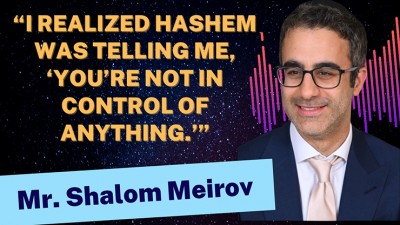
“I felt Hashem was telling me directly: ‘You think you run this family? You think your planning keeps them safe? You are not in control of anything.’”
They stayed the night, and at first, nothing happened.
Act II: The Swelling Secret
Two weeks later, back in the city, the real symptoms emerged. One of his daughters complained of itching near her bite. Shalom immediately brought her to the doctor, asking for preventive antibiotics. While researching Lyme symptoms online to protect his child, he began noticing strange occurrences in his own body.
His neck felt unusually stiff. His ear ached. A dull, heavy pain settled into his head and shoulder. Then, he woke up, reached for his neck, and froze. There was a hard, swollen lymph node on his throat the size of a walnut.
He discovered that many Lyme patients never get the classic, easily identifiable bullseye rash. Instead, their bodies ring the alarm internally. That walnut-sized swelling became a physical metaphor for exactly what Shalom was about to do emotionally: he was carrying a heavy, terrifying lump of fear, and he was determined not to let a single soul see it.
A blood test confirmed it: positive for Lyme disease.
The physical toll was baffling and brutal. Pain migrated fluidly through his body—waking up with arthritic wrists, switching to throbbing ankles by afternoon. A man who managed high school corridors suddenly lacked the physical strength to carry ordinary grocery bags. Pressing the gas pedal of his car became painful.
The conflicting medical noise online was deafening—some doctors advised two weeks of antibiotics, others three months, some warned against them entirely. Well-meaning acquaintances shared horrifying anecdotes about relatives bedridden for years.
To protect his pregnant wife from added stress, and to spare his elderly parents from panic, Shalom chose absolute, radical silence. He wore his standard persona like a mask. He smiled at the dinner table, taught his classes, and pretended everything was fine while he was quietly falling apart inside.
“The physical pain was intensely real,” Shalom reflected. “But the crushing loneliness of keeping it all inside was far worse.”
Act III: Quieting the Highway
Just as the antibiotics began to clear the physical infection and Shalom thought the nightmare was ending, a different battle began.
He awoke in the middle of the night drenched in sweat, gasping from agonizing pain. Then came the insomnia. For three consecutive, agonizing nights, sleep vanished. He lay perfectly still, watching his entire house sleep peacefully in the dark, trapped in a hyper-vigilant mind.
His physician prescribed a temporary sleep aid and gave him a blunt directive: see a therapist. For a man who thinks three times before taking a Tylenol, the suggestion felt foreign and deeply uncomfortable.
Before this ordeal, Shalom never truly understood what the word "anxiety" meant. Now, he was trapped in a vicious cycle: the mind raced, sleep disappeared, the nervous system flared, and the body produced genuine, excruciating physical pain in response to the panic. Raised in a cultural environment where mental health struggles are often shrouded in taboo, he did not know where to turn.
Hashem sent help through a close friend who directed him to SIMHA, a Brooklyn-based mental health organization. There, Shalom sat in an office with Dr. Mandelbaum. For two uninterrupted hours, the armor cracked. The veteran educator, the resilient father, the reliable provider finally let go. Everything he had been suffocating came pouring out—the guilt of planning the trip, the terror for his pregnant wife, the exhausting facade of strength.
When he finally finished, Dr. Mandelbaum looked at him with profound empathy and said words Shalom initially resisted: “Shalom, you are dealing with severe anxiety.”
Shalom was referred to a psychotherapist and a psychiatrist. He realized he needed a multi-pronged approach that integrated both faith and psychology. When the psychiatrist recommended Lexapro, Shalom hesitated, stating he only wanted a sleeping pill. The doctor stopped him and offered an analogy that completely reframed his perspective:
“Trying to learn coping skills and utilize bitachon while your nervous system is trapped in severe anxiety is like trying to study for a critical exam while standing right next to a roaring highway. You aren't weak. But until we lower the baseline noise of that traffic, your mind cannot absorb the tools to heal.”
Medication wasn't a replacement for faith; it was the earplugs that quieted the highway so that his emunah and therapy could actually be heard.
Act IV: The Wisdom of Acceptance
The road to healing wasn't instantaneous. Ironically, Shalom’s reflex to "fix" things initially hindered his spiritual recovery. He began fiercely judging himself: If only I had stronger bitachon, I wouldn't feel this panic. He tried to force himself to take on the intense pace of Daf Yomi to earn spiritual credit.
Instead, the pressure magnified his anxiety. He learned a vital lesson: even beautiful spiritual commitments require self-awareness and wisdom. During a crisis, Hashem does not measure our growth by how heavily we burden an already exhausted soul, but by our willingness to take the right step for the current season.
During his first therapy session, seeking immediate formulas, Shalom demanded a checklist to fix the panic. The therapist looked at him and said two words that felt entirely counterintuitive: “Just be.”
He hated the advice at first. He wanted to fight the anxiety, to conquer it. But he learned that constantly fighting panic only feeds it. In Jewish terms, this is the profound secret of accepting a challenge with love. Not pretending it doesn't hurt, but surrendering the exhausting demand to control the outcome.
A pivotal turning point occurred during the Three Weeks—the national season of Jewish mourning over brokenness and destruction. Shalom sat in a crowded room and heard a lecture where the speaker uttered a simple, routine phrase: "Hashem is in control."
It was a phrase he had heard ten thousand times before. But sitting there, fully aware that his own health had slipped from his grasp, the words hit him with the force of a tidal wave. He burst into tears. For the first time in his life, the concept became a living, breathing reality. True rebuilding could only begin once he totally surrendered his reliance on himself.
One book accompanied him throughout those months more than any other: Gateway to Happiness by Rabbi Zelig Pliskin. Unable to sleep, he would sit with it, underline passages, write notes in the margins, and slowly absorb its messages. It became a lifeline.
Act V: A Specific Gratitude
Today, Shalom is channeling his journey into a book, determined to ensure that no one else in the community suffers through the isolation of mental health challenges in silence.
For families heading to the mountains, his practical advice is direct: don't panic, but respect the terrain. Cover your skin in tall brush, use insect repellent, check thoroughly before showering, and if you find a tick, visit a local urgent care immediately rather than relying on guesswork.
But the lasting transformation of that summer has nothing to do with ticks. It is written across the pages of Shalom’s daily prayers.
Before this ordeal, his expressions of gratitude to the Almighty were standard, sweeping, and general. Now, three times a day, before he steps into the words of Modim, he pauses. He micro-details his praise, thanking Hashem for the specific, everyday blessings he once took entirely for granted: the ability to take a deep, clear breath; the ability to think without a racing mind; the strength to lift an ordinary grocery bag; the gift of hearing his children's voices; and the extraordinary, miraculous blessing of simply closing his eyes and falling asleep.
He discovered that asking for help is an act of ultimate courage, that isolation is heavier than any illness, and that true, unbreakable strength only begins when we finally let go of the wheel and trust the One who is actually driving.
Lyme disease eventually left his body. The gratitude it awakened never did.
About the Subject
Shalom Meirov is a veteran teacher and educator residing with his family in Kew Gardens Hills, Queens. He holds a Master’s degree in education from Brooklyn College, completed his rabbinical and educational training at Mesivta Chofetz Chaim and Yeshivas Zichron Aryeh, and serves as a long-time public high school instructor at Franklin Delano Roosevelt (FDR) High School in Brooklyn. Following his personal encounter with Lyme disease and somatic anxiety, he has become a passionate advocate for mental health awareness, the de-stigmatization of therapy, and the power of specific gratitude in everyday life.
Rabbi Yaniv Meirov is the mara d’atra of Kehilat Charm Circle in Kew Gardens Hills and serves as Chief Executive Officer of Chazaq. Now 222 episodes strong, Chazaq Torah Talks continues to inspire by showing that Jewish growth and survival are shaped through lived experience, commitment, and connection.
One Tiny Tick Changed Everything
Typography
- Smaller Small Medium Big Bigger
- Default Helvetica Segoe Georgia Times
- Reading Mode