


Lessons Of Chinuch And Responsibility
In Episode 114 of Chazaq Torah Talks, Rabbi Yaniv Meirov welcomed Rabbi Don Pacht, menahel of Yeshiva Tiferes Moshe (YTM), for a thoughtful and deeply relevant conversation about education, parenting, and the shared responsibility of raising the next generation.
The conversation carried a personal dimension. Rabbi Pacht grew up in Kew Gardens Hills and is himself a proud graduate of YTM. After years studying and serving in yeshivos in Forest Hills and Rochester, he spent seventeen years leading a Torah day school in Vancouver, British Columbia. Recently, he returned to Queens to guide the very yeshivah that helped shape his own formative years.
“It’s a little surreal,” Rabbi Pacht reflected. “I remember being a student here, and now I’m part of the administration.”
From there, the conversation turned to one of the most important questions facing Jewish families today: what does chinuch truly mean?
Understanding The Meaning Of Chinuch
Rabbi Pacht explained that the concept of chinuch appears early in Torah, and Rashi provides a powerful explanation of the term.
Rashi explains that chinuch refers to the first introduction of a person into the role or path they will eventually occupy in life. Education, therefore, is not simply about transmitting information.
“We often think education means teaching skills or knowledge,” Rabbi Pacht explained. “But from the Torah perspective, chinuch means building the individual — helping a child grow into the adult they are meant to become.”
Academic success is important, but it is only one part of a much larger goal: developing character, responsibility, and a meaningful connection to Torah and Yiddishkeit.
Reaching Children Through Care
Educational approaches have changed over the decades, but one principle remains clear: children respond best when they know their teachers genuinely care about them.
“Fire and brimstone is not the way to reach children,” Rabbi Pacht explained. “Children need to know that their rebbe cares about them.”
Authority and discipline certainly have their place, but without a foundation of trust and care, those tools lose much of their effectiveness.
Rabbi Pacht shared a powerful example from his own childhood. One of his rebbeim, Rabbi Pollack, did something extraordinary on the first day of school. He wrote down the Hebrew name and the mother’s Hebrew name of every student in his class and carried the list in his jacket pocket throughout the year.
Every day, he would say T'hilim for each child.
For Rabbi Pacht, even as a young student, that message was unmistakable: this rebbe truly cared about his students.
“That kind of connection,” he said, “stays with a student for life.”
Parents As The Primary Educators
Throughout the conversation, Rabbi Pacht emphasized that education does not belong to schools alone.
Parents remain the most influential educators in a child’s life.
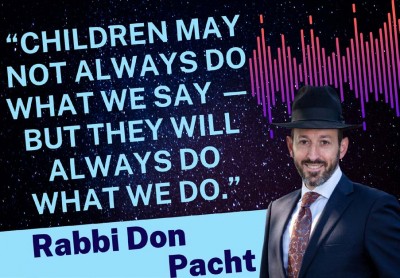
“Children are always watching,” he explained. “They may not always do what we say, but they will always do what we do.”
This means that every parent, whether formally trained in education or not, plays a critical role in shaping a child’s values, habits, and emotional development.
In the school environment, educators operate under the concept of in loco parentis—acting in place of parents during school hours. Yet the primary responsibility of education still begins in the home.
Schools and parents must therefore function as partners.
The Power Of A School–Home Partnership
That partnership is essential for a child’s success.
Rabbi Pacht compared the relationship between parents and schools to a marriage. Parents and educators may sometimes disagree about particular approaches, but in front of the child there must be unity.
When children sense conflict between parents and teachers, the educational message weakens. When parents and educators work together, however, the impact becomes far stronger.
“At the end of the day,” Rabbi Pacht said, “we are all working toward the same goal — the success of the child.”
Why Teachers Continue Learning
Rabbi Pacht also shed light on something many parents rarely see: teachers themselves must constantly continue learning.
Professional development days allow educators to refine their skills, review new research, and deepen their understanding of how children learn.
He offered a fascinating example. Even an eighth-grade Gemara rebbe may participate in training related to the science of reading.
Why? Because sometimes a reading difficulty that began in third or fourth grade surfaces years later. When teachers understand how reading develops, they are better equipped to help students overcome those challenges.
Education, like any profession, requires continual growth.
“If we want to be effective teachers,” Rabbi Pacht said, “we must keep learning as well.”
Using The Summer To Plan For Growth
Since the episode originally aired during the summer months, Rabbi Pacht also offered practical guidance for parents during the break from school.
Summer provides an opportunity to step back and think carefully about a child’s long-term development.
Parents might ask themselves questions such as: What kind of person do I want my child to become? What skills or values should they develop in the coming year?
One practical example might involve preparing a boy for his Bar Mitzvah. Rather than waiting until just a few months before the occasion, families can begin nurturing familiarity and confidence with krias haTorah earlier.
Summer offers space to plan thoughtfully and nurture growth without the daily pressure of school schedules.
A Lesson From Kriat Shema
Toward the end of the discussion, Rabbi Pacht shared a beautiful insight drawn from Kriat Shema.
The pasuk states, “These words shall be upon your heart,” and immediately afterward comes the instruction, “You shall teach them diligently to your children.”
The placement of these two ideas carries a powerful lesson.
Before parents can successfully pass their values to their children, those values must first live deeply within their own hearts.
When parents live their ideals authentically, children absorb those values naturally.
“If these words are truly in your heart,” Rabbi Pacht explained, “then you will be able to teach them to your children.”
As Chazaq Torah Talks continues highlighting voices shaping Jewish life today, this episode offered an important reminder.
Education is not the responsibility of teachers alone, nor of parents alone. It is a shared mission built on partnership, consistency, and genuine care.
When families and educators work together with that spirit, the next generation is given the strongest possible foundation for a life rooted in Torah, responsibility, and purpose.
Rabbi Yaniv Meirov is the mara d’atra of Kehilat Charm Circle in Kew Gardens Hills and serves as Chief Executive Officer of Chazaq.
Now 222 episodes strong, Chazaq Torah Talks continues to inspire by showing that Jewish growth and survival are shaped through lived experience, commitment, and connection.
Educating With Heart And Partnership
Typography
- Smaller Small Medium Big Bigger
- Default Helvetica Segoe Georgia Times
- Reading Mode