


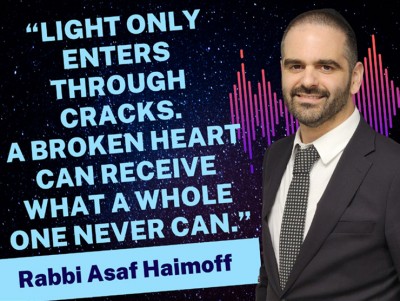
Episode 84 of Chazaq Torah Talks, recorded on December 28, 2022, stands among the most searing and transformative conversations ever shared on the program. My guest, Rabbi Asaf Haimoff, did not speak from theory. He spoke from lived reality—hospital rooms, darkness, loss—and from the rebuilding that followed.
This was not a discussion about pain.
It was a roadmap for turning pain into purpose.
Roots In Queens,
A Life Shaped By TorahRabbi Haimoff was born and raised in Queens, New York, growing up in Jamaica Estates before his family became part of the emerging Torah landscape of Kew Gardens Hills. His father, Rabbi Yigal, mara d’atra at Yeshiva Ohel Simcha, is among the pioneers who helped establish and elevate Sephardic Torah life in Queens, laying foundations that continue to support generations of families, talmidei chachamim, and institutions.
From a young age, Rabbi Haimoff absorbed what it means to live for klal Yisrael. He learned in local yeshivot, continued his growth in South Fallsburg, and later spent years immersed in Torah learning in Eretz Yisrael, including time at the Mir. He married and remained in Eretz Yisrael for close to a decade, later receiving advanced rabbinic training that shaped both his worldview and his approach to strengthening families and communities.
Eventually, he returned to New York, engaging in kiruv and communal work in Queens before relocating to Brooklyn so his children could learn within the Syrian community’s educational framework. Life was full, demanding, and purposeful—until everything changed.
A Shabbat That Altered Reality
On his eldest daughter’s 16th birthday—a Shabbat—a doctor arrived at the family’s home with devastating news. She had been diagnosed with AML leukemia, one of the most aggressive and unforgiving forms of the disease, particularly rare and severe in children.
Within hours, Shabbat zemirot gave way to hospital corridors. What followed were more than two years spent largely on the ninth floor of Memorial Sloan Kettering. Rabbi Haimoff described it as galut—exile. Darkness was not only emotional, but physical; lights were often forbidden due to treatment side effects. Time blurred. The outside world continued celebrating life, while theirs was suspended between hope and heartbreak.
Despite relentless suffering, his daughter never asked, “Why me?”
Her question was always different:
“What is my avodah?”
From Anger To Surrender
Rabbi Haimoff spoke candidly about the anger he initially felt—anger at the illness, at the injustice, at the spiritual dissonance of watching a righteous child suffer. The instinct to control outcomes, to fight harder, to force an ending, was overwhelming.
The shift came when he stopped trying to manage the outcome and began surrendering to Hashem’s will—not passively, but with trust. Guided by his rebbi and mentor, Rabbi Aharon Walkin, zt”l, he learned a difficult but transformative practice: to thank Hashem even when gratitude felt impossible.
Not because he felt thankful—but because truth spoken consistently reshapes the heart.
Slowly, pain did not disappear—but it transformed.
“I realized that if Hashem entrusted me with this pain, it’s because I was capable of carrying it—and transforming it into something eternal.”
An Everlasting Legacy
When Make-A-Wish asked his daughter what she wanted most, she surprised everyone. Not a trip. Not an experience. She asked for a sefer Torah—something eternal.
That sefer Torah was written.
Using remaining funds from the campaign, Rabbi Haimoff and his family established Beit Midrash Efrat in Brooklyn, named in her memory. What began around Pesach 2022 as a modest initiative quickly grew into a vibrant kehillah of dozens of families, offering Torah learning, youth programming, and a warm spiritual home.
Pain became purpose.
Loss became legacy.
Her Final Question
In her final days, when doctors explained there was nothing more medically to offer, her last meaningful conversation took place just days before Rosh Hashanah. Unable to see, unable to leave her bed, she asked:
“What is my avodah for Rosh Hashanah?”
That question was how she left this world.
Rabbi Haimoff later told his kehillah on Yom Kippur that she would hold every healthy person accountable—those who can see, walk, learn, and live—for never stopping to ask that same question.
Birth After Loss
Thirty days after she passed away, Rabbi Haimoff’s wife gave birth to a baby boy. The same machines that had fallen silent now pulsed with new life. The same hospital corridors witnessed both death and birth within weeks.
Rabbi Haimoff called it a “Grand Slam from Heaven.”
From that moment on, blessing flowed in ways he never could have imagined—rebuilding livelihood, teaching Torah without financial pressure, expanding his family, and continuing to grow Beit Midrash Efrat into a thriving center of Jewish life.
Victim Or Hero
Throughout the conversation, one theme returned again and again:
Pain does not define you.
Your response does.
Rabbi Haimoff rejected victimhood. He chose to live as a hero—someone who uses suffering to build deeper vessels, to contain greater blessing, and to forge a real relationship with Hashem.
“Hashem doesn’t send pain as a verdict,” he explained. “He sends it as an opportunity—to build vessels, to grow closer, and to receive greater blessing.”
Light, he taught, only enters through cracks. A broken heart can receive what a sealed heart never can—if the brokenness is embraced rather than denied.
The Ball, Not The Walls
Drawing from Yosef HaTzadik’s imprisonment, Rabbi Haimoff shared a powerful metaphor: focus on the ball, not the walls. Yosef never lost sight of his destiny, even in a dungeon. When focus remains on purpose rather than pain, exhaustion fades and clarity takes over.
The same applies to marriage struggles, health challenges, financial stress, and personal battles. Hardship is not a verdict—it is an opportunity.
Takeaway
Rabbi Haimoff closed with words every soul needs to hear:
Hashem loves you.
Hashem wants only good for you.
And whatever you are facing right now is not random.
It is an invitation—to trust, to grow, and to turn pain into purpose.
For listeners, this was not just inspiration.
It was proof.
Rabbi Yaniv Meirov is the mara d’atra of Kehilat Charm Circle in Kew Gardens Hills and serves as Chief Executive Officer of Chazaq. He is the host of Chazaq Torah Talks, a long-running and widely followed series that presents Torah through honest, experience-driven conversations addressing faith, struggle, and personal growth.
Now comprising 222 episodes, Chazaq Torah Talks features rabbanim, educators, and individuals whose life stories illuminate enduring Torah truths. Through this platform and his communal leadership, Rabbi Meirov continues to inspire by showing how emunah is forged through real life, not despite it.
Turning Pain Into Purpose
Typography
- Smaller Small Medium Big Bigger
- Default Helvetica Segoe Georgia Times
- Reading Mode