


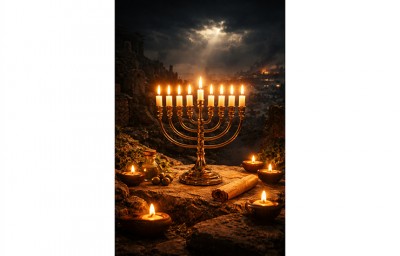
I’ll begin by wishing all the readers a lichtige and freilichen Chanukah!
There are many relevant messages for us in the parshiot at this time of year which connect to Chanukah. Parshat Mikeitz begins with Yosef being brought to explain Pharaoh’s dreams. Yosef had been in prison for two more years after interpreting the dreams of the two sarim—officers. He had requested of the Sar HaMashkim to tell Pharaoh about him and about how he had been framed, hoping that this was proper hishtadlut—effort—to gain his freedom. The Sar HaMashkim forgot about Yosef, some say intentionally. Either way, Yosef ended up remaining in prison for two more years.
Rashi brings the Medrash which explains that Yosef had to wait because he placed his trust in the Sar HaMashkim, rather than relying solely on Hashem. Yosef, on his exalted level of holiness, should have relied only on Hashem, patiently waiting for his yeshua—salvation.
Then suddenly, Yosef was whisked out of prison, cleaned up, and brought before Pharaoh. This surprising turn of events happened swiftly, without any prior warning. There were no signs beforehand that Yosef was about to be freed. The Seforno explains that all yeshuot from Hashem come in this way—suddenly and speedily. He brings a proof from the Navi Yeshayah (56:1), which teaches that the yeshua is close, and we must be ready for it.
That is how the geulah—redemption—from Mitzrayim unfolded. Even though Klal Yisrael had been anticipating the geulah, having just brought the korban Pesach and experienced makat bechorot, the actual redemption came very suddenly. That is why they became so busy and did not have time to bake bread, resulting in the matzah.
The Purim miracle also unfolded suddenly. After Haman was forced to lead Mordechai through the streets in the royal parade—receiving a shower of garbage (or worse) along the way—he did not even have time to clean himself before the king’s guards rushed him to Esther’s feast. There, Esther identified him as the enemy, and very quickly and unexpectedly, he was killed.
The Seforno teaches that the future geulah will come in the same way—suddenly and swiftly. The Navi Malachi (3:1) says that when Moshiach arrives, he will come pitom—suddenly.
We say after Aleinu, al tira mipachad pitom—do not fear a sudden terror when the destruction of the reshaim comes. Hashem’s yeshua will arrive suddenly, just as it did for Yosef, and it is our responsibility to be prepared for it.
The Medrash Rabbah (Bereishis 85:1) teaches that everyone involved in the sale of Yosef was very busy. The Shevatim were occupied with the sale and its repercussions. Reuven was immersed in teshuvah for his sin. Yosef was mourning his fate. Yaakov Avinu was consumed with aveilut over Yosef. Yehudah was busy getting married, having children, marrying off his sons, burying two sons, and then becoming involved with Tamar.
And what was Hakadosh Baruch Hu doing?
He was preparing Moshiach.
All the hardships and confusion were laying the groundwork for redemption.
It is important to note that even after Yosef became viceroy of Mitzrayim, he was still technically a slave—only now he belonged to Pharaoh instead of Potiphar. He lived as a slave in a golden cage. Yosef ruled Mitzrayim with wisdom and authority, managing the entire economy—from food production and storage to sale and distribution. He relocated the population so that his family would not feel like outsiders. He exempted the priests from taxation, paving the way for the Leviim to eventually be exempt from governmental service.
Yosef was Klal Yisrael’s longest-ruling monarch, serving as viceroy for over eighty years—Pharaoh essentially retired early! Yet Yosef still needed special permission to bury Yaakov Avinu in Eretz Yisrael, because he remained a slave. His salvation came suddenly, but it was not complete. Still, it was precisely what Klal Yisrael needed at that time—to survive the famine and settle safely in Goshen.
The Chanukah miracle shares these qualities. When the Yevanim issued decrees against Torah and mitzvot, it required tremendous courage and determination to continue living as Torah Jews. When the Chashmonaim finally rose to fight, it was against all odds. When Yehudit led the way by killing the Greek general (the episode involving cheese and wine), her success itself was miraculous. Each military victory was an open miracle. And when the oil burned for eight days, it was an astonishing miracle.
Yet the victory did not bring lasting peace. Wars continued for many years. Still, those miracles were a brilliant spark of light in the darkness. At that moment in time, it was a complete yeshua.
We express our hakarat hatov—gratitude to Hashem—on Chanukah by lighting the Chanukah candles. In truth, one candle would suffice, yet no one does that. Instead, we fulfill the mitzvah in the way of mehadrin min hamehadrin—the best possible manner—lighting eight candles (and for Ashkenazim, each member of the household lights). Why?
Because we want to demonstrate our love and gratitude to Hashem. He did not need to perform the miracle of the oil. The Kohanim could have used impure oil, yet they chose to serve Hashem in the most elevated way possible, out of love rather than necessity. So too, we light in the best way to show our love and appreciation for the miracles Hashem performed for us.
This year, Chanukah began with terrible news from Australia. The number of korbanot is horrifying. Why did it happen? We do not know Hashem’s calculations. Yet even within the darkness, there were miracles. Among them was the fact that two bombs planted by the terrorists did not explode. The tragedy could have been far worse.
Additionally, it was reported that the FBI uncovered and prevented a major terror attack in Los Angeles that primarily targeted Jews.
As world events continue to unfold, we must awaken ourselves to recognize how everything is orchestrated by Hashem—from beginning to end—even when we do not yet see the final outcome. We must remain prepared for the arrival of Moshiach, who will come suddenly, at precisely the right moment.
We are living with the bright light of Hashem’s yeshua, reflected in the Chanukah miracle—a light shining within the darkness of this difficult and confusing galut. May we merit to witness miracles even greater than those of Chanukah, with the arrival of Moshiach, speedily and in our days.
R’ Dovi Chaitovsky and his family have the zechut to live in Eretz Yisrael, where he dedicates himself to Torah learning and teaching in Yerushalayim Ir HaKodesh. His divrei Torah often draw from the shiurim of Rav Yisrael Altusky, shlit”a, Yeshivas Torah Ore, Yerushalayim which can be heard at kolhalashon.com.
A Sudden Light In The Darkness
Typography
- Smaller Small Medium Big Bigger
- Default Helvetica Segoe Georgia Times
- Reading Mode