


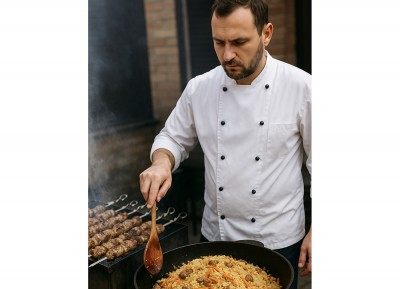
Plov is a cornerstone of Bukharian Jewish culinary tradition, commonly prepared for family gatherings and other special occasions. Considered a “main event” dish, it is often served communally from a large platter as the centerpiece of the meal.
Shashlik (also spelled shashlyk or shish kebab) is another iconic Bukharian Jewish dish, rooted in Central Asian cooking. It consists of skewered, marinated meat, typically lamb, beef, or chicken, grilled over open coals on a mangal (a portable grill). In home settings, a Jewish family member usually oversees the cooking or grilling, but for larger events, especially in the United States and Israel, it is common to hire outside help. Private chefs or “plov/shashlik specialists” are frequently booked for pop-up home events, often providing full on-site cooking.
Chazal1 enacted a prohibition against food cooked entirely by a non-Jew. This decree, known as bishul akum, was instituted to prevent overly close social interaction that could lead to intermarriage.2 There is also a concern that non-Jews might add non-kosher ingredients to the food.3 However, it is important to recognize that Chazal did not always reveal all the reasons behind their enactments.4 Sometimes, even when the most obvious reason no longer appears applicable, deeper or hidden reasons still remain in force.5
Rav Shlomo Zalman Auerbach6 writes sharply that the rise in intermarriage and assimilation in the United States is related to lax attitudes and newly introduced leniencies concerning bishul akum.
For this reason, it is essential that the food we eat be cooked by a Jew. If a non-Jew cooks the food, even when all ingredients and utensils are kosher, the food becomes non-kosher according to halacha, and the utensils require koshering (a halachic purging process).7
- EXCEPTIONS TO THE RULE: WHEN BISHUL AKUM DOES NOT APPLY
There are several cases in which food prepared by a non-Jew is permitted:
- Food That Is Eaten Raw
Food that is normally eaten raw8 is not subject to bishul akum.
- Food Not Fit for a King’s Table
Food that is not considered fit to serve at a king’s table, wedding feast, or smorgasbord is exempt from bishul akum. Examples include, corn snacks, Rice Krispies, potato chips,9 and popcorn.10
- Food Cooked Unintentionally
Food cooked by a non-Jew unintentionally, as a secondary result of another action, is exempt from the prohibition. For example, if a non-Jew lights an oven to dry wood, and food placed there by a Jew cooks unintentionally, the food is considered incidental and is permitted.11
- The Sephardic Model of Bishul Yisrael
The Sephardic approach to bishul yisrael can be explained through a straightforward halachic cooking model. Halachically, there are three possible actions that begin the actual cooking process:
- Igniting the heat source
- Placing a vessel containing food directly onto the flame
- Placing uncooked food into a pot that is already heated
Any one of these actions initiates the process that will ultimately result in D: cooked food.
According to this model, in order to fulfill the requirement of bishul yisrael, a Jew must perform the final action (whether A, B, or C) that actually begins the cooking on the heat source. Once this action is done by a Jew, the food must remain on the heat until it reaches a halachic stage known as ma'achal ben derusai, meaning the food is at least one-third cooked.12 This represents the point at which the food is considered partially cooked from a halachic perspective. After reaching this stage, a non-Jew may complete the cooking without creating an issue of bishul akum.13
In addition, if a Jew stirs the food, ideally before it reaches the stage of ma'achal ben derusai, this is also considered bishul yisroel and renders the food permissible.14
- Food Processed Without Fire
Foods prepared without fire, such as through salting, pickling, or cold smoking,15 are not subject to bishul akum.16
BISHUL YISRAEL CHECKLIST WHEN HIRING A NON-JEWISH CHEF FOR PLOV AND SHASHLIK
PART I: Before Cooking Begins
- Confirm All Ingredients Are Kosher
All meat (lamb, beef, chicken) must be must be kosher-certified and properly sealed
All oils, spices, and rice (for plov) must have reliable kosher certification.
No non-kosher utensils or ingredients may be brought by the chef.
PART II: Establishing Bishul Yisrael
- The Jew Must Perform One of the Three Halachic “Start Actions”
According to the Sephardic model, a Jew must perform the last action that starts the actual cooking, either:
- Ignite the Flame
A Jew lighting the stove, burner, grill, oshton, or oven used for plov or shashlik is not a viable option, because this must be the final act performed while all the ingredients are still raw.
- Place the Cooking Vessel on the Flame
A Jew placing the pot (with all the raw ingredients) on a fire lit by a non-Jew is also not a viable option, because this must be the final act performed while all the ingredients are still raw in the pot.
- Place Raw Food on the Heat Source
The Jew places:
- The raw meat skewers on the grill for shashlik, or
- The rice/oil/meat base into the pot when making plov.
All the ingredients added to a pot that is cooking as it goes must be placed in by the Jew. It is also preferable for the flame to be lit by the Jew, in case any halachic issues arise.
PART III: Making Sure the Cooking Reaches the Halachic Threshold
- Ensure the Food Reaches Ma’achal Ben Derusai
This means one-third cooked.
To satisfy bishul yisrael:
- After the Jew performs C, the food must remain on that same heat source until it reaches one-third cooked.
For Shashlik:
Once the Jew places the skewers on the grill and they cook until roughly ⅓ done, the rest may be finished by the non-Jewish chef.
For Plov:
Once the Jew throws the ingredients in the flame, the mixture must cook to one-third completion before the chef continues on his own.
PART IV: Optional Additional Safeguard
- The Jew May Stir the Food
Halachically valid according to many Sephardic authorities:
- Stirring plov until it reaches ma’achal ben derusai
- Immediately turning the meat skewers once on the grill
This can serve as a valid act of bishul yisrael.
PART V: During the Event or Cooking Session
- Ensure the Flame Does Not Go Out
If the flame goes out (before the food reached 1/3 cooked) and:
- A non-Jew relights it → the cooking becomes bishul akum unless the Jew relights it again.
Correct procedure:
- If the fire goes out at any time, the Jew must be the one to reignite it.
PART VI: Practical Supervision
- Supervision Requirements
A Jew does not need to stand there the entire time, but must ensure:
- The Jew performed the halachic starting action
- The food cooked to one-third before the chef took over
- The flame stays under Jewish control if it goes out
- No non-kosher ingredients or equipment are used
- The chef does not swap pots, pans, or grills after the Jew’s action
1 משנה ע״ז לה
ואלו דברים של עובדי כוכבים אסורין ואין איסורן איסור הנאה חלב שחלבו עובד כוכבים ואין ישראל רואהו והפת והשמן שלהן … והשלקות
2 רש”י ע”ז לח. ד”ה מדרבנן
3 רש”י ע”ז לה: ד”ה והשלקות
4 Aruch HaShulchan Yoreh De’ah 115:6
ובאמת כך מקובלני שכל גזירת חכמים לבד טעמם הנגלה יש עוד הרבה טעמים כמוסים שלא גילו אותם
5 The Vilna Gaon (Rav Eliyahu of Vilna, 1720–1797), as cited in Meshech Hochmah (Shemot, pg. 76), explains that rabbinic decrees often contain multiple layers of meaning beyond their primary stated purpose. Therefore, even when the stated reason for a decree seems inapplicable, the enactment remains binding, for its deeper layers continue to operate beyond our understanding.
6 Halichot Shlomo – Moadim 2:3:footnote 11
7 Shulchan Aruch Yoreh De’ah 113:16
כלים שבשל בהם העובד כוכבים לפנינו דברים שיש בהם משום בישולי עובדי כוכבים צריכים הכשר ויש אומרים שאינם צריכים ואף לדברי המצריכים הכשר אם הוא כלי חרס מגעילו שלש פעמים ודיו מפני שאין לאיסור זה עיקר בדאורייתא: הגה עובד כוכבים שבשל לחולה בשבת מותר למוצאי שבת אפילו לבריא ואין בו משום בשולי עובדי כוכבים דכל כה”ג היכרא איכא)
8 However, determining whether an item is considered “edible raw” depends on how the majority of people typically consume it. Several authorities, including the Ra’avan (Avodah Zarah siman שג), the Aruch HaShulchan (113:12), and the Kaf HaChayim (113:10), rule that we follow majority practice.
For example, although sushi contains raw fish, the fish is not eaten alone but together with rice; therefore, it does not qualify as a food commonly eaten raw. Likewise, sashimi may not be popular enough in the United States to assume that these fish species are widely consumed raw on their own. This is the position of Rav Hershel Schachter and Rav Yisroel Belsky (Daf HaKashrut Vol. 22 #4).
9 Rav Binyamin Bar Shalom (Shulchan Melachim, vol. 1 pg. 332) notes that the prohibition depends on the method of preparation, not simply on the food itself. He cites potato chips as an example: since they are not served at a king’s table, Rav Ovadia Yosef and Rav Yisroel Belsky (Shulchan HaLevi page 341) ruled that they do not require bishul Yisrael.
10 This raises an important halachic question: Do we evaluate the inherent food, or the way it is prepared? The Pri Chadash (113:5) and Kneset HaGedolah understand the Rambam (Ma’achalot Asurot 17:17–18) to mean that beans and grains are considered oleh al shulchan melachim when cooked, but not when roasted. Therefore, if a non-Jew roasts them, they are permissible; but if he cooks them in water, they are prohibited. The distinction, therefore, lies in the method of preparation.
11 Yoreh De’ah 113:5
עובד כוכבים שבשל, ולא נתכון לבשול, מתר. כיצד, עובד כוכבים שהצית אור באגם כדי להעביר החציר, ונתבשלו בו חגבים, הרי אלו מתרים, ואפלו במקום שעולים על שלחן מלכים. וכן אם חרך הראש להעביר השער, מתר לאכל ראשי האזנים שנצלו בשעת החריכה. אבל אם כון לשם בשול, כגון שהסיק התנור לבשל בו, והיה בו בשר תחלה ונצלה, אף על פי שלא כון לזה הבשר, שהרי לא ידע בו, אסור
12 Yoreh De’ah 113:8
נתן ישראל קדרה על האש וסלקה ובא עובד כוכבים והחזירה אסור אא”כ הגיע למאכל בן דרוסאי שהוא שליש בישולו כשסילקה
13 Yoreh De’ah 113:7
אין שגירת (פי’ הבערה ובערו והשיקו תרגום ויהון שגרין) התנור מועלת אלא בפת אבל בשאר המתבשלים אין שגירת התנור ולא הדלקת האש מעלה ומוריד אלא ההנחה דווקא לפיכך הרוצה לבשל מחבת בתנור של עובד כוכבים צריך שיתן ישראל המחבת לתוך התנור למקום הראוי להתבשל בו
14 Yoreh De’ah 113:6
15 Hot-smoked fish, however, presents a different case. Rav Binyamin Bar Shalom (Shulchan Melachim, vol. 1 pg. 648) explains that modern hot smoking uses two separate elements: heat and smoke. Halachically, these are treated as distinct processes, and the fish is considered cooked or baked. For this reason, hot-smoked fish is subject to bishul akum. Cold-smoked fish (such as lox) is not cooked, and therefore does not pose a bishul akum concern.
16 Yoreh De’ah 113:13
דג שמלחו עובד כוכבים ופירות שעשנן עד שהכשירן לאכילה הרי אלו מותרין דמלוח אינו כרותח בגזירה זו והמעושן אינו כמבושל: הגה :גם כבוש אינו כמבושל דלא אסרו אלא בישול של אש
Hiring A Non-Jewish Chef To Cook Plov & Shashlik
Typography
- Smaller Small Medium Big Bigger
- Default Helvetica Segoe Georgia Times
- Reading Mode