



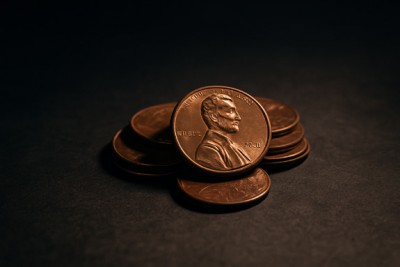
After 230 years of production — and with more than 250 billion pennies circulating in the American economy — President Trump has directed the U.S. Mint to cease minting the one-cent coin. The decision follows decades of debate, as each penny costs several cents to manufacture, making continued production financially impractical. Ending the minting process is projected to save taxpayers an estimated $56 million annually.
With this move, the United States joins countries such as Canada, Australia, and New Zealand, all of which have already phased out their lowest-denomination coin. While pennies will remain legal tender, no new ones will be produced. Cash purchases will now be rounded to the nearest five cents, whereas electronic payments will continue to be charged to the exact cent. Sales-tax calculations that sometimes result in half-cent totals — and which already vary by state — will continue to depend on each state’s rounding policy. In an amusing cultural twist, some have noted that the familiar expression “penniless” may lose its literal meaning, as even the wealthiest individual could technically now be without pennies.
This modern financial development brings to mind a fascinating episode involving ancient coins and the world of Chazal. Archaeologists routinely uncover coins from all eras of history, each carrying its own story and context. Years ago, R’ Aharon Dovid Dunner — a brother-in-law of Rav Matisyahu Salomon zt”l — described how scholars succeeded in assembling a complete set of the various coins referenced throughout Chazal, accurately identifying each one by name and historical use.
When Rav Elyashiv zt”l learned of this achievement, he asked that the collection be brought to him. The coins were placed before him, and he examined them silently for several minutes. Finally, he looked up and remarked:
“I now understand many statements of Chazal more clearly; several questions I have carried for years are now answered.”
He explained that certain sugyot — such as the Gemara’s comparison between the first light of dawn and the contrast between two specific coins — became instantly clearer once he could visualize their actual colors and textures. Other halachic discussions involving differences in size or appearance likewise took on new depth when paired with the physical reality of the coins themselves.
As America retires its smallest coin, we are reminded that even the simplest objects can unlock deeper meaning. Whether in the world of economics or in the study of Torah, small details often illuminate profound truths — and sometimes, as Rav Elyashiv demonstrated, the smallest coin can shed the greatest light.
By S.R.
Farewell To The Penny — And A Timeless Lesson From Chazal
Typography
- Smaller Small Medium Big Bigger
- Default Helvetica Segoe Georgia Times
- Reading Mode