


Queens is now home to one of the world’s largest concentrations of Bukharian Jews. In Bukhara itself, the ancient community that gave Bukharian Jewry its name has dwindled to only a fraction of its former size.
That reversal has created an unusual reality: Many of the people, families and institutions best positioned to preserve Bukhara’s Jewish legacy now live thousands of miles from the synagogues, homes and cemeteries that carry that history.
Estimates of the number of Jews remaining in Bukhara vary. Some census figures are higher, while local observers and preservation organizations place the active community below 200. By contrast, tens of thousands of Bukharian Jews live in Queens, where 108th Street through Forest Hills and Rego Park has long been known as “Bukharian Broadway.”
The old Jewish mahallah in Bukhara still contains narrow streets, traditional courtyard homes and an active synagogue whose history reaches back centuries. Yet much of the neighborhood is no longer Jewish. Historic houses have changed ownership, been altered or converted into guesthouses, workshops and tourism businesses. The World Monuments Fund has warned that traditional homes in the old Jewish quarter face disappearance and inappropriate renovation.
The threat is not necessarily deliberate destruction. Heritage can vanish more quietly as roofs deteriorate, courtyards are remodeled beyond recognition, inscriptions are discarded or gravestones become illegible. A building can remain standing even as the knowledge that it was once a Jewish home, school or communal space disappears.
UNESCO recognizes Bukhara’s historic center as a World Heritage Site and notes broader threats including deteriorating earthen structures, development pressure and the loss of traditional building methods. Formal protection of the city, however, does not automatically ensure that its specifically Jewish history is documented or interpreted accurately.
Bukharian Jews abroad have already helped support synagogues, cemeteries and communal needs in Central Asia. The next stage requires more than occasional donations. It calls for a coordinated preservation effort linking Queens institutions, historians, families, religious leaders and trustworthy partners in Uzbekistan.
That effort could begin with a comprehensive inventory of Jewish sites in Bukhara, Samarkand, Tashkent and the communities of Tajikistan. Synagogues, cemeteries, former Jewish schools, courtyard homes and other sites should be identified, photographed and mapped. Inscriptions and gravestones should be documented before weather and redevelopment make them unreadable. Communal records should be cataloged alongside the places and institutions they document, preserving not only individual objects but the stories connecting them.
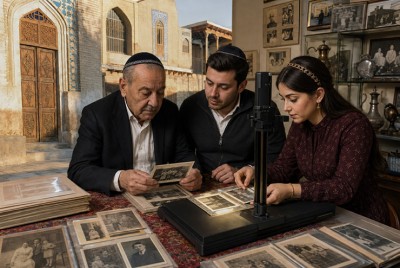
Queens does not have to begin this work from nothing. Aron Aronov, who emigrated from Tashkent in the early 1990s, founded the Bukharian Jewish Museum in Rego Park to collect artifacts from Jewish life in Central Asia and preserve the community’s cultural identity for younger generations. The museum provides an existing foundation and a valuable point of connection between the thriving diaspora and the world from which it came.
The larger opportunity is to connect that work with preservation on the ground. A photograph of a synagogue becomes more valuable when researchers know exactly where it stood. A family document means more when descendants can identify the mahallah, courtyard or congregation connected to it. A cemetery photograph becomes historical evidence when the name, location and inscription are properly recorded.
Preservation must be conducted respectfully and in partnership with the communities and governments responsible for the physical sites. The goal should not be to remove the history from Central Asia, but to make certain that no single fire, redevelopment project, deteriorating structure or passing generation can erase it.
This is where the responsibility of a successful diaspora becomes clear.
Bukharian Jewish life has not disappeared. It has been transplanted and rebuilt with remarkable strength in Queens, Israel and elsewhere. The community now possesses institutions, professionals, philanthropists, scholars and families with the ability to help protect the places earlier generations left behind.
The companion feature in this issue asks whether another generation will understand the language of its grandparents. The preservation challenge extends thousands of miles farther: Will that generation still be able to see, identify and understand the physical world those grandparents came from?
One challenge begins at the family table. The other begins in the streets, synagogues and cemeteries of Central Asia. Both are ultimately about memory — but they require different answers.
A thriving diaspora should be able to look forward while also protecting the streets, sanctuaries and stories from which it came.
From Queens To Bukhara: Who Will Preserve A Vanishing Jewish Legacy?
Typography
- Smaller Small Medium Big Bigger
- Default Helvetica Segoe Georgia Times
- Reading Mode