


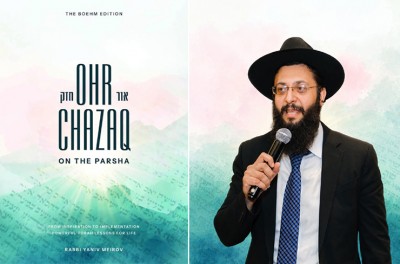
Rabbi Yaniv Meirov’s new book pairs a two-minute video with every Torah portion — and quietly builds one of the smartest Jewish engagement models I’ve seen.
We’ve all lived the moment. You’re at a Shabbat table, a Sheva Brachot, a wedding, and a voice cuts across the room: “Say a few words.” Your face turns — as Rabbi Yaniv Meirov puts it — “red, white and blue,” shaking, nervous, thinking, “I have nothing to say.”
Meirov wants to erase that moment forever. And he thinks he’s found the tool to do it.
The founder and CEO of Chazaq, the Queens-based organization that has spent two decades “igniting the spiritual spark of thousands of people,” Meirov is now bringing that same approach to print. His new book, Ohr Chazaq on the Parsha, has already logged 13,000 preorders before reaching most shelves. Its distinguishing feature is built for the way people consume information today.
A Book for a World That Stopped Reading
Open to any week’s portion and you’ll find a short, sharp insight — a story, a parable, an idea you can actually carry. Next to it is a QR code. Scan it, and up pops a two-to-three-minute video of the rabbi delivering that same dvar Torah himself.
“The cool thing about this book,” Meirov told me, “is that a lot of people don’t like to read. So there is a QR code you can scan for each week’s Parsha before Shabbat, and you’ll watch a two-to-three-minute video of yours truly giving over that Dvar Torah.”
That instinct — meeting people where their attention actually lives — is the whole game.
We live in a short-form world. I’ve sat at Meirov’s events and felt genuinely lifted, then walked out an hour later already fuzzy on what, exactly, had moved me. This book fixes that gap. It takes the inspiration of the room and puts it somewhere you can find it again.
“It’s the first of its kind — a Parsha book with videos on it that’s ever been around.”
The Cure for “I Didn’t Prepare”
The problem Meirov keeps circling back to is beautifully mundane.
“Many, many times you see people get up there and say, ‘The truth is I didn’t prepare,’ or ‘I don’t really have anything to say,’ and they just say ‘Blessings and success,’ and that’s it,” he said.
His book is, in the most practical sense, a cheat sheet for grace under pressure: “You can review it right before you go up there.”
The marketing team has already turned the idea into scenes. In one, a father asks his kids at the Shabbat table to say a few words. “No, no, no,” they protest — until one pulls out the book, shares an idea, and the father lights up: “Wow, that’s amazing.” In another, the nervous wedding guest called to the mic gets a do-over — book in hand this time — and earns a standing ovation.
Six Years, One Shul, Thousands of Notes
This is not a weekend project.
“This is six years’ worth of material that I’ve been giving over in my shul, Congregation Charm Circle, every Shabbat,” Meirov said.
Each week he studied, opened sefarim, took notes, recorded the talks, and eventually handed the trove to trusted friends who mined it for the sharpest material.
“Everyone loves it,” he said of the early manuscript readers. “The vibes, the energy is amazing.”
Printed in Israel and distributed by Feldheim, the book is already available for preorder on Amazon. Ask Meirov to name a favorite dvar Torah inside and he stalls like a good parent.
“That’s a complicated question,” he laughed. “It’s like asking your favorite child.”
He offered one anyway, from Shoftim. The verse commands judges and officers “in all your gates.” Meirov relayed a teaching of the Shelah HaKadosh: Those gates can also be understood as our own openings to the world.
“You have two eyes — what are those eyes looking at? You have two ears — what are you listening to? People are extra careful about what goes into their mouth being kosher. But how about what comes out of your mouth? That has to be kosher as well.”
Where the Joy Comes In
This is the part that speaks to the work I care about most — what I call Jewish Joy: the idea that visible, unapologetic, happy Jewish identity is the strongest answer we have to a loud and fearful moment.
Meirov didn’t hesitate when I raised it.
“I’m a very big fan of being proud and happy with our Judaism,” he said. “That’s what we’ve been teaching all of our students — kids in public schools — explaining how proud we should be. Don’t be scared; be prepared.”
Then he offered a Hebrew wordplay that has stayed with me: simcha, joy; sameach, happy; and tzomeach, growing.
“When a person grows spiritually,” he said, “that’s true joy — because growth is happiness.”
Fear tells you to shrink. Joy tells you to grow.
“Don’t be scared; be prepared. Know what Judaism is all about, learn about it, grow.”
From Inspiration to Implementation
The book’s cover carries a promise: from inspiration to implementation. Meirov breaks it into what he calls the three I’s.
“Throughout the day we get a lot of information,” he said. “Sometimes that becomes inspiration — ‘Wow!’ But very few people do the last one: implementation. Actually doing something about it, changing your ways, becoming a better person.”
His hope isn’t a nod and a “that was nice.” It’s a discussion that carries through the week and across generations at the table.
One page in the book stacks the images: a parent and child, two friends over coffee, a teacher and student, grandparents and grandchildren.
“The idea of the book,” he said, “is for everyone and anyone, all generations, young and old.”
The Domino That Started at Fifteen
For all the talk of scale, Meirov says none of it was engineered.
“People think, ‘Oh, you probably planned that out.’ The whole organization just came about,” he said.
It began 20 years ago with a Parsha newsletter. His older brother had run one in Hebrew, then got married and stopped. Meirov, all of 15, was annoyed enough to start his own in English.
“One thing led to another in a domino effect,” he recalled.
The first lecture they organized, expecting only a small crowd, drew 500 people. It wasn’t even called Chazaq yet.
Two decades later, the pattern is repeating. Friends pushed him to write the book. Now 13,000 copies have been preordered, a 40-stop tour is planned from Arizona to Canada, and requests are already coming in for volumes on the Chagim, dating and marriage, and parenting.
Here is what makes this more than a publishing story.
A local Queens organization has taken a model built on presence — the room, the energy, the rabbi at the front — and made it portable. Book, video, shareable link. A community, as I keep insisting, is not defined by a ZIP code. Meirov has taken a deeply local form of Jewish engagement and handed it a passport.
That’s the quiet revolution here. Not the QR code itself, but what it represents: Torah you can carry, review, share, and — finally — implement.
Fear is loud. But a proud, prepared, joyful Jew with something to say is louder.
And now, apparently, there’s a book for that.
Ohr Chazaq on the Parsha is available for preorder on Amazon and through Feldheim and will reach Jewish bookstores worldwide by the High Holidays.
Aaron Herman is a nonprofit fundraiser, video journalist, and growth strategist specializing in Jewish storytelling and advocacy. He is co-founder and CEO of IMPACT, a movement that organizes, empowers, and mobilizes communities against hate while celebrating Jewish joy. His reporting has appeared in national and Jewish media outlets. He holds a BA from Binghamton University and an MPA from NYU’s Wagner School. Follow IMPACT at @joinimpactnow. Aaron can be reached at This email address is being protected from spambots. You need JavaScript enabled to view it..
Fear Is Loud. Joy Is Louder. And Now It Has a QR Code.
Typography
- Smaller Small Medium Big Bigger
- Default Helvetica Segoe Georgia Times
- Reading Mode