

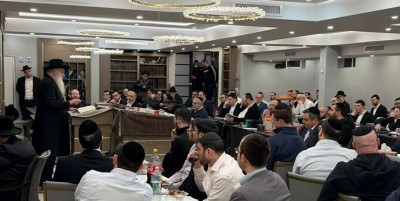
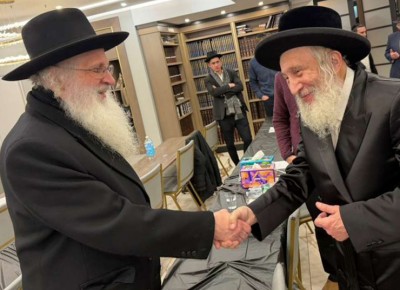
This past Wednesday evening, March 18, the halls of Congregation Bait Yosef D’Ulem on 72nd Road and 141st Street were filled with the vibrant sound of Torah, as men from across Kew Gardens Hills gathered for a special Rosh Chodesh Nissan Yarchei Kallah.
Hosted under the leadership of Rav Yaakov Yitzchok Friedman, the Ulemer Rav, the shul—widely known for its nonstop Shacharit minyanim—once again served as a central hub of Torah and avodas Hashem for the neighborhood.
The evening opened with chavrusa and chaburah learning, as participants worked through thoughtfully prepared mareh mekomos. The room buzzed with energy—voices rising and falling in animated discussion, friends and neighbors learning side by side, setting the tone for a night of meaningful preparation ahead of Pesach.
The highlight of the evening was an in-depth iyun shiur delivered by HaGaon HaRav Osher Kalmanowitz, Rosh HaYeshivah of the Mirrer Yeshivah, who presented a powerful and practical framework for understanding our relationship with Yetziat Mitzrayim.
Focusing on the Rambam, Rav Kalmanowitz explored the contrast between two familiar mitzvot: the mitzvah of Sipur Yetziat Mitzrayim on the night of the Seder, and the daily obligation to recall the Exodus through Kriat Shema. While often viewed as similar, the Rav showed that they operate on entirely different levels.
On Leil Pesach, the mitzvah is to tell the story—l’saper. It requires engagement, structure, and interaction. Questions must be asked, answers developed, and the journey from slavery to redemption must be expressed clearly and thoughtfully. It is not enough to simply recall the events; the mitzvah demands active transmission.
But during the rest of the year, the obligation is different. It is not sipur, but something else entirely.
Here, Rav Kalmanowitz highlighted a striking nuance in the language of the Rambam: instead of describing the daily mitzvah as l’zkor—to remember—the Rambam uses the term l’hazkir—to mention.
That distinction, the Rav explained, is not stylistic—it is foundational.
Remembering can take place internally. A person can think about something and fulfill a mitzvah of zechirah. But hazkarah—mentioning—requires expression. It must be said. One cannot “mention” something silently.
This insight reshapes how we understand the daily inclusion of Yetziat Mitzrayim in Kriat Shema. It is not simply a quiet moment of reflection, but a verbal reaffirmation—something that must be spoken, morning and night, as part of how we define ourselves as a people.
Building on this idea, Rav Kalmanowitz offered a deeper understanding of how Chazal connect Yetziat Mitzrayim to other mitzvos. When we speak about Shabbat, we are not merely fulfilling an independent obligation—we are incorporating the mention of the Exodus into that framework.
It is not two separate mitzvot placed side by side, but one integrated expression. The act of verbalizing Shabbat naturally includes hazkaras Yetziat Mitzrayim.
This approach also sheds light on the well-known ruling of the Magen Avraham, that even in the absence of formal kiddush over wine, one can fulfill the core concept through the verbal mention of Shabbat within tefillah. The mitzvah of hazkarah is achieved through speech itself.
The shiur concluded on a deeply meaningful note. Turning to the language of redemption, Rav Kalmanowitz addressed the phrase “V’hayisi lachem l’Elokim”—“I will be for you a G-d.”
Quoting the Rabeinu Yonah, the Rav explained that Hashem is often described as a Keil Mistater—a concealed G-d. We come to recognize Him through His actions. When He redeems us, when He intervenes in history, His presence becomes revealed.
Through Yetziat Mitzrayim, klal Yisrael became the vessel through which that revelation is experienced. Redemption was not only about leaving Egypt—it was about entering a relationship in which we can speak about, recognize, and live with awareness of Hashem.
Following the shiur, the tzibbur joined together for Maariv, bringing the evening to a close with a sense of unity and elevation. Participants then enjoyed a generous hot fleishigs buffet, where the conversations continued—reviewing the shiur, reconnecting with friends, and carrying the inspiration forward.
The event drew participation and support from across the Kew Gardens Hills Torah community, including Agudath Israel of KGH, Congregation Ahavas Yisroel, Congregation Charm Circle, Beit Medrash Zichron Shalom, Beit Yosef D’Ulem, Bet Medrash Ohel Michael, Chevrah Bais Dovid D’Lantzut, Kehilat Derech Emunah, Kehillat KGH, Kehillas Torah Temima, Khal Nachlas Yitzchok, Yeshiva Ohel Simcha, Young Israel of Queens Valley, and the L.A.T.E. Shiur.
As Rosh Chodesh Nissan ushers in a season of renewal and redemption, the Yarchei Kallah stood as a powerful reminder of what defines the community: Torah, achdut, and a shared commitment to grow—together.
A Night Of Torah, Unity, And Preparation: Rosh Chodesh Nissan Yarchei Kallah Uplifts Kew Gardens Hills
Typography
- Smaller Small Medium Big Bigger
- Default Helvetica Segoe Georgia Times
- Reading Mode