


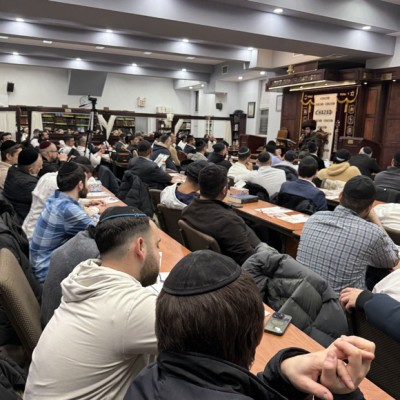
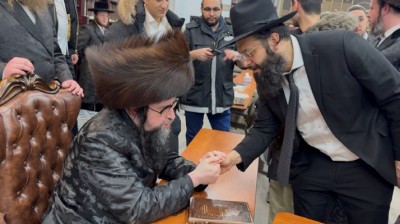
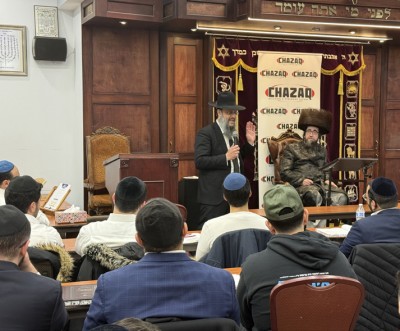
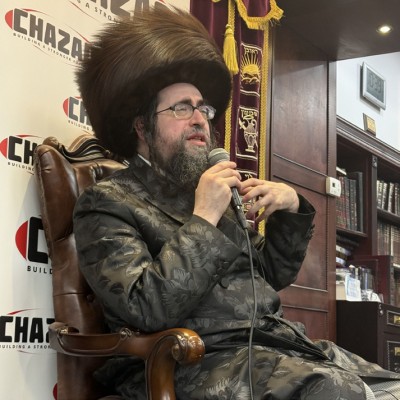
On Motza’ei Shabbat, February 21, a large crowd from across Queens gathered at Ohel Simcha in Kew Gardens Hills for an evening of inspiration as Chazaq welcomed renowned speaker Rav Shulem Landau, widely known as the Rivnitz Rav. The program brought together attendees from neighborhoods throughout Queens and beyond for an evening devoted to strengthening Jewish identity, reinforcing the foundations of the Jewish home, and encouraging greater communal responsibility.
Opening remarks were delivered by Chazaq Director Rabbi Ilan Meirov, who spoke passionately about the importance of unity and outreach in today’s challenging environment. Looking out at the diverse crowd that had assembled, Rabbi Meirov noted how meaningful it was to see Jews from different communities and backgrounds coming together to hear words of Torah and encouragement.
Rabbi Meirov emphasized the growing need for outreach, particularly among Jewish youth who are increasingly disconnected from their heritage. Through Chazaq’s expanding initiatives, thousands of students across the tri-state area are finding opportunities to reconnect with their roots through after-school programs, mentoring, Shabbatonim, and community learning experiences.
Chazaq currently operates programs in more than 25 locations, serving students from public schools across the region. Over the past nine years alone, more than 11,000 young people have participated in these initiatives, with over 2,300 eventually transitioning into Jewish educational environments.
“We’re not asking everyone to become teachers,” Rabbi Meirov told the audience. “We’re asking people to care. Every person here knows a cousin, a neighbor, or a friend whose child is in public school. Sometimes all it takes is opening a door or making a referral.”
“Sometimes all it takes is opening a door for one child. One act of care can change a life.”
To illustrate the impact of one person’s dedication, Rabbi Meirov shared a remarkable story connected to Jamaica Hospital, located only a short distance from the venue.
Years ago, at the request of Rav Ovadia Yosef, ztk"l then the Sephardic Chief Rabbi of Israel, Rabbi David Ozeri shlit"a of Brooklyn was asked to arrange accommodations and support for Rav Ovadia’s son, Rav David Yosef, shlit"a who needed specialized medical treatment in the United States. The surgery could only be performed at Jamaica Hospital in Queens.
Rabbi Ozeri personally took responsibility for every detail — arranging housing, transportation, meals, and assistance throughout the family’s stay — ensuring that Rav David Yosef and his family could focus entirely on the procedure and recovery.
Today, Rav David Yosef serves as the Rishon LeZion, the Sephardic Chief Rabbi of Israel. Rabbi Meirov explained that acts of chesed carried out quietly and without recognition can ultimately influence the future in ways no one could have predicted.
“That’s the power of one person who cares,” he said.
Following the introduction, Rav Shulem Landau took the podium and delivered a thought-provoking address that combined Torah insight, practical wisdom, and relatable stories.
Rav Landau began by exploring the difference between temporary inspiration and lasting change. People often experience powerful moments of emotion during lectures or gatherings, he explained, but those feelings can quickly fade if they are not internalized.
Communities, he said, must strive to create environments that produce leaders — individuals who absorb inspiration deeply enough that it becomes part of who they are.
Using a modern analogy, Rav Landau compared life to a GPS navigation system. Even the most sophisticated system cannot guide someone properly if it does not first know its current location.
“In life,” he said, “before we start giving directions to others, we must first understand where we ourselves are.”
A significant portion of Rav Landau’s address focused on marriage and the concept of shalom bayit. With warmth and humor, he challenged a common misconception that peace in a home means the absence of disagreements.
True harmony, he explained, emerges when differences between two people become the source of growth rather than conflict.
Drawing on the symbolism of the Havdalah candle, Rav Landau described how two flames joined together to create a stronger and brighter light. In the same way, a healthy marriage does not eliminate differences between husband and wife but transforms those differences into unity.
“Wholeness is not two people sitting next to each other. Wholeness is when two people create light together.”
He stressed that disagreements are not a sign of failure in a marriage. When approached with humility and understanding, they can become opportunities for deeper connection.
Throughout his talk, Rav Landau returned to the theme of personal responsibility, particularly within the family. Leadership, he explained, begins at home long before it extends to the wider community.
Using a striking metaphor, he compared the role of a husband to that of the sun, which constantly provides light regardless of whether anyone acknowledges it.
“The sun keeps shining,” he said. “Even when the world turns away, the sun never stops doing its job.”
Children, he added, absorb their parents’ values primarily through example rather than instruction. A parent’s presence and behavior shape the home far more powerfully than lectures or rules.
Rav Landau also addressed the topic of outreach and how communities can bring fellow Jews closer to Torah and tradition. The key, he explained, is not pressure but warmth.
“You don’t force light. You become light — and people naturally come closer.”
He urged the audience to recognize the unique strengths within every child and individual. Too often, he warned, society attempts to mold everyone into the same framework, overlooking the fact that each person has been created with different talents and energies.
Throughout the evening, Rav Landau emphasized that leadership is not reserved for a select few. Every individual possesses the ability to influence others — through kindness, example, and genuine care.
As the program concluded, Rav Landau offered a blessing that everyone present should merit becoming a source of light within their homes and communities.
In an era when many Jewish communities face uncertainty and spiritual challenges, the evening served as a reminder that the strength of klal Yisrael ultimately depends on individuals who are willing to shine — beginning with their own families and extending outward to the world around them.
Judging by the packed room and the attentive audience at Ohel Simcha that evening, the message clearly resonated deeply with the Queens community.
By Shabsie Saphirstein
Rivnitz' Rav Shulem Landau Inspires Queens Audience
Typography
- Smaller Small Medium Big Bigger
- Default Helvetica Segoe Georgia Times
- Reading Mode