


A powerful one-night performance gathered 26 artists and the millennia of Jewish letters in support of rebuilding Kibbutz Be’eri.
When people walk into Carnegie Hall, they expect music. A symphony, perhaps. A famous soloist. Something polished and beautiful.
What the nearly 2,800 people seated in Stern Auditorium on February 24 did not expect was to find themselves moved to tears by a simple letter written on thin blue airmail paper.
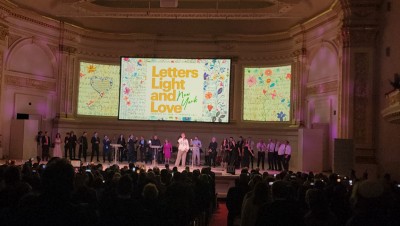
Yet that was precisely the effect of Letters, Light and Love, a sweeping theatrical production that stitched together Jewish letters written across three thousand years of history. The New York premiere brought actors, musicians, activists, and writers together in a performance that felt part concert, part dramatic reading, and part communal gathering.
Produced by Michal Noé and Sarah Sultman, written by Rob Messick, and presented with the support of UJA-Federation of New York, the event raised funds for the rebuilding of Kibbutz Be’eri, one of the Israeli communities devastated during the October 7 attacks.
The evening never settled comfortably into one category. It wasn’t just theater, and it wasn’t simply a concert. For many in the room it felt closer to something communal—a moment of reflection and connection during a difficult year for the Jewish world.
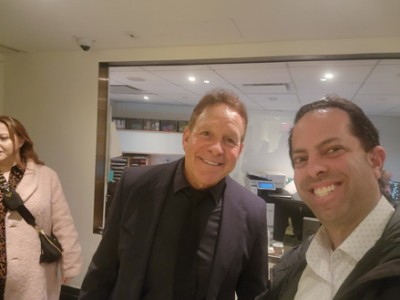
After the performance I had the opportunity to speak with producer Sarah Sultman about how the idea came together and why she felt the moment demanded it.
Sultman’s path to producing a show at Carnegie Hall was anything but conventional. Before entering the cultural world she worked in investment management in London. Later she became involved in art consulting and eventually spent a decade helping build Gesher, a Jewish school serving children with autism and special needs.
Looking back, she sees a common thread.
“I’ve always tried to do things that matter,” she said.
The idea for Letters, Light and Love began shortly after October 7, when Sultman joined one of the first British delegations visiting the communities near Gaza. The experience left a deep impression.
“At the end of the trip,” she recalled, “someone asked us, ‘What are you going to do now?’ People talked about fundraising or posting online. I just needed time to process everything.”
Her way of processing turned out to be deeply personal. For years Sultman had kept every letter she ever received—notes from camp, letters from friends, messages from family—carefully saved in boxes.
At the same time she found herself increasingly frustrated hearing claims that Jews lacked a deep historical connection to the Land of Israel.
“The entire story of Judaism is tied to Zion,” she said. “You see it everywhere—in our texts, in our history, and in the letters Jews have written to one another for centuries.”
That thought sparked the idea of telling Jewish history through the voices of Jews themselves.
The research quickly expanded. Sultman searched archives at the National Library of Israel as well as collections in Cambridge, University College London, and the Wiener Library in London. Soon hundreds of letters covered her dining room table as she arranged them chronologically.
But historical documents alone do not make a performance. To shape the material into something audiences could experience emotionally, the producers brought in scriptwriter Rob Messick.
“We didn’t want a lecture,” Sultman explained. “We wanted people to feel the connection.”
The letters chosen for the performance ranged widely—from ancient texts and writings attributed to Maimonides to messages sent by Israeli soldiers during the War of Independence and even letters written during the current war.
Despite the centuries separating them, the themes were remarkably consistent: longing, faith, resilience, and hope.
The choice of venue was also intentional. Rather than presenting the show in a synagogue or Jewish cultural center, the producers wanted a stage that symbolized Jewish life flourishing within the broader world.
“Jews have built lives in the diaspora,” Sultman said. “We’re proud of that. We wanted to stand in a place like Carnegie Hall.”
Initially the venue suggested a smaller auditorium with about 500 seats.
The producers declined.
“We said we’re going big,” she recalled with a laugh.
Two producers from London booked a 2,800-seat hall in New York—and filled it.
The cast itself reflected the wide reach of Jewish culture. Performers included Michael Aloni, David Draiman, Tovah Feldshuh, Debra Messing, David Schwimmer, Julianna Margulies, Matisyahu, Noa Tishby, Amy Schumer, and Eli Sharabi, among others.
Each brought a different voice to letters that stretched across centuries.
One of the most memorable moments came when Amy Schumer read a lighthearted letter written by a young woman spending a year in Israel. The tone was casual and familiar to anyone who had written home during a gap year.
After the show I mentioned to Sultman that the letter sounded like someone I might know.
She smiled.
“That was my letter,” she said.
The photographs projected on the stage were hers as well.
“I almost didn’t include it,” she admitted. “But that letter could have been written by thousands of Jewish kids in the ’90s.”
It was exactly that mix of personal memory and shared experience that gave the evening much of its emotional power.
Another memorable moment came when Noa Tishby sang “Somewhere Over the Rainbow,” first in English and then in Hebrew. Sultman noted that the song itself was written in 1938 by Jewish composers Harold Arlen and Yip Harburg, just before the Holocaust.
“It’s about hope,” she said. “And we felt it was important to reclaim that message.”
Perhaps the most powerful moment of the night came when Eli Sharabi took the stage. Sharabi had spent eleven months in Hamas captivity, and hearing him describe how he tried to observe Shabbat while held in the tunnels left the hall in stunned silence.
The performance opened with a letter from Israeli astronaut Ilan Ramon reflecting on purpose and responsibility. It closed with words from Rabbi Jonathan Sacks, delivered by Tovah Feldshuh, urging Jews to embrace their identity with pride.
“You’re a Jew,” Sultman said simply. “Own it. Love it.”
Originally the show had been scheduled for Monday night, but a major snowstorm threatened to derail everything. Carnegie Hall offered Tuesday as an alternative.
Only the ticket holders and cast knew about the change.
“There was no public drama,” Sultman said. “We trusted that people would come.”
They did.
After the performance ended, people lingered in the lobby rather than rushing out the doors. The mood felt less like the end of a theater performance and more like the conclusion of a shared experience.
“I needed this,” several people said.
The evening closed with the entire audience singing Hatikvah, followed by a performance from Matisyahu that lifted the energy in the room once more.
For the producers, the partnership with UJA-Federation of New York proved essential. The organization served as both sponsor and fiscal partner, helping ensure that the proceeds from the evening would support the rebuilding of Kibbutz Be’eri.
Eric S. Goldstein, CEO of UJA-Federation of New York, reflected on that connection, noting that the bond between Jewish communities transcends geography and time.
Following earlier performances in London and the New York premiere, discussions are now underway about bringing the production to Los Angeles, Toronto, Sydney, and Argentina.
Sultman described the project as something like a modern Seder.
Not a memorial. Not a lecture.
A living act of Jewish storytelling.
Walking out of Carnegie Hall that night, the sense lingered that the evening had done something more than entertain an audience. It reminded people of a story that stretches far beyond any single generation.
And at a moment when Jewish identity is being tested in public arenas across the world, that reminder felt both powerful and necessary.
‘Letters, Light And Love’ Brings Jewish Memory — And Emotion — To Carnegie Hall
Typography
- Smaller Small Medium Big Bigger
- Default Helvetica Segoe Georgia Times
- Reading Mode