


An Evening Of Heart And Torah With Rabbi Maor Bendel
Presented Monday Evening, January 12, by Chazaq at Ohr
Hatorah in Kew Gardens Hills, in conjunction with MeorotOn the winter Monday night of January 12 in Kew Gardens Hills, the walls of Ohr Hatorah seemed to hold more than sound. A packed room settled into an attentive hush as Rabbi Bendel’s measured cadence set the tone for an evening of reflection. They held feeling, they held ache, and they held hope. As Rabbi Maor Bendel spoke—carefully weaving Midrash, Chazal, and lived experience into a single, flowing message—it became clear that this was not just a shiur about Moshe Rabbeinu. It was a call to the heart.
Sensitivity Before Salvation
As Parashat Shemot opens the story of Jewish exile and redemption, Rabbi Bendel returned the audience to the Torah’s earliest description of leadership. Not miracles or power—but sensitivity. Before the makot, before the drama of Egypt’s collapse, the Torah introduces Moshe Rabbeinu through one defining moment: “Vayigdal Moshe vayetzei el echav vayar b’sivlotam”—Moshe grew up, went out to his brothers, and saw their suffering.
Moshe Rabbeinu, Rabbi Bendel reminded the audience, was born into greatness. His father Amram was among the leaders of the generation, and his birth filled the home with light. He was destined for something extraordinary from the moment he entered the world. And yet, none of that alone made him worthy to redeem klal Yisrael. What made Moshe different was not his brilliance or lineage, but his heart.
He could have remained in the palace. He could have lived comfortably, untouched by the suffering of his brothers. Instead, Moshe went out to see their pain—and not as a spectator. Chazal tell us that he carried their burdens on his own shoulders, crying with them, feeling their anguish so deeply that he uttered words almost impossible to imagine: “I wish I could die to take away your suffering.”
That willingness to feel another’s pain, Rabbi Bendel explained, is what set Moshe apart.
When Redemption Waits
One of the most striking moments of the evening—and one with profound relevance for our own lives—came when Rabbi Bendel addressed Moshe’s initial refusal to accept Hashem’s command to redeem the Jewish people. For seven days and seven nights, Moshe argued. Not out of fear. Not out of doubt. But out of concern for his brother Aharon. Perhaps Aharon would feel even the slightest pain in his heart seeing his younger brother chosen as leader. And if so, Moshe said, it wasn’t worth it—even if redemption itself was delayed.
Let that sink in. A nation enslaved. Babies dying daily. And still, Moshe hesitated—for a maybe of emotional pain in another person’s heart.
That, Rabbi Bendel emphasized, is the Torah’s definition of greatness.
The Cost Of Good Intentions
From there, the message widened, touching on stories that felt uncomfortably close to home—family tensions, communal disagreements, and the quiet moments of daily interaction where words and actions can either heal or wound. A mitzvah done at the expense of another’s dignity is not a mitzvah Hashem desires. Even good intentions do not grant permission to cause pain. Like fire that burns regardless of intent, hurting another person carries consequences—not punishments, but realities woven into the fabric of the world.
The room grew quiet as Rabbi Bendel shared story after story: of knowing when to speak and when to step back; of recognizing when an argument will uplift and when it will only harden hearts; of understanding that sometimes the holiest act is silence, patience, or simply walking away.
But the evening was not heavy—it was luminous.
He told of ordinary people becoming angels without knowing it. Of knocking on a door with a guitar and a drum and discovering that they were the answer to a woman’s tefillah. Of the Baal Shem Tov’s teaching that to see Eliyahu HaNavi in your life, you must first be someone else’s Eliyahu HaNavi.
The shiur, presented by Chazaq in conjunction with Meorot at Ohr Hatorah, reflected the shared mission of the organizations—to bring Torah that speaks not only to the mind, but to the heart, and to translate timeless values into lived Jewish life.
Living With Care
Then, with striking honesty, Rabbi Bendel turned inward. He spoke of marriage, of learning, and of responsibility—of the delicate balance between Torah obligations and the hearts of those waiting at home. He described moments when the right choice was to close the sefer, help with bedtime, or simply stay.
Hashem, he reminded the audience, does not want mitzvot soaked in someone else’s tears.
Moshe Rabbeinu became the redeemer not because he was powerful, but because he was humble. “V’ha’ish Moshe anav me’od.” True humility, Rabbi Bendel explained, is knowing that everything comes from Hashem—and that awareness makes room for others. When a person knows he is not the owner, only the messenger, he can no longer trample another’s feelings in the name of righteousness.
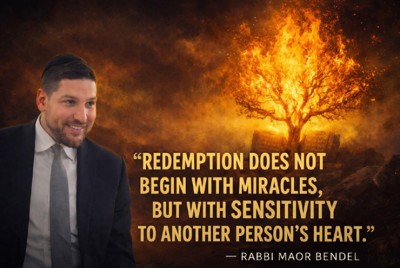
As the evening drew to a close, the takeaway was clear and quietly demanding: redemption does not begin with miracles, but with sensitivity—with noticing, with pausing before speaking, and with asking, “Will this hurt someone?” and caring enough to stop if the answer might be yes.
If we live that way—if we choose empathy over ego, heart over honor—we become redeemers in our own right. We become answers to tefillot we never heard spoken. And in doing so, may we be zocheh that Hashem becomes ours, just as we strive to be there for one another. Amen.
When Sensitivity Becomes Redemption
Typography
- Smaller Small Medium Big Bigger
- Default Helvetica Segoe Georgia Times
- Reading Mode