


An Evening of Faith, Light, and Torah in Loving Memory of Yosef Chaim ben Larisa Leah Yakubov
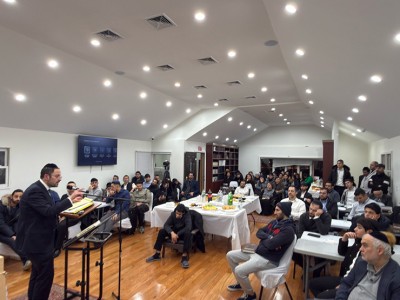
The main sanctuary of Congregation Charm Circle filled quietly on Tuesday evening, December 23. People arrived steadily—some alone, some with family, many greeting familiar faces with gentle nods rather than conversation. It was the kind of gathering where words felt secondary to presence.
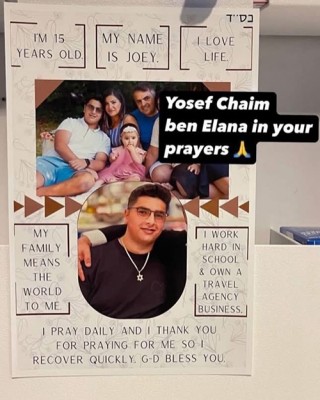
Hosted by Chazaq, “The Path to a Life of Emunah” was held in lezecher nishmat Yosef Chaim ben Larisa Leah Yakubov, a”h. Men and women of all ages came together not for answers, but for strength—to learn, to reflect, and to elevate a young neshamah through Torah and faith.
Misaskim had quietly set up four shiv’ah chairs for the aveilim. No announcement was made about them, but everyone noticed. They grounded the evening in reality: this was not theoretical emunah. This was lived emunah.
Robbie Aboff, Operations Manager at Chazaq, opened the evening with brief but heartfelt remarks. He welcomed the crowd and spoke about why this night mattered—not just for the family, but for the community as a whole.
During the shiv’ah, he shared, the parents repeatedly expressed gratitude to Hashem. They did not ask “why.” They said, simply and sincerely, “Ein Od Milvado.” That response alone, Aboff noted, was a lesson—one that framed the entire night.
Early reflections focused on the Torah’s description of the soul as light—“Ner Hashem nishmat adam.” A candle may not burn long, but that is not its purpose. Its role is to illuminate.
There are souls, Chazal teach, that come into this world briefly—not to struggle, but to complete their mission swiftly. Their impact is not measured in years, but in what they leave behind. Sitting in that sanctuary, it was hard not to feel that truth.
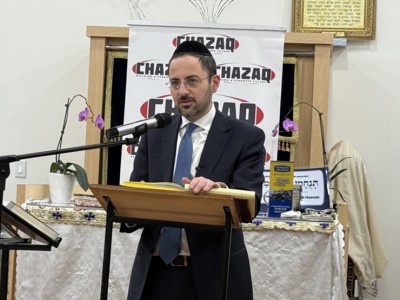
When Rabbi Yaakov Mizrahi took the podium, the room leaned in.
A Brooklyn-based maggid shiur, Rabbi Mizrahi is known for his ability to speak plainly and powerfully—blending Torah, story, and emotion without distance or formality. His shiurim, delivered locally and to thousands online, center on one core idea: living with Hashem in real life.
The rav began with a story that felt almost at first.
At a checkpoint in Israel, guards stopped a car that had already passed inspection. Something didn’t sit right. It wasn’t the plates—it was a bumper sticker that read Ein Od Milvado. That sticker made one guard pause, take a second look, and uncover that the car was stolen.
That pause changed everything.
“Emunah,” Rabbi Mizrahi said, “doesn’t only change what you believe. It changes what happens.”
Yosef HaTzaddik and a Life Without ‘Bad’
From there, Rabbi Mizrahi turned to Yosef HaTzaddik.
Yosef grew up in the home of Yaakov Avinu, immersed in Torah and holiness. And then, in a single moment, it was all stripped away—betrayed by his brothers, sold into slavery, imprisoned in Egypt for years.
By all logic, Yosef should not have survived spiritually. Even his own brothers assumed that if he was alive, he must have fallen.
But Yosef didn’t fall. He rose.
Rabbi Mizrahi explained that Yosef lived with one constant awareness: Hashem is with me. So deeply did he internalize this that he could not even accept the idea that something in his life had been “bad.” When his brothers later suggested they had wronged him, Yosef wept—not from pain, but from confusion. In his world, nothing that came from Hashem was purposeless.
Not Alone—Ever
One of the most moving moments of the night came through a personal story.
Rabbi Mizrahi described disciplining his child by sending him to his room. Instead of leaving, he locked the door from the inside and sat on the floor beside him.
“You’re being punished,” he told his child. “But you’re not alone.”
That, he explained, is how Hashem relates to us. Even in moments of pain or consequence, Hashem does not walk away. He stays.
Rabbi Mizrahi stressed that it is not enough to believe Hashem runs the world, or even that everything He does is ultimately good. A Jew must know something deeper—that Hashem does everything with love.
He pointed to the Torah’s command to violate even Shabbat to save a single Jewish life, even if success is uncertain. That halachah, he said, reveals how precious every soul truly is.
As the evening came to a close, Rabbi Mizrahi asked each person to leave with something concrete in memory of Yosef Chaim—one small commitment: a bit more Torah, a step toward, a greater awareness of Hashem’s presence.
“One small move,” he said, “can change more than you imagine.”
People rose slowly from their seats. Some wiped away tears. Others sat quietly for a moment longer.
In memory of a child whose time in this world was heartbreakingly brief, the community left with something lasting—a reminder that light is not measured in years, but in the lives it touches.
And through emunah, Torah, and quiet growth, Yosef Chaim ben Larisa Leah Yakubov continues to illuminate the path forward.
By Shabsie Saphirstein
The Path To A Life Of Emunah
Typography
- Smaller Small Medium Big Bigger
- Default Helvetica Segoe Georgia Times
- Reading Mode