



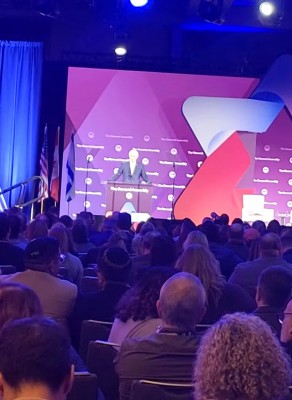
At the Jewish Federations of North America’s (JFNA) General Assembly, held November 8–10 in Washington, D.C., some 2,500 Jewish leaders gathered to discuss the future of Jewish communal life. Some of the most revealing conversations took place between sessions, when participants considered a question that extended well beyond the conference: How do we remain strong and joyful in the face of antisemitism?
Over two days of interviews, leaders, volunteers, and young advocates offered their own answers, drawing on experiences in Israel and across North America.
Showing Up
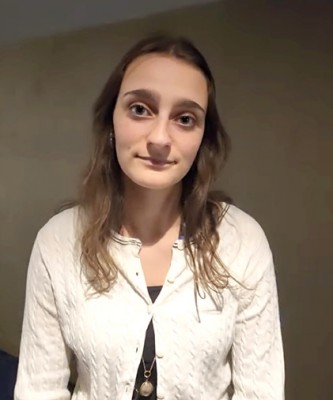
While leaders gathered inside, protesters assembled outside. Yair Elias, a teenager, went out to meet them. “I was a little nervous, a little scared, but also very aggravated,” he recalled. Then he decided: “We need to send a message to the whole world that as Jews, we’re proud and we’re not going anywhere.”
Social media, Elias explained, allows teenagers to advocate “from an anonymous account from behind the screen.” Showing up in person, however, “shows confidence and it shows that you’re not afraid.”
Amalia Antine, president of the Potomac Bnei Akiva chapter and a student at Berman Hebrew Academy, trains other teenagers to become leaders. Her advice for responding to antisemitism online: “Let’s post more than them. Let’s also show how amazing Judaism is.” She also encouraged young people to verify what they encounter online by asking, “Is this real?”
“Fight With Joy”
Comedian Ryan Turkienicz described humor as a source of resilience. “We won’t have the resilience to overcome them unless we get together in a room, make a few jokes,” he said. Laughter can also bridge differences: “They might still disagree with you, but you’ve had that connection.”
Pascale Bercovitch, a four-time Israeli Paralympian, lost both legs in a train accident as a teenager and considers the experience a blessing. “I have nothing to prove to anybody—not as a person, not as disabled, not as Jewish,” she said. After immigrating to Israel in 1985, Bercovitch became a pioneering wheelchair-using volunteer in the Israel Defense Forces (IDF). Today, she competes in adaptive surfing and has exchanged jerseys with athletes from Algeria and Iran. “When you have something you love in common,” she said, “we are all together.”
Bercovitch encouraged people to remain aware of antisemitism without allowing it to overwhelm them: “Fight with positiveness. Fight with joy.”
Light In The Darkest Places
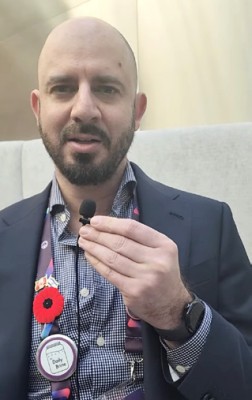
Jamie Lassner works with the Purple Vest Mission, led by Access Israel, which assists people with disabilities and older adults during emergencies. Lassner said the initiative helped evacuate more than 5,000 people from Ukraine. He recalled how Yelena, a 95-year-old Holocaust survivor, was stranded on the fifth floor of a building in Kiryat Shmona during the war with Iran. A volunteer named Mahmoud from Akko, who himself has a disability, carried her to safety. “I view it more as humanity,” Lassner said.
Peter Schwarzbein of the Aleph Institute works to ensure that “no one is alone or forgotten,” whether in prison or serving aboard a military vessel. “Even though somebody might make a mistake, they’re not a mistake,” he said. His approach to combating antisemitism begins with individual acts of kindness: “One little act, one little more light at a time.”
“The First Line Of Defense Is Your Neighbor”
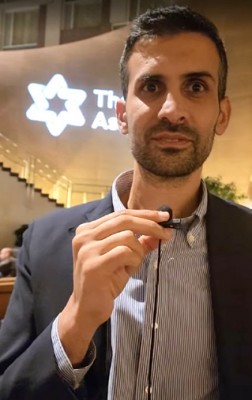
For Uri Shacham of Magen David Adom (MDA), saving a life can include comforting a frightened child after a missile strikes nearby. MDA volunteers use emergency response motorcycles to navigate traffic, and defibrillators are stationed at lottery kiosks across Israel. “We truly believe that the first line of defense is your neighbor,” Shacham said. During the war with Iran, he explained, artificial intelligence helped predict missile impact locations so ambulances could be dispatched before emergency calls arrived.
Shacham recalled that on October 7, 2023, MDA staffed 1,700 ambulances within an hour. Among those killed that day was MDA medic Aharon Haimov. Despite the danger, volunteers continued reporting for duty. “There was not one person who said, ‘I’m staying home.’” According to Shacham, MDA has since grown to 40,000 volunteers, bringing together Jews, Arabs, Bedouins, and Druze. “It’s the most Israeli place,” he said.
One of his proudest moments came when his daughters, both MDA volunteers, cared for a reservist experiencing post-traumatic stress disorder. At Shabbat dinner, his eldest daughter told him that calming the man had felt like saving his life. “This is my family’s legacy,” Shacham said through tears.
Telling Our Story
Gal Atia, head of the Jewish Agency’s delegation to North America, defines resilience as “having the ability to dream.” Atia said registration for the ShinShinim program, which brings young Israeli emissaries to Jewish communities abroad, filled in five days this year. Atia emphasized the need for Israelis and Diaspora Jews to become better acquainted: “We need more interactions, we need large scale.”
Zack Sage Fox of Think Again, a film and television producer, argued that Jewish advocacy must also engage audiences through entertainment. “You have to fight fire with fire,” Fox said.
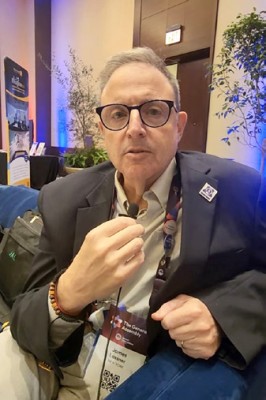
“So many people have stories, but it’s really, really hard to write a book,” said Dave Weinberg, founder of Jerry Press, named in memory of his father, a Toronto educator. At the General Assembly, an attendee approached Weinberg and told him that his father had been the attendee’s principal. “It’s so rare that I get to hear about my dad,” Weinberg said. “We’re still the People of the Book.”Who Packs Your Parachute?
JFNA Board of Trustees Chair Gary Torgow closed with two stories about gratitude and responsibility. Navy pilot Charlie Plumb, who was shot down over Vietnam, later encountered the sailor who had packed his parachute, a man he had never greeted during their service. Torgow also recounted a story from Auschwitz in which six Jewish prisoners were given one blanket. Rather than fight over it, the prisoner who received the blanket shared it with the others.
“When we are given a blanket, or a benefit, or an opportunity, we rarely keep it for ourselves,” Torgow said. Torgow urged those returning to their communities to entrust young leaders with greater responsibility and thank the professionals whose work often goes unrecognized.
From teenagers confronting antisemitism to volunteers caring for strangers, the people interviewed at the General Assembly offered examples of what Torgow’s stories mean in practice. Their work is a reminder that Jewish resilience depends not only on standing up for ourselves, but also on showing up for one another.
Aaron Herman is the co-founder and CEO of IMPACT, an initiative that mobilizes the Jewish community and its allies to combat hate and promote Jewish joy and resilience. A video journalist, startup advisor, and growth strategist, Herman holds a BA from Binghamton University and an MPA from New York University’s Wagner School of Public Service. Follow @joinimpactnow or visit joinimpact.app/get. Herman can be reached at This email address is being protected from spambots. You need JavaScript enabled to view it..
Packing Our Parachutes: Joy, Courage, And Light At The JFNA General Assembly
Typography
- Smaller Small Medium Big Bigger
- Default Helvetica Segoe Georgia Times
- Reading Mode