


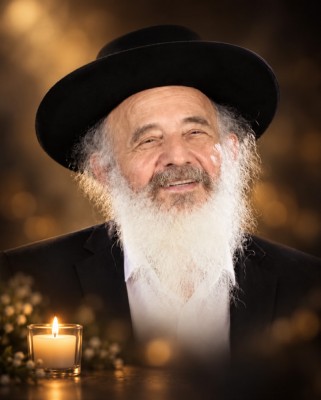
When a visitor asked Hagaon Harav Mordechai Galai zt”l how he and his wife found the strength to care for two severely ill children, the answer came from across the room. Before Rav Galai could respond, his son Yochanan spoke.
“Hashem knows whom to entrust with children like these,” he said.
Few words could better describe a family whose daily life demanded extraordinary sacrifice, yet whose home remained a place of Torah, emunah, and love.
Rav Galai, 75, a veteran shochet and leading authority in bedikat sakinim, the examination of shechitah knives, was niftar overnight into Sunday, October 25, 2026, at Maayanei Hayeshua Medical Center in Bnei Brak, following a prolonged illness. His levayah took place that Sunday, 14 Marcheshvan 5787, with kevurah in Elad.
A longtime resident of Bnei Brak’s Ramat Elchanan neighborhood, Rav Galai was the brother of Hagaon Hatzaddik Rav Shimon Galai shlit”a, renowned for his heartfelt tefillot. Their father, Rav Shalom Galai zt”l, had learned under the Chofetz Chaim in Radin, passing a rich heritage of Torah and yirat Shamayim to his children.
For decades, Rav Mordechai held senior supervisory responsibilities with Badatz She’erit Yisrael. His expertise also brought him into other kashrut operations and private chaburah arrangements, including those serving Sephardic avreichim.
In March 2020, he was among the supervising rabbanim who met Sephardic Chief Rabbi Rav Yitzchak Yosef during inspections of major poultry facilities. His work crossed communal boundaries, serving Jewish families whose minhagim differed but whose commitment to proper shechitah was shared.
The smallest imperfection in a chalaf could affect the status of poultry destined for Jewish homes. At the Segev Shalom slaughterhouse, Rav Galai described safeguards that enabled inspectors to identify potentially affected birds while protecting rabbinic supervisors from commercial pressure. Nothing could take precedence over halachah.
Yet the man entrusted with safeguarding kashrut returned home each day to responsibilities no less demanding.
His son Yechiel Yehoshua z”l developed muscular dystrophy as a young child. Another son, Yochanan, also faced serious medical difficulties. As their conditions progressed, Rav Mordechai and his wife, Golda, equipped their home to provide extensive care, determined that their sons remain surrounded by family.
In an account published following Yechiel’s passing, Rav Galai described nights when the children’s needs kept him awake until four in the morning. By 5:30, he was expected at his shechitah work. Sometimes he had scarcely slept.
Yet the family made every effort to include Yechiel in outings and celebrations. Despite his illness, he possessed remarkable intellectual abilities. Rav Galai recalled discovering that his son knew Mishnayot Bava Kamma by heart, though the family had not realized when he had mastered them. Yechiel had also taught Yochanan to read and write.
The family’s relationship with Rav Yitzchak Zilberstein shlit”a, the mara d’atra of Ramat Elchanan, extended to the earliest stages of Yechiel’s illness. During a visit to Talmud Torah Ohel Torah, Rav Zilberstein noticed something unusual about the young boy’s eyes and urged his father to investigate. An initial examination revealed nothing, but further medical evaluation uncovered his condition.
The diagnosis began decades of exhausting care, interrupted sleep, and heartfelt t'fillot. Through it all, Rav Galai and his wife sought to preserve the ordinary joys of family life.
When Yechiel was niftar in October 2025 at age 42, Rav Galai delivered a hesped that revealed how profoundly those years had shaped his relationship with the Ribbono Shel Olam.
He related a mashal about a poor man whose struggle to earn a living drove him repeatedly to Hashem in tefillah. When a wealthy benefactor relieved him of his financial worries, the man discovered that he missed the closeness to Hashem he had found through those daily prayers.
Weeping, Rav Galai explained that caring for Yechiel had given him countless reasons to daven. Every medical uncertainty and daily difficulty had drawn him back to the Ribbono Shel Olam. Now, amid the terrible pain of losing his son, he feared losing that particular closeness forged through years of t'fillah.
His words revealed a father who had found spiritual meaning within an ordeal that never became easy.
Even as Yechiel’s life drew to a close, Rav Mordechai thought of others. He contacted families awaiting yeshuot, encouraging them to daven during what he regarded as a special eit ratzon. In the depths of his own tzaar, he sought rachamim for fellow Yidden.
Barely a year later, Rav Galai himself was niftar. His commitment to kashrut had endured through his final illness. Israel’s Chief Rabbi, Rav Kalman Meir Ber shlit”a, recalled that only days before his passing, Rav Galai insisted on traveling to Haifa to oversee examinations for prospective shochtim, despite considerable suffering.
For decades, his trained hands searched for the slightest imperfection in a chalaf. At home, those same hands cared for children whose needs demanded extraordinary patience and tenderness. His public responsibilities and private sacrifices reflected the same unwavering devotion to serving Hashem.
Rav Mordechai Galai zt”l leaves behind a legacy extending from the kashrut of Jewish homes to the extraordinary emunah of his own family. For Rav Mordechai and Golda Galai, mesirut nefesh was not confined to exceptional moments. It was lived through the demands of every ordinary day.
Yehi zichro baruch.
By Shabsie Saphirstein
The Children Hashem Entrusted To Him: The Remarkable Life Of Rav Mordechai Galai zt”l
Typography
- Smaller Small Medium Big Bigger
- Default Helvetica Segoe Georgia Times
- Reading Mode