


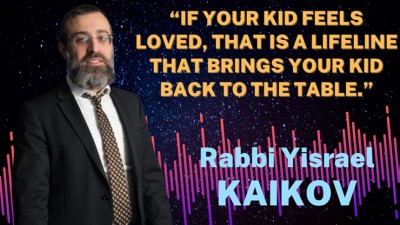
When a child begins struggling in school, questioning expectations, or distancing himself from family, parents naturally wonder what went wrong. Should they become stricter? Seek guidance? Change their approach? For Rabbi Yisrael Kaikov, a longtime Queens educator, the first question is more fundamental: Does the child know how much he is loved?
Rabbi Kaikov’s perspective comes from years in the classroom and his own upbringing in a Bukharian immigrant family.
His parents left Uzbekistan during the 1970s. His father traveled to Eretz Yisrael in 1973, while his mother, originally from Tashkent, arrived in America several years later, traveling through Italy. They eventually married in the United States.
Shabbat and kashrut were firmly established in their home, even as Rabbi Kaikov attended public school for first and second grade. He remembers carrying a head covering in his schoolbag and being unable to eat the food served to his classmates. Some of his extended family were not fully Shabbat observant, exposing him to different Jewish environments.
His parents subsequently enrolled him in Jewish schools, including Hebrew Academy of West Queens. As his education progressed, he became increasingly connected to the yeshivah world. While his father had instilled the observance of Shabbat and kashrut, his teachers introduced him to ahavat Hashem, yirat Shamayim, the importance of Torah study, and the responsibility to use one’s time meaningfully.
He eventually studied at the Mir Yeshivah for many years before entering education himself. After teaching Jewish history in Boro Park, he returned to Queens, where he taught second grade and later eighth grade. Working with children at different stages gave him an opportunity to observe how family life and parental involvement affect their development.
One of the most significant changes he witnessed was the arrival of smartphones.
Rabbi Kaikov remembers teaching when parents were not constantly connected to electronic devices. As smartphones became commonplace, he noticed what he believes was a gradual reduction in the attention children received at home.
Parents might be sitting beside their children while answering messages, working, browsing, or checking social media. Although physically present, their attention is elsewhere.
A child may perceive the device as competing for a parent’s attention. Being temporarily occupied with household responsibilities does not necessarily send the same message as repeatedly turning toward a phone.
Rabbi Kaikov distinguished between children using smartphones and parents using them. He even joked with his eighth-grade students, who were accustomed to hearing his warnings about phones, that this particular message was working in their favor. This time, he wanted their parents to put the devices away.
Rabbi Meirov summarized the advice with a phrase: “Disconnect to connect.”
For Rabbi Kaikov, recognizing the problem is the first step toward addressing it. Parents cannot change habits they refuse to acknowledge, whether those habits involve smartphones, communication, or the way they respond to their children.
He compared the situation to visiting a dentist. Someone unfamiliar with dentistry generally accepts the need for professional guidance. Parents, however, may become so confident in their own experience that they resist advice, particularly when they have spent years within the religious educational system and believe they already understand what their children need.
He observed that parents who recognize the limits of their knowledge can sometimes be more receptive to guidance than those who consider themselves authorities. The danger is not religious commitment or experience, but assuming that experience eliminates the possibility of being mistaken.
Rabbi Kaikov pointed to a pattern he had noticed in some families of baalei teshuvah. Parents beginning their religious journey may approach their children’s education with humility, seeking direction because they recognize how much they have to learn. Years later, greater familiarity with the system can sometimes bring an overconfidence that makes accepting advice more difficult.
His point was not that parents should abandon their judgment, but that they must remain willing to reconsider an approach that is not helping their children.
Even when parents do not immediately know how to solve a problem, acknowledging it leaves the door open for the child to receive guidance.
Rabbi Kaikov also emphasized the importance of establishing the home’s direction early. He recalled advice comparing family life to a train: When the first car is properly directed, the cars behind it generally follow.
Parents who invest effort in building healthy routines, expectations, and relationships during their children’s earliest years establish a foundation that can continue influencing the household as the family grows. Beginning with unhealthy habits makes later adjustments more difficult.
In the case of smartphones, that might mean setting aside regular periods when devices are turned off and family members can be fully present with one another.
Yet being attentive does not mean allowing children to determine every household decision.
Rabbi Meirov raised the idea of involving children in discussions rather than simply issuing instructions. If a child requests another piece of candy, for example, a parent might ask whether eating more would be healthy or sensible.
Rabbi Kaikov agreed that children need opportunities to express themselves, but cautioned against confusing participation with authority.
A child who feels heard is more likely to remain engaged in the conversation. Once that connection exists, the parent can explain expectations and provide direction. The child should feel respected without being made responsible for decisions that belong to the parent.
The discussion brought to mind the Torah’s account of Creation. Before creating Adam, Hashem said, “Na’aseh adam” — “Let us make man.” Rashi explains that Hashem consulted the angels to teach humility and proper conduct, even when dealing with those of lesser standing.
Parents can similarly invite discussion without surrendering their responsibility to lead.
But what happens when a child is already struggling?
When Rabbi Meirov asked which approach Rabbi Kaikov considered most important, the answer came without hesitation: Love.
A child who feels genuinely loved has a connection worth preserving, even during periods of rebellion, confusion, or poor judgment. Difficulties may arise, but the relationship gives the child somewhere to return.
Rabbi Kaikov recalled an encounter with an eleventh-grade student during a period when he served as a high school principal. The boy was smoking cigarettes, a problem Rabbi Kaikov had encountered among teenagers.
Rather than begin with a lecture about the dangers of smoking, he asked a different question.
“If you knew your mother was crying because you’re smoking, would you smoke?”
The student replied that his mother was not crying. They had already discussed the matter.
Rabbi Kaikov then asked him to imagine passing his mother’s room and unexpectedly overhearing her crying because she was so distressed about his smoking. Would that change anything?
The boy surprised himself with his answer. Yes. He would stop.
Nothing about the dangers of cigarettes had changed. What changed was the boy’s awareness of how deeply his actions could hurt someone he loved.
Rabbi Kaikov drew another lesson from the encounter. The parents had apparently approached the matter through calm discussion, but the boy interpreted that conversation as an indication that smoking, while discouraged, remained an option.
The problem was not that the parents had spoken calmly. It was that the seriousness of their concern had not fully reached him.
Rabbi Kaikov remembered facing a similar choice during his own years at the Mir. He was astonished when someone offered him a cigarette and discovered that smoking was accepted in certain social settings. After encountering the practice several times, he considered how his mother would react if he began smoking.
He knew it would break her heart. That was enough to settle the matter.
In both cases, the relationship between mother and son influenced a decision in a way that warnings alone might not have accomplished.
Rabbi Kaikov urged parents to make their affection unmistakable. Hug their children. Kiss them. Show how much they mean to the family, even when older children appear embarrassed by such displays.
Parents will occasionally become upset, raise their voices, or make mistakes. Those moments do not necessarily undo the relationship when the child consistently knows that the love remains.
Rabbi Meirov added that ahavah is closely associated with giving. Parents strengthen their relationships through the time, attention, and energy they devote to their children.
That love must also be accompanied by sincerity.
Rabbi Kaikov recalled traveling by car with his father, who had served in the Israeli army. Whenever the news turned to war or another serious development in Israel, his father immediately demanded silence so he could listen.
The children understood that events in Eretz Yisrael mattered deeply to him. His reaction communicated that priority more effectively than an explanation could have.
Another story, one of Rabbi Kaikov’s favorites, illustrated how a parent’s actions can leave an impression that lasts for generations.
A father accompanied his son from New York to England, where the young man was beginning his studies at a yeshivah. After helping him settle into the dormitory, the father said goodbye and flew home.
Only after returning did he discover that his son’s tallit had been left in his luggage.
The family followed the custom associated with German Jewish communities of wearing a tallit before marriage, and the father was deeply attached to preserving that minhag.
He could easily have called his son and arranged for another tallit to be purchased in England. Instead, he booked another flight, crossed the Atlantic again, and appeared at the dormitory.
The young man was astonished. His father had only just left. Why had he returned?
“You forgot your tallit in my bag,” the father explained.
His son pointed out that purchasing another tallit locally would have cost far less than an international flight.
But the father had considered something beyond the expense.
Had he simply purchased a replacement, the family custom might gradually have lost its significance. By making such an extraordinary effort to return the original tallit, he showed his son how precious the minhag was to him.
Rabbi Kaikov believed that the impression would endure. The young man would remember his father’s sacrifice, and the story could influence how he raised his own children and grandchildren.
The father’s actions were not a calculated performance. His attachment to the minhag was genuine, and that sincerity gave the gesture its meaning.
Children recognize what their parents truly value. They notice what makes them happy, what troubles them, and what they are willing to sacrifice for. A parent’s example often communicates more than repeated instructions.
That is why Rabbi Kaikov’s approach to struggling children begins with the relationships established long before a crisis. Parental authority, clear expectations, and professional guidance all have their place, but none should come at the expense of a child’s sense of belonging.
His message does not promise that affection will prevent every difficulty. Children face challenges for many reasons, and some situations require additional help. Parents may also need to change course, acknowledge mistakes, or seek guidance from people with greater experience.
What they can do is make certain that their children never have to question whether they are loved.
A parent may not always know the right thing to say. There will be disagreements, disappointments, and moments when even the best intentions fall short. But when a child knows that the relationship remains secure, there is still a reason to listen, reconnect, and come home.
As Rabbi Kaikov reminded his listeners, that love is the lifeline that brings a struggling child back to the table.
By Rabbi Yaniv Meirov
Chazaq Torah Talks –
Episode 185
Originally Aired January 28, 2025
Why Is My Kid Struggling? A Rabbi’s Message Every Parent Needs To Hear
Typography
- Smaller Small Medium Big Bigger
- Default Helvetica Segoe Georgia Times
- Reading Mode