


From Dushanbe And Two Armies To Technology, A $150 Million Opportunity, Family, Faith, And The Lessons That Last
Nearly half a century after his father’s death, David still quotes him, listens to the music he taught him to appreciate, and wrestles with questions they once discussed together in Dushanbe. That relationship became the thread running through a conversation that ranged from Soviet antisemitism and an improbable departure from the USSR to multimillion-dollar deals, technology, faith, family, and the future of Bukharian Jewish culture.
The conversation was personal from the outset. Roman remembered hearing David’s name from his own father, Gregory Kaykov, who described him as a serious communal figure and activist. David, in turn, remembered Roman’s father and grandfather with affection.
David was born in Dushanbe in the 1950s, when antisemitism remained part of Soviet life and a small but active Bukharian Jewish community was establishing itself in the Tajik capital. Writers, poets, religious figures, and communal leaders regularly gathered in his family’s modest two-room home. As a boy, David absorbed their language and conversations almost without realizing it, sometimes playing beneath the table while the adults spoke above him.
“There were no phones or iPhones back then to plug your ears and ignore what was going on around you,” he observed. Many of the Bukharian expressions, poems, sayings, and melodies David remembers today were never formally taught to him. He simply heard them often enough that they became part of him.
His Soviet education was very different from what he encountered at home. David became a Young Pioneer and later studied mathematics and physics, though he initially avoided joining the Komsomol. Political differences existed even within his family. When Stalin died, David recalled, his mother cried while his father was relieved.
His father, born in Samarkand to a family with roots in Bukhara, became David’s strongest influence. He had studied Torah seriously in his youth, received semichah, and continued observing Jewish practices even as Soviet life pushed him toward a more secular public existence. David remembers him performing chuppot, writing ketubot, carrying out shechitah, and helping families without accepting payment. At the same time, poets and writers from Tajik intellectual circles were frequent visitors to the home.
Nearly 50 years separated father and son, but David remembers them as friends. They discussed religion, science, literature, music, and whatever else interested him. When his father died from ALS in 1978, David said, “I hadn’t just lost a father. I had lost my closest friend.”
As his father became ill, David deliberately asked him to translate old verses and explain Shashmaqam lyrics. He wanted to understand the words rather than preserve only their sounds.
One childhood disagreement changed the way he heard that music. David preferred the Beatles and told his father he did not care for Shashmaqam. His father answered, “Listen, this is ours. This is our music,” and began explaining it to him.
Then foreign scholars who studied Shashmaqam visited the family and asked to hear recordings. David watched people with no personal connection to Bukharian Jewish life become absorbed in music he had dismissed as old-fashioned. His father pointed them out. If outsiders could appreciate something that was not even theirs, perhaps his son should listen again.
David did. Today, Shashmaqam occupies a place of its own for him.
His family also preserved reel-to-reel recordings from Dushanbe containing music, gatherings, and voices from decades ago. Roman immediately recognized their value. Kaykov Media has worked with families to salvage aging tapes, cassettes, and discs that sometimes contain the only surviving recordings of relatives who are gone, and he urged David to preserve what remains before time damages it further.
There appears to be little substantial video of David’s father, but photographs, audio, and memories survive. Roman suggested that those pieces could eventually be brought together so another generation could encounter the man who shaped David’s life. Shortly before dying, his father had made one request David never forgot: He wanted people who knew Shashmaqam to sing at his funeral.
David’s departure from the Soviet Union was nearly as remarkable. After studying mathematics, he entered the Soviet military as an officer. Officials initially considered sending him to Germany, but while completing paperwork he disclosed that he had a relative abroad. When an officer realized David was Jewish, the Germany assignment disappeared.
“We can’t send Jews to Germany,” David remembered being told.
He was instead assigned near the Chinese border. Meanwhile, his father had been arranging for the family to leave the Soviet Union. David ultimately departed while still technically attached to the military, and Soviet authorities later searched for him after the family was already gone.
About six months after arriving in Israel, David was summoned to the Prime Minister’s Office. He initially wondered whether he was being recruited for a job. Instead, officials wanted to know how a Soviet military officer had suddenly appeared in Israel and whether Moscow had sent him on an assignment.
Once the misunderstanding was resolved, David began rebuilding his life. He polished diamonds, worked at Tadiran, learned Hebrew, continued his studies, taught mathematics, and later served in the Israeli army.
His family had already given him a strong Jewish identity. David recalled that his paternal grandmother had attended an Alliance school, spoke several languages, including French, Spanish, Arabic, and Bukhori, and wrote poetry. He grew up surrounded by family histories involving religion, education, commerce, and Jewish life across Central Asia.
Mathematics gave him another way of looking at the world. David is drawn to things that can be demonstrated rather than merely asserted; one plus one remains two regardless of who is doing the calculation. That habit followed him into business and into his engagement with Judaism.
David does not describe himself as religious, but Torah and Jewish thought continue to occupy him. During the interview, he raised questions about divine knowledge, free will, prayer, biblical interpretation, and Jewish law. His father had welcomed those discussions rather than shutting them down, and David is still asking some of the same questions decades later.
In 1980, work brought him from Israel to New York. David arrived at 28 with little money, entered the technology field, and eventually settled in Rego Park. He soon realized that he wanted to work for himself, first through consulting and then by developing software that became the foundation of Nastel Technologies.
Looking back, David says he initially underestimated what he had built. His company had developed specialized technology and expertise connected to IBM environments, but David focused on the much larger competitors surrounding him. An industry analyst warned that giant companies could overwhelm a small operation, and David began looking for a buyer.
In one early negotiation, David and a partner had privately decided they would accept $500,000. The prospective buyer opened at $1 million. Instead of accepting immediately, David wondered why someone was offering twice what he expected. Negotiations eventually reached $5 million, though a dispute involving a former employer prevented the transaction from closing.
Later opportunities grew dramatically larger. David recalled negotiations around $100 million and another effort to sell the company for approximately $150 million. Before the latter transaction could be completed, the market changed and the opportunity vanished.
David does not present the episode as evidence of flawless judgment. His lesson is much shorter: “You should have sold. You can’t be greedy.”
Partnership disputes brought other costly lessons and changed the way he thinks about trust. Confidence in another person, he learned, cannot replace clear agreements and proper safeguards when large amounts of money are involved.
Roman asked whether success comes from talent, hard work, timing, or luck. David believes all of them matter, but age has changed his measure of success.
“Money doesn’t solve anything in the end,” he said. It can provide comfort and freedom, but it cannot return lost time or guarantee health. David spoke candidly about years when business consumed attention that could not later be recovered. “You don’t see them, the kids are growing up there. Life passes by.”
His father once compared life to the shadow of a herd passing by: It appears, crosses in front of you, and is suddenly gone. David’s conclusion today is simple: “You need to live.”
Technology still fascinates him. After a career spent around computers and software, David sees artificial intelligence as a major industrial change and expects it to transform or eliminate certain types of work. He described using newer systems for tasks once handled by outside staff and said the gains in speed and efficiency had been significant. Asked what he might pursue if he were 25 today, David said he would probably look toward venture capital and companies capable of becoming major technology businesses.
But technology also entered the conversation in another way: as a means of preserving a culture whose old environment is disappearing.
David worries about Bukhori. In America, children naturally become English-speaking; in Israel, they become Hebrew-speaking. He knows families whose teenagers still speak beautiful Bukhori because it remains the language of the home, and hearing them can transport him back decades. His concern is what happens when that environment is no longer there.
He feels the same way about Shashmaqam. Earlier generations heard it because adults played it, weddings included it, and grandparents explained what the songs meant. Roman argued that preservation still begins at home. If children never hear the language or music there, a communal program or occasional celebration cannot easily create the same attachment later.
David’s own childhood bears that out. The expressions he still uses came from adults talking around him. The music came from his father. His questions about Judaism began with a parent willing to discuss them. None of it required a formal preservation program.
He now sees a similar spark in his grandson, who is drawn to Bukharian Jewish life despite growing up in a very different environment. David brings him to communal events and encourages the interest. What matters, he said, is that the desire exists; if someone wants the connection, there is something to build upon.
At the end, Roman asked what David wanted his children and grandchildren to remember about him after Dushanbe, the Soviet Union, Israel, America, two armies, technology, business, money, mistakes, and success.
David had never given much thought to choosing his own legacy. His father had never handed him a list of lessons and announced what he was expected to preserve. He lived according to his principles, answered his son’s questions, surrounded him with people and music, and gave him something worth remembering.
Nearly half a century later, David is still carrying it.
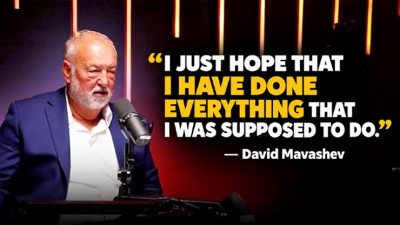
Asked what he hopes his own descendants will carry from him, David offered no grand declaration: “I just hope that I have done everything that I was supposed to do.”
DAVID MAVASHEV is a mathematician, technology entrepreneur, and founder of Nastel Technologies. Born in Dushanbe, he studied mathematics in the Soviet Union before immigrating to Israel, where he worked, taught, continued his studies, and served in the Israeli military. He later moved to the United States and built a career in software and technology. His interests also include Jewish thought, Bukharian history and culture, Shashmaqam, and preserving family and communal history.
ROMAN KAYKOV is president of Kaykov Media and host and senior producer of KAYKOV TV. Through Kaykov TV, Roman sits down with rabbis, educators, business leaders, artists, and community figures for conversations about Jewish life, Bukharian identity, family, culture, faith, business, and community.
David Mavashev: What Matters In The End
Typography
- Smaller Small Medium Big Bigger
- Default Helvetica Segoe Georgia Times
- Reading Mode