


The sukkahs are coming down. Decorations that looked so festive just a few days ago are being carefully packed into boxes, the schach is being bundled away, and sukkah panels are heading back to garages, basements, and backyard sheds until next year. After Sukkot, Shemini Atzeret, and Simchat Torah, another beautiful Yom Tov season has come to an end.
But before we say goodbye to this year’s sukkahs entirely, there is one place where they never really disappear: TikTok.
For almost as long as there has been TikTok, people have been posting videos of their sukkahs on it. Of course, there had to have been a first Sukkah Influencer: a person or organization that put together how the most joyful of Jewish holidays could benefit from the social media platform. That first influencer was Chabad.
Chabad was one of the first Jewish organizations to really crack the code in the early days of social media. They wanted to reach more college kids and watched as their audience migrated to the likes of Facebook, Twitter, Instagram, and ultimately TikTok. So Chabad followed them.
As an early influencer on the platform, Chabad posted in a simplistic way compared to today’s standards: a video clip of a white-draped sukkah with a lulav being shaken within, the dates of the holiday, the location of the sukkah, and an open invitation for students to share a meal inside. The tactic, while somewhat successful, was quite boring. Ultimately, Chabad discovered that the more impactful way to engage students wasn’t with the sukkah itself, but rather the promise of Etrog Schnaps for all who attended.
This doesn’t mean that once Chabad stopped sukkah posting, the temporary hut’s presence on TikTok faded from view. Quite the contrary. As the platform evolved, and the ways people used and monetized it changed, today’s Sukkah Influencer emerged.
Sukkah Influencers take sukkah building to the next—and often extreme—level. They have found that the wilder, more dangerous, and more outright insane their Sukkah posts are, the more views and likes they get. With that in mind, I wish to share some of my favorite “Sukkahs of TikTok” accounts before we pack away this year’s sukkahs for good.
The Sukkah Prankster
A common thread across TikTok is prankster accounts. These are people who mostly confuse being a public nuisance with humor, but there are some who thread the needle just right, leaving you with something you can’t help but like, share, and subscribe to.
@ThatchRoofJoker613 is one of those special accounts.
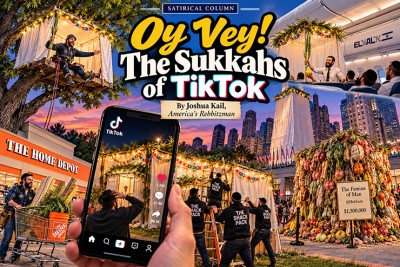
@ThatchRoofJoker613, whose real name is Michael Rambinowitz, spends every Sukkot scouting neighborhoods for the perfect sukkahs to prank. His prank is quite simple: Find an easily accessible sukkah of decent size, but not too large, sitting on a plot of land with enough space around it, and then build a larger sukkah that completely encapsulates the original.
He and his crew, known as “The Shack Pack,” sneak into the yards housing their target sukkahs and, through the use of drones and time-lapse cameras, film the entire process, down to the construction-paper chains. They then set up GoPro cameras around the property to capture the homeowner’s moment of confusion and, hopefully, laughter.
These “shell sukkahs” can become quite large, depending on the size of the backyard. To finish off the prank, @ThatchRoofJoker613 sends a catered meal from Moishe’s Deli to the homeowner, and everyone involved shares a meal together in either the larger or original sukkah.
The only known instance of someone not enjoying the joke came when the Shack Pack misinterpreted a half-built “she-shed” in the backyard of a nearby Presbyterian as its next target. Fortunately, it was nothing a few chocolate rugelach couldn’t smooth over.
Sukkah Extremists
Everyone knows that the crazier the account, the more likely it is to get views on TikTok. From extreme eaters to poorly thought-out stunts, chances are that if you have ever spent time on the platform, you have encountered something along these lines.
Rachel Greenberg is a skilled architect, an avid mountain climber, and a practicing Jew. During Sukkot 2022, she decided to put all three components of her life together and start the @SukkotAnywhere account.
Rachel has since made a name for herself by building elaborate sukkahs anywhere—and I do mean anywhere. The first year she became a Sukkah Influencer, she kept things simple, yet no less jaw-dropping. She traveled to South Carolina, to the location of a tree featured in Forrest Gump, climbed toward its apex, and built a simple white, four-walled sukkah among its branches, with the tree canopy serving as a living roof through which one could see the stars.
It struck awe and confusion in all who saw it. Eventually, it went viral and led to her now-famous interview with Anderson Cooper. The two dangled from the branches within its walls, with Anderson nearly falling off as he shook the lulav with a bit too much verve.
Rachel’s later extreme sukkahing included one that emerged from the gardening section of a Home Depot in Canarsie, using only materials found within the store; a sukkah in the back of an El Al flight; and perhaps her most famous build, a giant, 75-foot-tall sukkah in Rockefeller Center.
Because apparently ground level had become too mainstream.
The Sukkah as Art
Not all Sukkah Influencers are hobbyists or people looking for some easy online clout. The conceptual artist known only as @HekSure uses their TikTok account to open the world to their unique artistic eye.
While no one knows the true identity of @HekSure, they dedicate every Sukkot to sukkah installations around the world. Their 2024 sukkah, entitled “The Famine of Man,” featured decorations made only of rotting fruits and vegetables and was placed outside a Whole Foods Market in Glenside, California. The piece sold at auction the following year for $1.5 million, proving once again that one person’s compost is another person’s conceptual art.
@HekSure approaches sukkah building with the fervor of an artist who sees the degradation of the world around them and wishes to open everyone else’s eyes to it. Their next installation, titled “The Rat Trap,” featured a sukkah with four external walls and a series of complex, interweaving internal walls, creating a maze for anyone who ventured inside.
At the center of the sukkah maze lay a lulav, an etrog, and a stamp to validate parking for anyone who made it that far.
And with that, another Sukkot season is behind us.
Across our neighborhoods, the sukkahs that only days ago rang with zemirot, divrei Torah, conversation, laughter, and the sounds of family and friends are becoming empty frames once again. Soon even those will disappear, carefully folded, stacked, wrapped, and stored away for another year.
There is something bittersweet about taking down a sukkah. We spend so much effort building and decorating a temporary home, knowing from the beginning that it will not last. Then, almost as quickly as it went up, we take it apart.
Perhaps that is why we photograph our sukkahs, post them, and remember them. Whether yours was a simple canvas sukkah in Queens or—if TikTok is to be believed—a 75-foot architectural wonder towering over Rockefeller Center, each one was here for only a little while.
Now that Simchat Torah has passed, we carefully pack everything away and return to the regular rhythm of the year, hopefully carrying some of the simchah of the Yom Tov season with us.
So pack away the decorations carefully. Try not to lose the screws. Put the schach somewhere you will actually remember next year.
And before you lock the backyard shed, you might want to take one last look around.
You never know when the Shack Pack might be watching.
By Joshua Kail
America’s Rebbitzman
The Sukkahs Of TikTok
Typography
- Smaller Small Medium Big Bigger
- Default Helvetica Segoe Georgia Times
- Reading Mode