


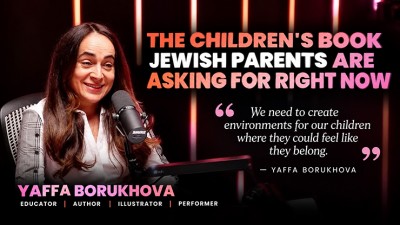
Yaffa Borukhova On Bukharian Pride, Finding Her Voice, And The Unexpected Journey Behind You Don’t Look Jewish
Interview by Roman Kaykov • Adapted for Publication by Shabsie Saphirstein
Yaffa Borukhova has been an opera performer, educator, author, illustrator, and artist. None of it followed the path she expected.
In her conversation with Roman Kaykov on Kaykov TV, Yaffa traced a journey from Dushanbe to New York, Colorado, Italy, and back to New York. Along the way, a girl who once imagined becoming an ambassador found herself studying opera, a singer found her calling through a child with autism, and an educator who had never illustrated a book spent a year drawing one herself.
Running through all those turns is a question that eventually became the heart of her debut children’s book, You Don’t Look Jewish: Where do I belong?
FROM DUSHANBE TO DENVER
Yaffa was born in Dushanbe, Tajikistan. Her family spent time elsewhere in the former Soviet Union before immigrating to the United States when she was 11. They arrived in New York in 1991, when many newly arrived immigrant families were struggling to establish themselves.
She remembers tensions among different immigrant groups, including an encounter in which another immigrant told her father to “go back home.” The irony still makes her laugh.
Eventually, her father visited Colorado, fell in love with it, and moved the family west.
“The mountains were calling,” Yaffa joked.
The family settled in Denver, where the pace and surroundings were dramatically different from New York. Her family was among the early Bukharian families there; Yaffa noted that the community has grown considerably since.
Roman had his own Colorado connection. While producing Tajikistan in Our Hearts, a documentary marking the tenth anniversary of Tajikistan’s independence, he visited the Dushanbe Teahouse in Boulder and incorporated its elaborate Tajik craftsmanship into the film.
Colorado would also become the setting for Yaffa’s first unexpected career turn.
THE OPERA SINGER WHO NEVER PLANNED ON OPERA
As a child, Yaffa imagined becoming an ambassador, promoting peace and perhaps, as she put it, “saving the world.” She was accepted into a school of international relations in Colorado and expected to pursue that path.
Then her high school choir director suggested she take voice lessons in college.
Yaffa tends to do things “full force.” Instead of simply signing up for lessons, she auditioned for the university’s music program despite having no formal vocal training.
She was accepted with a scholarship.
At first, Yaffa thought she could study international relations and music simultaneously. Conflicting schedules between two campuses made that impractical. Four years later, she graduated with a bachelor’s degree in opera performance.
Opera had not been part of her plan, and she was not entirely convinced it was where she belonged. But it changed her. A painfully shy young woman had been forced to stand onstage and perform before an audience.
After graduation, Yaffa performed in several concerts before moving into Jewish communal work with AIPAC. She continued singing at some of the organization’s events, and eventually the pull of music returned. She left her position, moved to Italy for further opera training, and spent several years preparing for the professional stage.
Then she came to New York, where another unexpected encounter changed her direction.
A LITTLE BOY CHANGED EVERYTHING
While trying to establish herself as a singer, Yaffa took various jobs. One brought her into the life of a young boy with autism.
She fell in love with working with him.
“There’s something so special about them,” she said of children on the spectrum.
The experience led Yaffa back to school. She earned an M.S. in Education from Bank Street College, specializing in early childhood and special education, and went on to spend more than a decade working with children.
Roman asked how those years influenced her storytelling.
Yaffa described herself as deeply empathetic. As an educator, she learned to pay attention not only to what children said but to what they might be struggling to express. She tried to understand what they needed and meet them there.
That instinct would eventually shape a very different kind of project.
AFTER OCTOBER 7
The idea for You Don’t Look Jewish took shape after October 7, 2023.
Yaffa heard Jewish parents asking what they could give their children that would inspire Jewish pride rather than fear. Her experience in progressive schools had exposed her to children’s books about many identities, cultures, and forms of diversity. Jewish identity, she felt, was far less visible on those shelves.
“I saw pretty much everything on the shelf except for something on Judaism or being Jewish,” she recalled.
She decided to write one.
The title came from something Yaffa had heard throughout her own life.
Growing up in Tajikistan, people sometimes questioned whether she was Jewish. In America, people unfamiliar with Central Asian Jews might hear that she came from Tajikistan and assume she was Muslim. Others, upon discovering that she was Jewish, would tell her: “You don’t look Jewish.”
She later discovered that Jews from many backgrounds had heard versions of the same remark.
As Yaffa began developing the child at the center of her story, she made another decision.
“I realized, you know, I don’t want this kid to be Jewish. I wanted this kid to be Bukharian.”
Roman immediately understood what she meant.
“That’s another pride,” he responded.
The project received support after Yaffa submitted a proposal through a nonprofit grant initiative connected with hate-crime prevention efforts. But receiving support and producing a finished book were two very different things.
WRITING WAS THE EASY PART
Yaffa identified naturally with the boy at the center of the story, and the writing came easily.
The illustrations did not.
She had never considered herself an illustrator. Her mother is artistic and can sketch quickly, which may have given Yaffa an overly optimistic impression of what illustrating a children’s book would entail.
“It’s a children’s book. How hard can it be?”
She soon found out.
Yaffa would draw, erase, and redraw until an image matched what she saw in her mind. A page she imagined a professional illustrator completing quickly could consume hours.
Then came the formatting, design, and preparation for print.
She did those herself, too.
“This book is completely from scratch,” Yaffa told Roman.
At one point, she considered hiring professionals to help finish it. Then she learned how much it would cost and how long it could take. There was another problem: She had already scheduled the book launch.
So she kept working.
A project she expected to finish in roughly four months took a full year.
“I would say this is a children’s book, but this was the hardest project I’ve ever undertaken.”
Finishing it also changed the way Yaffa thought about her own abilities. She had entered the project without knowing how to illustrate or produce a book and learned her way through both.
“If I could illustrate this book, which is completely out of my comfort zone,” she joked, “maybe I should run for office or something.”
“BREATHING LIFE INTO IT”
Roman asked what creating something means to her.
Yaffa answered simply: “It’s taking something and breathing life into it.”
That feeling became especially important as they discussed the illustrations. Yaffa acknowledged that newer technology might have made portions of the process easier had she waited. Yet after spending a year drawing the pages herself, she was glad she had not taken that route.
For Yaffa, art carries something of the person who created it—the time, thought, frustration, instinct, and emotion invested in the work. That human imprint mattered to her.
Roman told her he could feel “a soul” in the book.
Yaffa was delighted. That was exactly what she hoped would come through.
Her ideas often begin quietly. New York gives her plenty to observe, but she sometimes needs to return to Colorado to “regroup and recharge.” Mountains, water, and silence give her room to hear what she describes as an inner voice.
At first, an idea may barely register. Then it gets louder until she feels she has to do something with it.
For that reason, Yaffa is cautious about sharing ideas too early. Someone else’s doubt can become her own before an idea has had time to develop.
Roman saw another possibility: criticism can force a creator to defend an idea and become more determined to prove it.
Yaffa knew herself well enough to take a different approach.
“I just want it to come from inside of me.”
WHY STORIES MATTER
Her work as an educator taught Yaffa something else: People do not always need to be told what to think.
Sometimes they need a story.
“They make you feel not alone,” she said.
Deliver a message as a lecture, she explained, and people may become defensive. Put it inside a story and they can encounter the idea themselves.
That is important to understanding You Don’t Look Jewish. Despite the title, Yaffa emphasized that the book is not ultimately about whether someone physically “looks Jewish.”
It is about belonging.
“You will hear a child who is desperately searching to understand who he is and where he belongs.”
A child may understand one layer of the story while an adult recognizes another.
Roman experienced that himself. Before handing the book to his young daughter, he began looking through it and found himself drawn in. His 18-year-old daughter, an artist and songwriter, was struck by the illustrations and surprised to discover that Yaffa had drawn them herself.
Roman compared that experience to returning to Torah year after year. The text may be familiar, but the person reading it has changed.
Yaffa agreed.
“That means if we do that, then we grow.”
GIVING CHILDREN A PLACE TO BELONG
When Roman asked what she ultimately hopes readers take from the book, Yaffa returned to the idea that had been there from the beginning: children need roots, but they also need to experience those roots as something positive.
Creating the book strengthened Yaffa’s own connection to her Bukharian background.
“Putting this book together, it’s brought me closer to my own Bukharian roots and appreciate them even more,” she said.
She has encountered Bukharian Jews who minimize that part of themselves when outside the community, and she finds it painful.
Roman noted that difficult family or communal experiences can sometimes contribute to those feelings. Yaffa agreed that every family and community carries its own struggles. Her message to parents, however, was straightforward: Speak about what is beautiful.
Cook Bukharian foods. Play the music. Maintain family customs. Tell children what is worth loving about where they come from.
Children may sometimes roll their eyes at traditions or dismiss them as old-fashioned. Yaffa believes those same traditions often become precious later because they carry memories of family and home.
In a country where people frequently search genealogies and take ancestry tests to rediscover their origins, Bukharian Jews already possess an extraordinary inheritance.
The challenge is making the next generation want to carry it.
“I WANT TO BRING BEAUTY TO THE WORLD”
Near the end of the conversation, Roman asked what drives Yaffa to create.
“I want to bring beauty to the world,” she answered.
She connected that desire to tikkun olam, the Jewish responsibility to improve the world. When she sees something that could be made better, she wants to contribute what she can.
That applies to her classroom, her book, and the stage.
Yaffa once approached performing with anxiety about mistakes and fear of being judged. Today, she thinks about singing differently.
“I just want to use what G-d gave me and share it with the world.”
That sentiment ties together a career that otherwise might appear to have little connecting it: the shy girl who studied opera, the young woman who worked in Jewish communal advocacy, the singer who found a new calling through a child with autism, and the educator who decided children needed a particular story badly enough that she would learn to illustrate it herself.
The path was never straight, but it kept bringing Yaffa back to creativity, connection, identity, and belonging.
When Roman asked whether she was proud to call herself Bukharian, her answer required no explanation.
“Very proud.”
After more than two millennia of Bukharian Jewish continuity, Yaffa believes today’s families have something worth protecting—not by keeping their culture frozen in the past, but by allowing children to experience its beauty for themselves.
“There are too many beautiful things in us, in our community, in our DNA,” she said.
“We know who we are. So let’s keep going strong with it.”
Yaffa Borukhova is a Bukharian Jewish educator, author, illustrator, and performer. Born in Dushanbe, Tajikistan, she immigrated to the United States as a child and was raised in Denver, Colorado. After studying opera performance and continuing her vocal training in Italy, she earned an M.S. in Education from Bank Street College and spent more than a decade working with children, including in special education. Her debut children’s book, You Don’t Look Jewish, which she wrote and illustrated, draws on her experiences as an immigrant, educator, and Bukharian Jew to explore identity, belonging, and pride in one’s roots.|
Roman Kaykov is president of Kaykov Media and host and senior producer of Kaykov TV. Through Kaykov TV, Roman sits down with rabbis, educators, community leaders, entrepreneurs, artists, and other personalities for conversations about Jewish life, Bukharian identity, family, culture, faith, business, and community.
The Kaykov Exchange: Inside the Studio. Beyond the Conversation.ukharian Jews ha
CREATING A PLACE TO BELONG
Typography
- Smaller Small Medium Big Bigger
- Default Helvetica Segoe Georgia Times
- Reading Mode